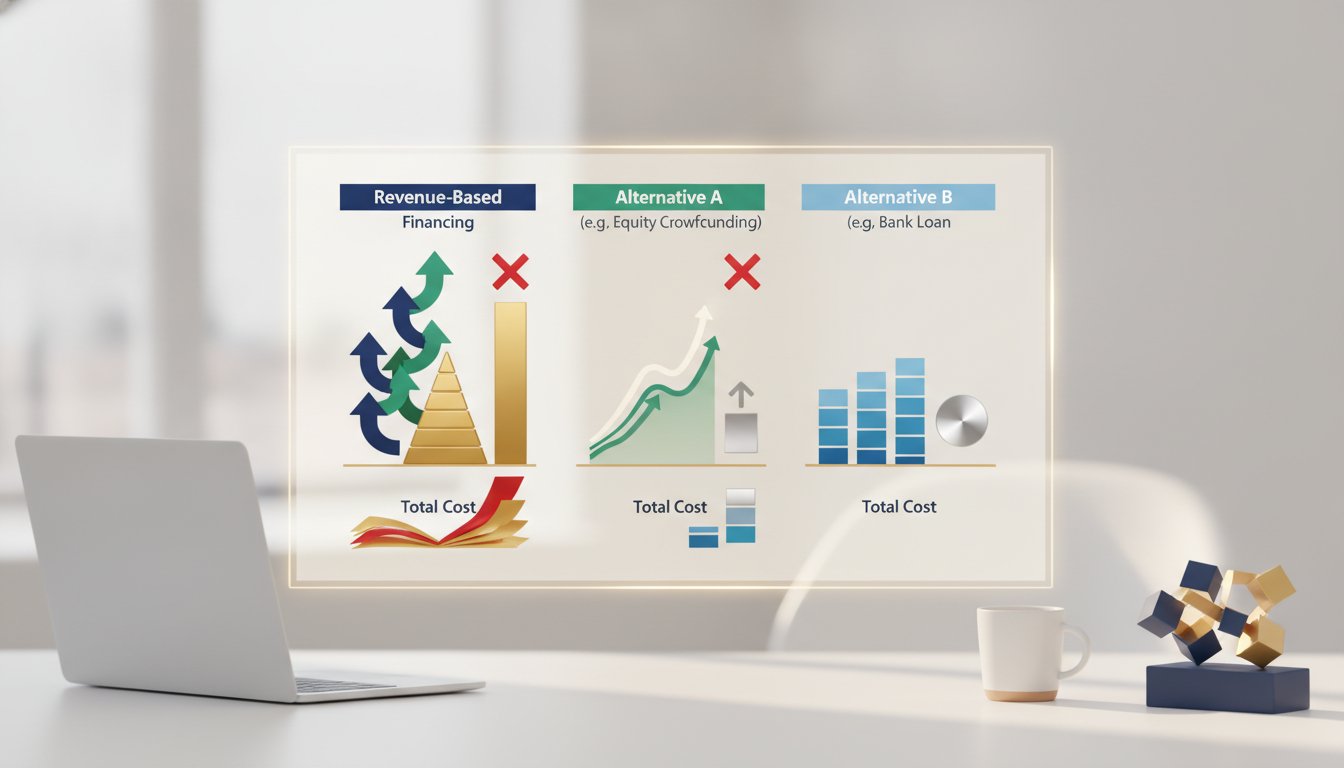
Revenue-based financing (RBF) is a funding structure where a business repays capital by sharing a fixed percentage of monthly revenue until reaching a predetermined cap, typically 1.3x to 2.5x the original advance. Understanding when revenue based financing costs more than alternatives like equity crowdfunding or term loans requires looking past the headline rate to the actual repayment mechanics. Revenue-based financing offers an attractive alternative when traditional bank loans are out of reach, but the structure that makes it accessible also creates specific scenarios where the total cost exceeds what most founders expect.
Revenue-based financing backfires in three distinct situations: when revenue grows too slowly, when revenue is seasonal or lumpy, and when the business needs to pivot or raise additional capital. Each scenario triggers a different cost mechanism that can make RBF significantly more expensive than equity crowdfunding or traditional debt.
The first scenario involves slow-growth businesses. RBF requires a fixed percentage of monthly revenue until a predetermined cap is reached — typically 1.3x to 2.5x the original advance.1 A business growing at 5 percent annually will take far longer to repay than one growing at 30 percent, and the effective APR rises with every extra month of payments.
The second scenario hits seasonal businesses. A retailer generating 60 percent of annual revenue in Q4 pays the same revenue percentage in January as in December, creating cash flow gaps during slow months.
The third scenario involves businesses that later qualify for cheaper capital. RBF agreements often include prepayment penalties or minimum payment periods that lock founders into expensive terms even after their credit profile improves.
The 3 Scenarios Where RBF Costs More Than You Think
Understanding when revenue based financing costs more than alternatives like equity crowdfunding or term loans requires looking past the headline rate to the actual repayment mechanics. Revenue-based financing offers an attractive alternative when traditional bank loans are out of reach, but the structure that makes it accessible also creates specific scenarios where the total cost exceeds what most founders expect.
Revenue-based financing backfires in three distinct situations: when revenue grows too slowly, when revenue is seasonal or lumpy, and when the business needs to pivot or raise additional capital. Each scenario triggers a different cost mechanism that can make RBF significantly more expensive than equity crowdfunding or traditional debt.
The first scenario involves slow-growth businesses. RBF requires a fixed percentage of monthly revenue until a predetermined cap is reached — typically 1.3x to 2.5x the original advance.1 A business growing at 5 percent annually will take far longer to repay than one growing at 30 percent, and the effective APR rises with every extra month of payments.
The second scenario hits seasonal businesses. A retailer generating 60 percent of annual revenue in Q4 pays the same revenue percentage in January as in December, creating cash flow gaps during slow months.
The third scenario involves businesses that later qualify for cheaper capital. RBF agreements often include prepayment penalties or minimum payment periods that lock founders into expensive terms even after their credit profile improves.
When Revenue-Based Financing Looks Cheaper Than It Is
The initial appeal of RBF is straightforward: no equity dilution, no personal credit score requirement, and payments that scale with revenue. For a business generating consistent monthly revenue, the math can work well. But the comparison to equity crowdfunding or a traditional term loan often ignores the total cost of capital over the full repayment period.
Consider a hypothetical SaaS company with $500K in annual recurring revenue that takes a $200K RBF advance at a 1.4x cap with an 8 percent revenue share. If the company grows at 15 percent monthly, repayment takes roughly 14 months and the effective APR lands around 35 percent. If growth slows to 5 percent monthly, repayment stretches to 22 months and the effective APR exceeds 60 percent.2
Equity crowdfunding, by contrast, requires no monthly payments. A founder who raises $200K through a Regulation Crowdfunding offering gives up 10 to 15 percent equity but preserves operating cash flow for growth.3 The cost is realized only at exit, not during the critical early years.
The RBF market reached $12 billion in 2025 and is projected to grow to $432.3 billion by 2034.4 As more providers enter the space, terms vary widely. A 6 percent revenue share with a 1.3x cap is dramatically different from a 10 percent share with a 2.0x cap, yet both are marketed as "revenue-based financing."
The Revenue Threshold Trap That Triggers Retroactive Penalties
Some RBF contracts include revenue threshold clauses that increase the payment percentage or extend the cap when the business crosses a predefined revenue milestone. These clauses are buried in the fine print and can retroactively increase the total cost by 20 to 40 percent.
For example, a contract might specify an 8 percent revenue share until the business reaches $2 million in trailing twelve-month revenue, at which point the share jumps to 12 percent. A founder who aggressively grows revenue to hit that threshold triggers a higher payment rate for the remainder of the repayment period.
This structure creates a perverse incentive: the more successful the business becomes, the more expensive the financing gets. Compare this to equity crowdfunding, where the cost is fixed at the time of the raise. An investor who buys equity at a $3 million valuation pays the same price regardless of whether the company later reaches $10 million in revenue.
The trap is most dangerous for businesses that are pre-revenue or early-stage when they sign the RBF agreement. A hypothetical marketplace startup that takes $150K in RBF at a 1.5x cap with a 7 percent revenue share might expect repayment in 18 months. If the business hits a growth inflection point and crosses the revenue threshold in month 12, the payment share increases and the effective cap rises to 1.8x, adding roughly $45K in unexpected cost1.
How Fixed Payment Schedules Crush Seasonal Businesses
Seasonal businesses face a structural mismatch with RBF. A landscaping company that generates 70 percent of annual revenue between April and October pays the same revenue percentage in February as it does in June. The fixed percentage means the business sends large checks during peak months when it needs working capital for inventory and labor, and continues sending checks during off-months when revenue is minimal.
The result is a cash flow squeeze at both ends of the season. During peak months, the RBF payment competes with payroll and supplier costs. During slow months, the payment consumes a disproportionate share of available cash.
A hypothetical holiday retailer with $1.2 million in annual revenue that takes a $300K RBF advance at a 1.35x cap with a 10 percent revenue share would repay roughly $405K total. If 60 percent of revenue arrives in Q4, the business sends roughly $24K per month in Q4 payments while also funding inventory purchases1. In Q1, when revenue drops to approximately $50K per month2, the same payment represents a far larger share of available cash — but the absolute dollar amount is unchanged, creating a cash deficit.
Equity crowdfunding avoids this entirely. A seasonal business that raises capital through equity crowdfunding has no monthly payment obligation. The cash stays in the business to fund inventory, marketing, and seasonal hiring. The cost is realized only when the founder sells shares or the business exits.
The Hidden Cost of Personal Guarantees and UCC Liens
Many RBF providers require a personal guarantee and file a UCC-1 lien on business assets. These terms are often presented as standard paperwork, but they carry real costs that founders overlook when comparing RBF to equity crowdfunding.
A personal guarantee means the founder is personally liable for the RBF advance if the business defaults. Unlike equity crowdfunding, where investors have no recourse beyond their shares, an RBF personal guarantee puts the founder's personal credit and assets at risk. If the business fails, the founder still owes the remaining balance.
A UCC-1 lien gives the RBF provider a secured interest in business assets, including accounts receivable, inventory, and equipment. This lien blocks the business from obtaining traditional bank financing because senior lenders require first-position liens. A business with an outstanding RBF lien cannot refinance into cheaper debt without first paying off the RBF provider in full.
The practical impact is significant. Only 41 percent of small businesses received all the financing they applied for in 2024, and a UCC-1 lien from an RBF provider reduces that probability further.3 A founder who signs an RBF agreement today may find themselves locked out of a 7 percent SBA loan next year because the lien position is already occupied.
Why Your Effective APR Can Exceed 50 Percent
The effective APR on RBF is not the revenue share percentage. It is the internal rate of return on the cash flows, which depends entirely on repayment speed. A slow-growth business can easily see an effective APR above 50 percent, far exceeding the cost of equity crowdfunding or a traditional term loan.
Take a hypothetical business that borrows $100K at a 1.5x cap with a 10 percent monthly revenue share. If monthly revenue is $100K, the business pays $10K per month and repays in 15 months. The effective APR is approximately 40 percent. If monthly revenue drops to $60K, the payment drops to $6K per month, repayment stretches to 25 months, and the effective APR exceeds 55 percent1.
Compare this to equity crowdfunding. A founder who raises $100K at a $1 million valuation gives up 10 percent equity. Suppose the business sells five years later for $5 million — the cost of that capital is $500K, but only at exit. During the five years, the founder pays nothing. The effective APR on equity crowdfunding is zero until the liquidity event occurs.
The RBF adoption rate increased 38 percent among technology startups as traditional bank lending tightened.5 But the same growth trajectory that makes RBF attractive for high-growth SaaS companies makes it punishing for businesses with steady, moderate growth. A business growing at 10 percent annually will pay an effective APR roughly double that of a business growing at 30 percent annually, even with identical contract terms.
When RBF Blocks Your Path to Traditional Bank Financing
RBF agreements typically run 12 to 24 months, but the UCC-1 lien and personal guarantee can create obstacles that persist long after repayment. Banks underwrite based on debt service coverage ratio, and a recent RBF repayment history signals that the business needed expensive capital — a red flag for traditional lenders.
The timing problem is acute. A business that takes RBF to bridge a growth phase and then seeks an SBA loan 18 months later will find that the RBF repayment period consumed cash that could have built the balance sheet strength banks require. The business may need another 12 to 24 months of clean financials before qualifying for traditional debt.
Equity crowdfunding creates no such obstacle. A business that raises equity has no repayment history to explain and no lien to clear. The equity strengthens the balance sheet, improving debt service coverage ratios and making the business more attractive to banks.
The RBF market's rapid growth — projected at a 48.9 percent CAGR through 2034 — means more businesses will encounter these lock-out effects.4 Founders should model not just the cost of the RBF itself, but the cost of delayed access to cheaper capital in subsequent years.
How to Model the True Cost Before Signing the Term Sheet
Before signing an RBF agreement, build a cash flow model that tests three scenarios: base case, slow growth, and high growth. For each scenario, calculate the effective APR, the total dollar cost, and the impact on operating cash flow in each month.
Compare the RBF cost to equity crowdfunding by estimating the dilution percentage and applying it to a conservative exit valuation. A business raising $200K through equity crowdfunding at a $2 million pre-money valuation gives up roughly 9 percent equity. Suppose the business exits at $10 million in five years — the cost is $900K, but only at exit. The RBF cost of, for example, $80K to $100K in total payments may look cheaper, but those payments come out of operating cash flow during the years when the business needs it most.
Include the cost of the UCC-1 lien in the analysis. If the business plans to seek bank financing within 24 months, the RBF lien may delay or prevent that financing. The cost of a 12-month delay in accessing a 7 percent SBA loan can easily exceed the RBF savings.
For businesses with seasonal or lumpy revenue, model the monthly cash position with and without the RBF payment. A business that shows positive annual cash flow but negative cash flow in six months of the year cannot afford a fixed revenue share payment in those months. I build these models for clients at CurrentCFO to stress-test assumptions before signing anything.
Your Next Step
Build a three-scenario cash flow model comparing RBF, equity crowdfunding, and an SBA loan for your specific revenue numbers. Include the monthly payment impact, the effective APR, and the effect on your ability to raise additional capital in the next 24 months. If the model shows RBF consuming more than 15 percent of monthly revenue in any quarter, explore equity crowdfunding or revenue-based financing alternatives with lower caps. For a template model tailored to your business, email [email protected].
Footnotes
-
https://www.re-cap.com/financing-instruments/revenue-based-financing ↩ ↩2 ↩3 ↩4 ↩5
-
https://www.businesscapital.com/guides/the-rise-of-revenue-based-financing-in-2025 ↩ ↩2
-
https://www.researchandmarkets.com/reports/6185584/revenue-based-financing-market-outlook-market ↩ ↩2
-
https://www.businessresearchinsights.com/market-reports/revenue-based-financing-market-118086 ↩
-
https://www.re-cap.com/financing-instruments/revenue-based-financing ↩