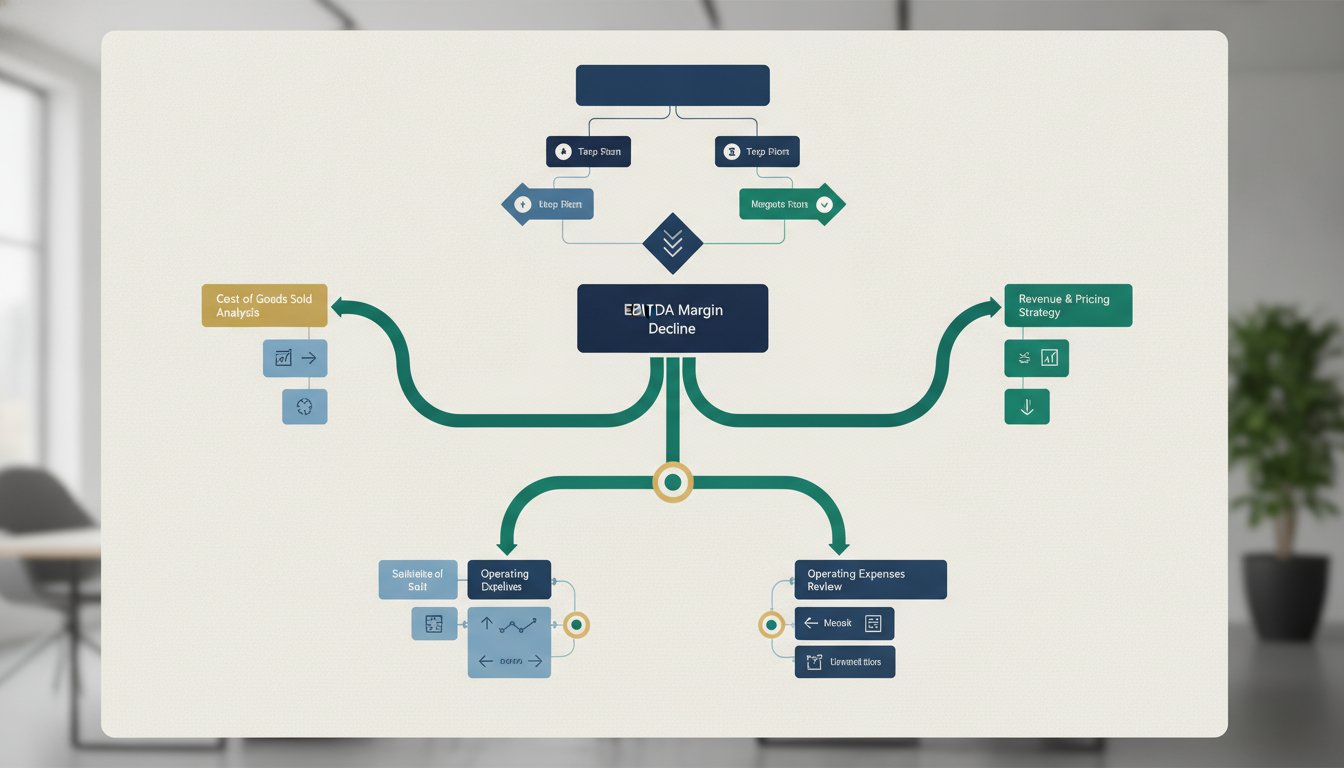
An ebitda margin decline diagnostic is a systematic process that identifies whether cost increases, revenue shifts, or operational inefficiencies are causing your margin to erode. This framework helps $2M-$25M SMB owners pinpoint the real cause without a full-time CFO. When your EBITDA margin drops, work through this diagnostic decision tree: check revenue mix shifts first, then cost structure changes, then operational inefficiencies. An ebitda margin decline diagnostic starts with a structured framework that isolates whether the problem lives in revenue, cost of goods sold, or operating expenses. Without this diagnostic, SMB owners often waste weeks chasing symptoms instead of root causes.
The Three-Question Diagnostic: Revenue, COGS, or OpEx
An EBITDA margin decline diagnostic starts with a structured framework that isolates whether the problem lives in revenue, cost of goods sold, or operating expenses. Without this diagnostic, SMB owners often waste weeks chasing symptoms instead of root causes.
Every margin problem falls into one of three buckets. The diagnostic begins with three questions answered from the trailing 12 months of financial data.
| Diagnostic Question | What to Compare | Red Flag Threshold |
|---|---|---|
| Is revenue flat or declining? | Month-over-month revenue for 6+ months | 3 consecutive months of decline |
| Is COGS rising faster than revenue? | COGS as % of revenue vs prior year | >2 percentage point increase |
| Are operating expenses growing? | OpEx as % of revenue vs prior year | >3 percentage point increase |
EBITDA margin for SMBs typically ranges 10-20%, with healthy margin defined as 10-20% per Commerce Bank.1 If your margin dropped below that range, the three-question diagnostic tells you which financial statement line to investigate first. A revenue problem requires a different playbook than a COGS problem, and mixing them up wastes time.
The First Sign: How to Spot a Real EBITDA Decline vs a Seasonal Dip
Seasonal businesses see margin compression every year. The diagnostic separates a trend from a cycle by comparing the same month across three years. If EBITDA margin in October 2025 matches October 2024 and 2023, that is seasonality, not decline.
A real EBITDA decline shows three characteristics:
- Margin drops below the prior year's same period by 3+ percentage points
- The drop persists for two consecutive quarters
- Revenue may be flat or growing, but margin keeps falling
82% of small businesses fail due to cash flow problems per a US Bank study.2 The early warning sign is margin compression that precedes cash shortage by 60-90 days. If you see margin dropping while revenue holds steady, the problem is cost-side, not revenue-side.
The 5-Question Diagnostic Every SMB Owner Should Run First
Before calling for help, run these five questions against your current month's P&L. Each question targets a specific margin erosion cause.
Are any single expense line items up more than 15% year-over-year? Insurance, rent, software subscriptions, and payroll taxes are common culprits.
If three or more answers point to cost increases, the margin erosion is systemic. If only one answer flags, the fix is targeted.
Revenue Leak vs Cost Creep: Isolating the Root Cause
Revenue leak means you are earning less per transaction than before. Cost creep means your expenses are growing faster than revenue. The two require opposite fixes. Running an ebitda margin decline diagnostic requires you to determine which pattern your business is exhibiting, because the corrective action for revenue leak is fundamentally different from the corrective action for cost creep.
| Symptom | Revenue Leak | Cost Creep |
|---|---|---|
| Revenue trend | Flat or declining | Flat or growing |
| Gross margin | Stable or improving | Declining |
| OpEx % of revenue | Rising (fixed costs spread over less revenue) | Rising (variable costs increasing) |
| Typical fix | Pricing review, sales process audit, churn reduction | Vendor renegotiation, headcount freeze, subscription audit |
Consider a hypothetical software-as-a-service company with $500K ARR. Revenue grew 10% year-over-year, but EBITDA margin dropped from 18% to 11% — a pattern that typically points to cost creep rather than revenue leak. If this company's OpEx hit roughly 45% of revenue, a typical threshold for software businesses, the diagnostic points to cost creep. The fix is a 30-day expense freeze, not a sales push.
Private equity buyers typically apply EBITDA multiples of 3-6x for SMB acquisitions, making margin trends critical to exit value per Axial.3 A 5-point margin drop on a $5M revenue business reduces valuation by $750K to $1.5M at a 3-6x multiple.
When to Call Your Fractional CFO vs When to Act Alone
Some margin problems are fixable with internal data and a spreadsheet. Others require an outside diagnostic because the data itself is misleading.
Act alone when:
- You have clean, monthly financial statements within 15 days of month-end
- The diagnostic points to one clear cause (e.g., a single vendor price increase)
- You have capacity to run a 30-day expense freeze and track results
Call a fractional CFO when:
- Financial statements are more than 30 days old or use cash basis accounting
- Multiple diagnostic branches point to different causes simultaneously
- You need EBITDA coverage ratio analysis for SBA 7(a) loan underwriting, which is required for loans over $350,0004
- Margin dropped suddenly with no obvious trigger
The CEO Confidence Index shows "uncertainty" mentions rose 21% in 2025, correlating with profit pressure on SMBs.5 When uncertainty is high, the cost of a wrong diagnostic is higher than the cost of professional help. At CurrentCFO, we offer one-time diagnostic engagements specifically for situations where internal analysis has not produced a clear answer.
The 30-Day Recovery Playbook: Cash Preservation and Margin Repair
A 30-day recovery plan has three phases. Each phase has specific actions and measurable targets.
Week 1: Cash Freeze
-
Stop all non-essential spending immediately
-
Review every recurring subscription and cancel unused licenses
-
Freeze discretionary bonuses and non-critical contractor work
-
Contact top 5 vendors by spend and request a discount or extended terms — for example, a typical 15% reduction or net-60 payment terms
Week 4: Margin Measurement Reset
- Recalculate EBITDA margin using the new cost structure
- Set a 90-day target margin based on current operations
- Implement weekly margin tracking, not monthly
For a business with $3M revenue and a 12% EBITDA margin, a 3-point margin recovery adds $90K to annual profit.
Setting Your Next EBITDA Target Based on Current Operations
Your next EBITDA target should be realistic based on your industry and current cost structure, not aspirational. EBITDA margin is calculated as EBITDA divided by total revenue and measures operating profitability per Investopedia.6
| Industry | Typical EBITDA Margin Range | Recovery Target (90 days) |
|---|---|---|
| Professional services | 15-25% | 18% |
| SaaS / Technology | 10-20% | 15% |
| Manufacturing | 8-15% | 12% |
| Retail / Wholesale | 5-12% | 10% |
These industry benchmarks reflect median ranges from Commerce Bank's 2026 SMB financial analysis, with recovery targets set at 2-3 points above typical floor values for each sector.
Set the target 2-3 points above your current margin, not 5-10 points. A 2-point improvement is achievable through the 30-day playbook. A 10-point improvement requires structural changes like new product lines or facility closures.
Your Next Step
Run the three-question diagnostic against your trailing 12 months of financial data today. Identify whether the problem is revenue, COGS, or OpEx. If the answer is not immediately clear from your current financial statements, that is the signal to bring in a fractional CFO for a one-time diagnostic engagement. Email [email protected] to discuss a margin diagnostic review.
Disclaimer: This framework is for informational purposes only and does not constitute financial, legal, or tax advice. Consult a qualified CPA or financial advisor before making business decisions based on this content.
Footnotes
-
https://www.commercebank.com/business/trends-and-insights/2026/ebitda-explained ↩
-
https://www.usbank.com/small-business/business-checking/why-small-businesses-fail.html ↩
-
https://www.axial.net/forum/use-ebitda-valuation-small-business ↩
-
https://chiefexecutive.net/companies-2025-profits-coming-in-short ↩