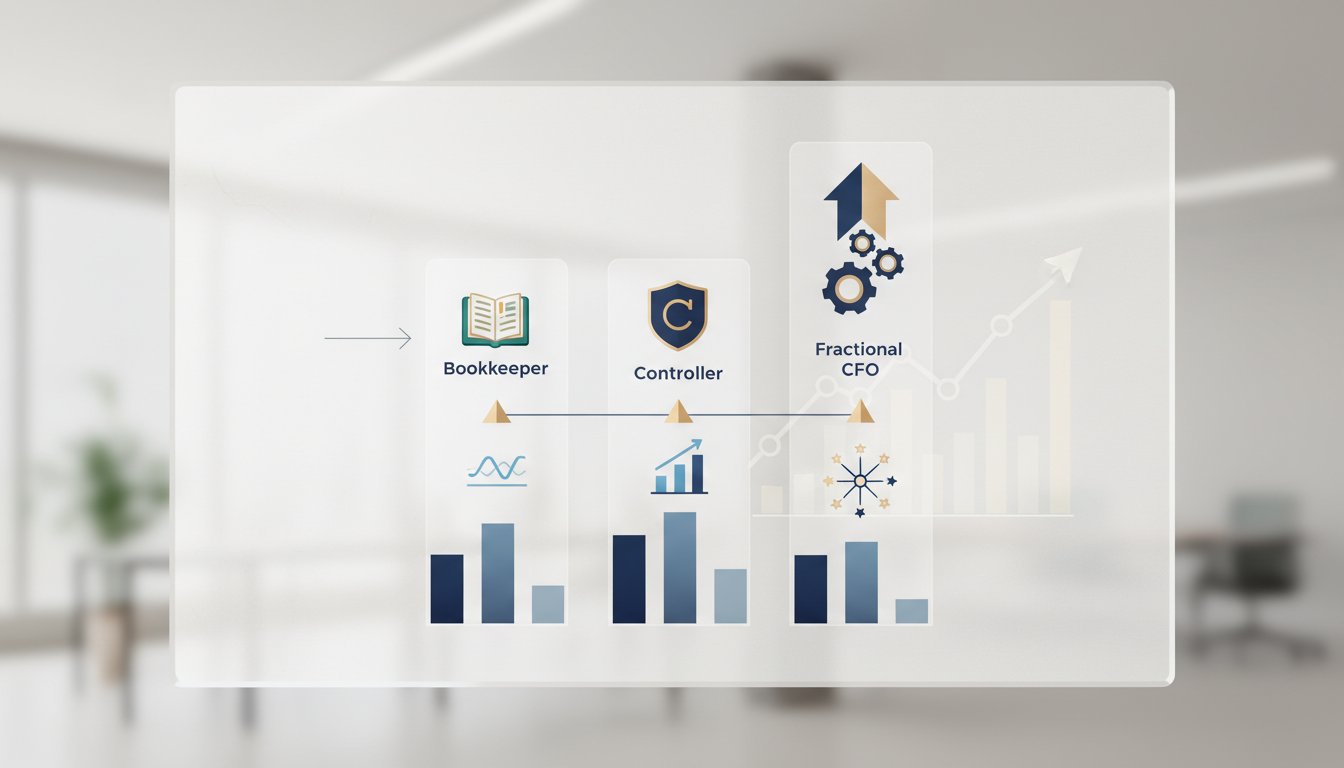
The Three Financial Roles: Bookkeeper, Controller, CFO
A fractional CFO is a part-time chief financial officer who provides strategic financial leadership to growth-stage companies on a flexible, part-time basis without the cost of a full-time executive.
You know you need financial help, but the titles are confusing. Is a bookkeeper enough? Do you need a controller or a CFO? The distinction isn’t about seniority; it’s about function. Each role solves a different problem at a different stage of your company’s life.
A bookkeeper is your historian. They record what happened: transactions are logged, invoices are sent, bills are paid, and bank accounts are reconciled. Their output is accurate historical data. A controller is your interpreter. They take the bookkeeper’s data and turn it into financial statements—the P&L, balance sheet, and cash flow statement. They ensure GAAP compliance, manage the month-end close, and establish internal controls to prevent errors or fraud. A CFO, fractional or full-time, is your strategist. They use the controller’s interpreted data to guide future decisions. They model scenarios, secure capital, optimize pricing, and align financial strategy with business goals.
The confusion shows up in predictable ways. Consider a hypothetical $8M-revenue founder who says, “Our bookkeeper is great, but I still don’t know if we can afford to hire three new engineers.” The bookkeeper is providing perfect records, but nobody is translating those records into a forward-looking hiring budget. That gap — between historical accuracy and forward-looking decision support — is the gap between roles.
Signs You’ve Outgrown Your Bookkeeper
Your bookkeeper is essential, but their role has natural limits. The first sign of outgrowing them is a constant time lag in your financial insight. If you’re making decisions in June based on a P&L that finalized in mid-May for April’s activity, you’re driving using only the rearview mirror. A bookkeeper’s process is inherently backward-looking.
The second sign is recurring accounting errors that slip through. A bookkeeper focuses on transaction entry, not systemic control. A common pattern: a bookkeeper miscategorizes $120,000 in software development costs as a monthly operating expense instead of capitalizing it, distorting gross margin by 11 points for a year. No fraud is involved — just a lack of oversight on complex accounting rules. Without a controller’s review layer, material errors like these become routine.
Third, you’ll feel operational friction. Is your sales team waiting for the bookkeeper to generate custom client profitability reports? Are department heads asking for budget vs. actuals? The bookkeeper can likely pull the raw data, but building consistent, accurate managerial reports isn’t their primary function. When you start needing financial information tailored to drive internal management decisions, you’ve crossed into controller territory.
When a Controller Solves Your Scaling Problems
Hiring a controller is rarely about revenue alone; it’s triggered by complexity and risk. The primary trigger is the need for formalized financial controls and auditable processes. When you start seeking debt financing, most banks will require reviewed or audited financial statements. A bookkeeper cannot produce these; a controller builds the process and controls that make an audit possible.
Another clear trigger is managing a team. Once you have a bookkeeper and perhaps an AP/AR clerk reporting to a founder who isn’t a finance expert, you need a controller. They become the manager of the accounting function, ensuring quality, training staff, and streamlining the monthly close. Consider a hypothetical $14M SaaS company whose monthly close takes 23 days because two bookkeepers work without a playbook. A controller who installs a structured close checklist can reduce that to 6 days within two quarters, freeing up founder time immediately.
Finally, consider a controller when operational decisions require granular financial data. For example, if you need to understand the true cost and profitability of each service line, client, or location, a controller builds that costing model. They implement the job costing or departmental reporting that turns generic bookkeeping data into actionable business intelligence.
The Fractional CFO Hiring Trigger: Revenue and Complexity
When to hire a fractional CFO is defined by two intersecting axes: strategic financial need and resource constraints. You need CFO-level strategic insight but don’t yet need or can’t justify a full-time executive.
The most quantifiable trigger is preparing for a capital event. If you are planning to raise equity (Series A or beyond), secure a significant growth loan, or prepare the business for sale in the next 18-24 months, you need a CFO. Investors and acquirers will perform intense due diligence. A fractional CFO builds the data room, crafts the financial narrative, and ensures your metrics are investor-grade. Sellers commonly leave $2-3 million on the table in an acquisition simply because their financial story is poorly presented.
The second trigger is strategic ambiguity amid growth. You’re profitable, but growth has stalled. You have cash, but don’t know the most efficient way to deploy it—should you hire sales, invest in marketing, or build a new product feature? A bookkeeper records the cash; a controller reports its level; a fractional CFO builds a model to simulate the ROI of each option. When your decisions carry a price tag of $500,000 or more and the right choice isn’t obvious, you need strategic finance.
| Trigger | Typical Revenue Range | Key Question to Ask |
|---|---|---|
| Capital Event Planning | $5M+ | Are we preparing to raise capital or sell the business in the next 24 months? |
| Strategic Investment Decisions | $3M+ | Do we have the financial model to confidently invest $250K+ in a new initiative? |
| Pricing & Margin Complexity | $5M+ | Do we truly understand the unit economics and lifetime value of each customer segment? |
| Multi-Entity or International Ops | Any | Are we dealing with multiple legal entities, transfer pricing, or foreign currency? |
How a Fractional CFO Handles Strategic Finance
A fractional CFO operates at the intersection of finance, strategy, and operations. Their work product isn’t a journal entry or a financial statement; it’s a recommendation backed by a model.
Take pricing strategy. A controller can tell you what your gross margin was last quarter. A fractional CFO builds a pricing model that shows how a 7% price increase for new clients would impact conversion, churn, and overall EBITDA, segmenting by customer cohort. A typical application: a professional services firm modeling a tiered pricing shift that increases average contract value by 22% without losing volume.
They also own the capital strategy. This means determining the optimal capital structure for your stage. Should you take on debt, raise equity, or finance growth through cash flow? A fractional CFO will model the dilution, cost of capital, and covenant restrictions of each option. Consider a hypothetical $9M manufacturer weighing venture debt against an asset-based lending facility: the ABL structure often comes in roughly $1.5M cheaper over three years than the equivalent venture debt term sheet.
Finally, they implement financial KPIs and dashboards that actually drive management behavior. Instead of just a P&L, you get a dashboard tracking leading indicators like sales pipeline coverage, fully loaded customer acquisition cost, and rolling cash flow forecast. This shifts the management conversation from “What happened?” to “What are we going to do about it?”
The Cost-Benefit Analysis for Each Role
The decision isn’t just about need; it’s about return on investment. Let’s break down the typical cost and the tangible benefit you should expect.
A skilled bookkeeper costs between $50,000 and $70,000 annually for a full-time role, or $2,000-$4,000 per month for a qualified outsourced service.1 Their benefit is clean, timely records and compliance—avoiding IRS penalties and the chaos of disorganized finances. The ROI is foundational.
A controller commands a salary between $110,000 and $160,000, plus benefits.2 The benefit is financial clarity, control, and efficiency. The ROI manifests in faster closes (freeing up management time), fewer errors (saving real money), and providing the reliable data needed for debt financing. One client’s new controller identified $40,000 in duplicate vendor payments in their first 90 days, covering nearly a third of their annual salary.
A fractional CFO typically costs between $3,000 and $12,000 per month, depending on scope and company complexity.3 The benefit is directly tied to strategic outcomes: better pricing, smarter capital allocation, and successful fundraising. The ROI is measured in multiples. For example, a fractional CFO helping to secure a $2 million growth loan at a 2% lower rate saves $40,000 annually in interest—often covering their entire fee while enabling growth that wouldn’t otherwise be possible.
| Role | Annual Cost Range (FTE or Equivalent) | Primary Financial Benefit | ROI Metric |
|---|---|---|---|
| Bookkeeper | $50K - $70K | Accurate historical records; compliance | Avoided penalties & operational chaos |
| Controller | $110K - $160K | Reliable reporting & internal controls | Faster close cycle; error reduction; debt readiness |
| Fractional CFO | $36K - $144K | Strategic guidance & capital strategy | Improved margins; successful fundraising; optimal capital structure |
Making the Decision: A Step-by-Step Framework
Use this framework to diagnose your need. Start by auditing your current pain points.
Step 1: Assess Your Reporting Lag. How many days after month-end do you get a usable P&L? If it’s more than 15 days, your bookkeeping or closing process is a bottleneck. Solving this may require a better bookkeeper or a controller, depending on the root cause.
Step 2: Evaluate Error Frequency. Have you had to make material prior-period adjustments? Do you find regular miscategorizations? If yes, you lack the review and control layer a controller provides.
Step 3: Identify Your Strategic Questions. List the top three financial questions keeping you awake at night. Are they about the past (“Why was Q3 profit so low?”) or the future (“Can we afford to open a second location next year?”). Past-focused questions indicate a controller gap. Future-focused questions signal a CFO need.
Step 4: Map to Upcoming Milestones. Overlay your 18-month business goals. Are you seeking a bank loan? Planning a key hire? Beginning M&A conversations? Each milestone has a financial readiness requirement. A controller is often needed 6-12 months before a loan application. A fractional CFO should be engaged 12-18 months before a serious fundraising round or sale process.
Step 5: Conduct a Cost of Delay Analysis. What is the financial cost of not hiring this role? For a controller, it might be the interest on a loan you can’t yet qualify for. For a fractional CFO, it could be the suboptimal pricing or missed market opportunity. If the cost of delay exceeds the annual cost of the role, the decision is clear.
Your Next Step
Your next step is to perform the five-step diagnostic framework in this post. Start with Step 3: write down the three financial questions that are most urgent for your business right now. That simple list will immediately clarify whether your need is for historical accuracy, managerial control, or future strategy. If your questions point toward strategic complexity, the conversation is about timing and scope for a fractional CFO. My email is [email protected].
Footnotes
-
U.S. Bureau of Labor Statistics, Occupational Employment and Wages, May 2023, Bookkeeping, Accounting, and Auditing Clerks. https://www.bls.gov/oes/current/oes433051.htm ↩
-
Robert Half 2024 Salary Guide, Financial Services. https://www.roberthalf.com/salary-guide ↩
-
Industry pricing data based on 2024 engagements for fractional CFO services at CurrentCFO. ↩ ↩2
-
Robert Half 2024 Salary Guide, Financial Services. https://www.roberthalf.com/salary-guide ↩