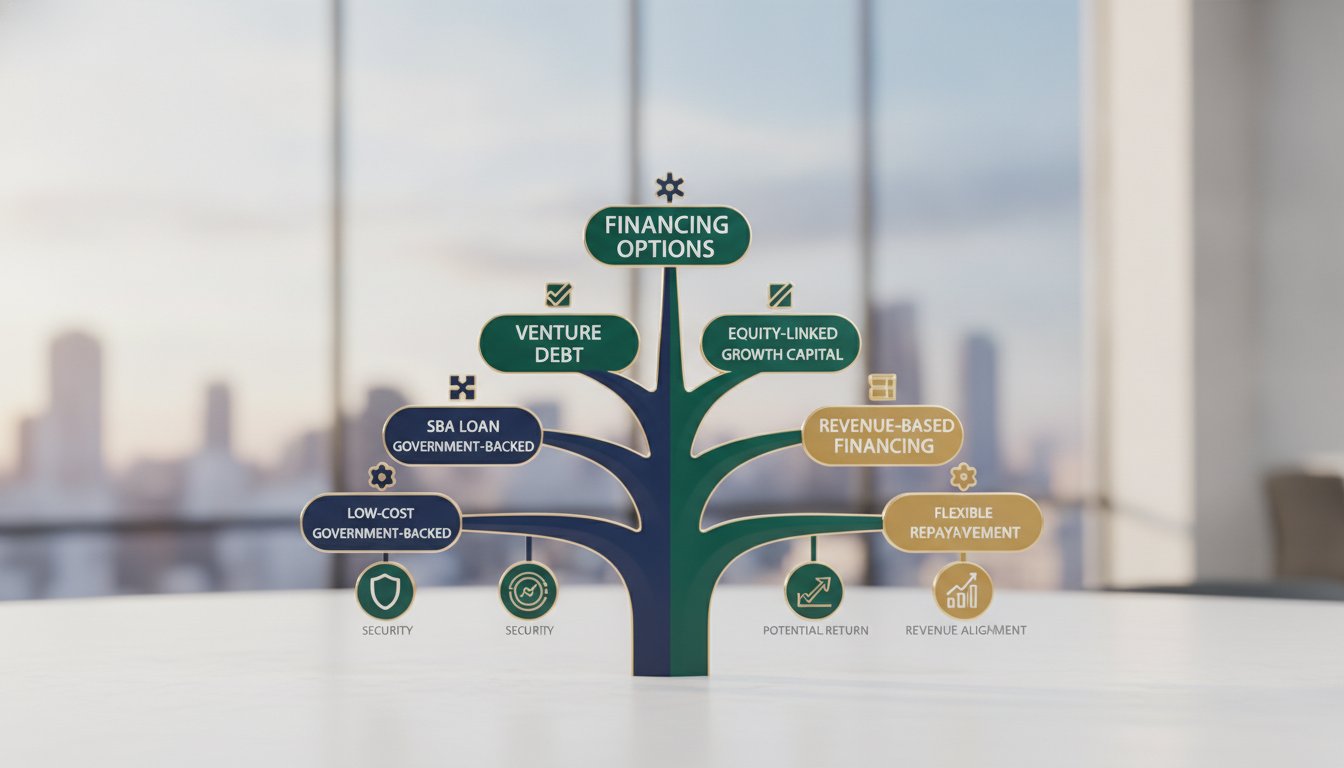
SMB financing options refer to the capital sources available to small and medium-sized businesses with $1M–$10M in annual revenue, including SBA loans, venture debt, and revenue-based financing. An smb financing options comparison helps founders evaluate these trade-offs against their specific revenue stage, credit profile, and growth velocity rather than relying on generic advice.
SBA 7(a) loans are the most established financing option for small businesses, offering up to $5M with rates typically around 9.75% and terms extending to 25 years for real estate.1 The long amortization keeps monthly payments low, which is critical for businesses with thin margins or lumpy cash flow.
The SBA loan structure works best for asset-heavy businesses. A manufacturer needing to purchase equipment, a retailer buying commercial property, or a construction firm requiring working capital for large contracts all benefit from the extended repayment timeline. The 25-year real estate term means a $500K equipment loan might carry a monthly payment of roughly $4,500, versus $10,000+ on a five-year conventional loan.
However, the application process is slow. From application to funding typically takes 60–90 days, and the paperwork requirements are substantial. Personal guarantees are required for owners with 20% or more equity, and the SBA charges a guarantee fee of 2–3.75% of the loan amount.1 For a business that needs capital within two weeks, an SBA loan is not the right vehicle.
When SBA Loans Actually Make Sense for Growth Capital
Choosing between SBA loans, venture debt, and revenue-based financing is one of the most consequential decisions a founder with $1M–$10M in revenue will make. Each option changes your cash flow, ownership, and growth trajectory in fundamentally different ways. An smb financing options comparison helps founders evaluate these trade-offs against their specific revenue stage, credit profile, and growth velocity rather than relying on generic advice.
Choosing between SBA loans, venture debt, and revenue-based financing is one of the most consequential decisions a founder with mid-seven-figure revenue will make. Each option changes your cash flow, ownership, and growth trajectory in fundamentally different ways. An smb financing options comparison helps founders evaluate these trade-offs against their specific revenue stage, credit profile, and growth velocity rather than relying on generic advice.
Choosing between SBA loans, venture debt, and revenue-based financing is one of the most consequential decisions a founder with mid-seven-figure revenue will make. Each option changes your cash flow, ownership, and growth trajectory in fundamentally different ways. An smb financing options comparison helps founders evaluate these trade-offs against their specific revenue stage, credit profile, and growth velocity rather than relying on generic advice.
SBA 7(a) loans are the most established financing option for small businesses, offering up to $5M with rates typically around 9.75% and terms extending to 25 years for real estate.1 The long amortization keeps monthly payments low, which is critical for businesses with thin margins or lumpy cash flow.
The SBA loan structure works best for asset-heavy businesses. A manufacturer needing to purchase equipment, a retailer buying commercial property, or a construction firm requiring working capital for large contracts all benefit from the extended repayment timeline. The 25-year real estate term means a $500K equipment loan might carry a monthly payment of roughly $4,500, versus $10,000+ on a five-year conventional loan.
However, the application process is slow. From application to funding typically takes 60–90 days, and the paperwork requirements are substantial. Personal guarantees are required for owners with 20% or more equity, and the SBA charges a guarantee fee of 2–3.75% of the loan amount.1 For a business that needs capital within two weeks, an SBA loan is not the right vehicle.
When an SBA Loan Makes Sense for Your Business
The decision to pursue an SBA loan hinges on three factors: asset ownership, credit history, and time horizon. If your business owns or plans to acquire hard assets like real estate, heavy machinery, or vehicles, the long-term financing structure aligns well with the asset's useful life.
Consider a hypothetical distribution company with $3M in annual revenue that needs $400K for warehouse shelving and a forklift. The equipment has a 15-year lifespan, so financing it over 10 years matches the asset's productive period. The SBA loan's lower monthly payment preserves cash for inventory purchases during growth months.
Credit requirements are more flexible than conventional bank loans. The SBA requires a minimum credit score of around 640, compared to 680+ for most traditional term loans.1 Businesses that have been operating for at least two years and can demonstrate consistent revenue qualify, even if they lack extensive collateral beyond the asset being financed.
The 2024 Small Business Credit Survey found that employment growth and revenue expectations held steady year-over-year for employer firms, suggesting a stable environment for long-term borrowing commitments.2 If your business fits this profile and you can wait 60–90 days for funding, an SBA loan is often the lowest-cost option over the full term.
What Venture Debt Actually Costs Beyond the Interest Rate
Venture debt is frequently misunderstood as simply a higher-interest loan. The real cost includes warrants, which give the lender the right to purchase equity at a fixed price, typically 5–20% of the loan amount.3 A $1M venture debt facility might carry a 12% interest rate plus warrants representing 10% of the principal, effectively increasing the total cost of capital to 15–18% when the warrant value is included.
Venture debt is designed for VC-backed startups that need a non-dilutive bridge between equity rounds. The lender evaluates the quality of the venture capital investors, not just the business's cash flow. If Sequoia or Accel led your Series A, venture debt providers will compete to lend to you. If you are bootstrapped or angel-funded, venture debt is generally unavailable regardless of your revenue.
The repayment structure is also different. Most venture debt requires interest-only payments for 6–12 months, followed by principal amortization over the remaining term. This creates a cash flow cliff when principal payments begin. A hypothetical SaaS company with $500K ARR that takes $750K in venture debt might pay $7,500 monthly in interest for the first year, then $20,000 monthly when principal amortization kicks in.
How Revenue-Based Financing Aligns With Monthly Cash Flow
Revenue-based financing (RBF) ties repayment directly to your daily or weekly revenue, typically taking 5–15% of each transaction until a fixed cap is reached, often 1.35–1.5x the original advance.4 For a business with predictable recurring revenue, this structure eliminates the fixed monthly payment risk that causes cash flow crises.
Most providers require a minimum of roughly $15K–$20K in monthly revenue and at least six months of bank statements.4
The trade-off is cost. A typical RBF advance of $100K with a 1.35x cap means repaying $135K total. If repayment takes 12 months, the effective APR is roughly 35%.5 If repayment takes 6 months, the effective APR exceeds 70%.5 The faster your revenue grows, the more expensive RBF becomes because the lender's return accelerates.
For a seasonal business, RBF can be ideal. Suppose a landscaping company generates $80K monthly in summer and $20K monthly in winter. A fixed loan payment of $8K per month would be impossible in winter. RBF payments of roughly 10% of daily revenue automatically adjust to approximately $2K in winter and $8K in summer, matching cash flow availability.[^6]
Comparing Qualification Requirements Across All Three Options
| Requirement | SBA 7(a) Loan | Venture Debt | Revenue-Based Financing |
|---|---|---|---|
| Minimum credit score | 640 | 680+ (firm-level) | 550+ |
| Time in business | 2+ years | Typically 1+ year | 6+ months |
| Monthly revenue minimum | Varies by lender | $50K+ | $15K–$20K |
| Collateral required | Yes (asset + personal guarantee) | IP + warrants | No |
| VC backing required | No | Yes | No |
| Time to funding | 60–90 days | 2–6 weeks | 4–24 hours |
| Maximum amount | $5M | $1M–$5M | $600K |
The table above shows that each option serves a fundamentally different borrower profile. SBA loans require patience and collateral but offer the lowest rates. Venture debt requires VC backing and accepts warrant dilution. Revenue-based financing requires no collateral or VC backing but carries the highest effective cost.
The Dilution and Control Trade-Off You Cannot Ignore
Every financing option carries a hidden cost beyond the interest rate: control. SBA loans require personal guarantees, meaning the lender can pursue your personal assets if the business defaults. Venture debt includes warrants that dilute existing shareholders, typically 5–20% of the loan amount.3 Revenue-based financing requires daily access to your bank account and payment processing system.
The personal guarantee on an SBA loan is the most significant control transfer. If your business has $2M in revenue and you personally guarantee a $500K loan, your personal net worth is now tied to the business's performance. Many founders do not realize that SBA lenders can garnish wages, seize personal bank accounts, and place liens on personal property in a default scenario.
Venture debt's warrant dilution is often underestimated. A $1M venture debt facility with 10% warrants means the lender receives shares worth $100K at the current valuation. If your company's valuation triples before the next round, those warrants are worth $300K. The lender captures this upside without taking the same risk as equity investors.
Revenue-based financing avoids both personal guarantees and dilution, but the daily payment structure gives the lender real-time visibility into your cash flow. If your revenue drops, payments drop automatically, but the total repayment cap remains fixed. A slow quarter extends the repayment period, keeping the lender's claim on your revenue active for longer.
Matching Your Growth Stage to the Right Financing Type
| Growth Stage | Revenue Range | Best Financing Option | Why |
|---|---|---|---|
| Early traction | $500K–$1M | Revenue-based financing | Fast funding, no collateral, flexible payments |
| Growth stage | $1M–$5M | SBA 7(a) loan | Lower cost, long terms, asset financing |
| High-growth VC-backed | $2M–$10M | Venture debt | Non-dilutive bridge, interest-only period |
| Mature stable | $5M–$10M | SBA 7(a) or conventional | Lowest rates, established credit history |
A business at $800K in annual revenue with consistent monthly receipts of $70K should pursue revenue-based financing1. The speed and flexibility outweigh the higher cost because the business needs capital to capture growth opportunities now, not in 90 days.
A business at $3M in revenue with $200K in equipment needs should pursue an SBA loan1. The 10-year term keeps payments manageable, and the equipment serves as collateral, reducing the lender's risk and your effective cost.
A VC-backed SaaS company at $5M ARR with a Series A from a top-tier firm should pursue venture debt. The interest-only period preserves cash for sales and marketing, and the warrants are a small price for, say, $2M+ in non-dilutive capital2.
Red Flags That Signal the Wrong Financing Choice
Three patterns consistently indicate a mismatch between financing type and business reality. First, pursuing an SBA loan when you need capital in under 30 days. The application timeline is fixed, and rushing the process leads to errors, incomplete documentation, and rejection. If you need money next week, choose RBF or a business credit card.
Second, taking venture debt without VC backing. Venture debt providers evaluate the quality of your equity investors, not your business fundamentals. Without a lead investor with a strong track record, you will either be rejected or offered terms that effectively function as high-interest debt with warrants attached.
Third, using revenue-based financing for a one-time capital expenditure. RBF is designed for working capital needs that generate immediate revenue. Financing a $100K piece of equipment with RBF means repaying $135K over 6–12 months, while the equipment generates value over 5–10 years. The cost structure does not match the asset's useful life.
The Lendio Q1 2025 SMB Lending Index showed no change from Q4 2024, indicating a flat lending market where lenders are not loosening standards.5 This means qualification requirements are firm, and mismatched applications will be rejected quickly. Do not waste time on the wrong option.
Your Next Step
Map your business's current revenue, growth rate, and asset needs against the three financing options using the decision framework above. Identify which option matches your timeline — if you need capital within two weeks, eliminate SBA loans. If you lack VC backing, eliminate venture debt. If you need to finance a long-term asset, eliminate revenue-based financing. Once you have narrowed to one option, prepare the specific documentation that option requires: bank statements for RBF, tax returns and financial statements for SBA, or investor materials for venture debt. For a personalized assessment of which financing structure fits your specific revenue profile and growth plans, contact [email protected].