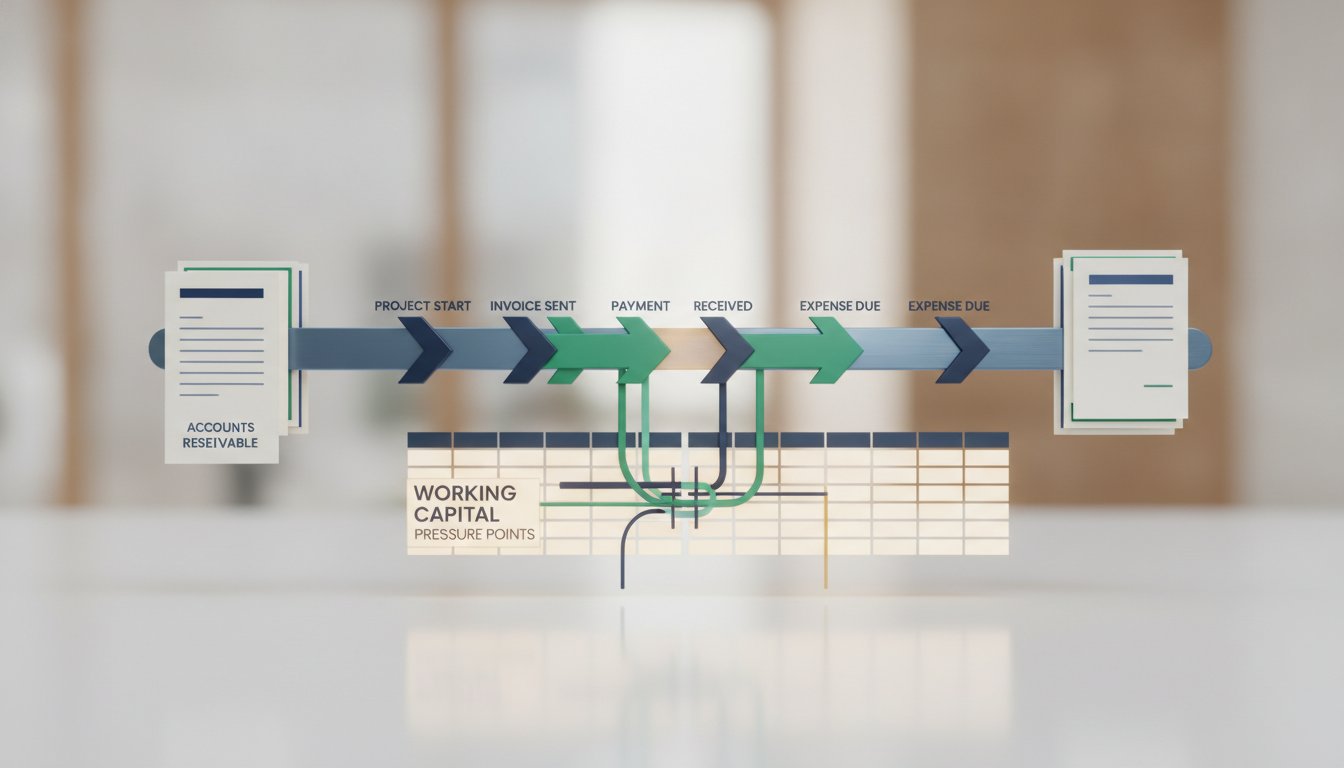
The 30-Day Gap Between Payroll and Payment
Cash flow timing mistakes service business owners make are systematic gaps between earning revenue and collecting payment. These gaps occur because service businesses pay labor costs weekly or biweekly while clients pay invoices on net-30 or net-60 terms, creating a structural 30-to-60-day timing mismatch.1 A marketing agency with $50,000 in monthly payroll pays staff on the 1st and 15th. If the agency invoices on the 1st with net-30 terms, the client payment arrives 30 days later — but payroll has already been paid twice.
This timing mismatch is the most common cash flow timing mistake service business owners make. The business is profitable on paper, but the bank account dips below zero every two weeks. The fix is not higher revenue. The fix is aligning billing cycles with payment cycles. Switching from net-30 to net-15 on new contracts, or requiring a deposit before work begins — for example, 50% upfront — closes the gap by shifting cash inflow earlier in the month.
Late Payments: The Hidden Working Capital Drain
When a client pays 15 days late on a $25,000 invoice, the service business effectively extends an interest-free loan for two extra weeks. For a business with a typical 10% profit margin, that late payment wipes out the profit on the next $250,000 of revenue because the cash is tied up in receivables instead of funding operations.1
According to a 2024 PYMTS survey, 45% of small business owners have skipped their own paycheck due to cash flow shortages.2 Late payments are the primary driver. A single overdue invoice can force a founder to delay vendor payments, triggering late fees that compound the cash drain.
The solution is systematic follow-up. Send invoices on day one. Send a reminder on day 15. Call on day 20. Automate this sequence in your accounting software so it runs without manual effort. Every day an invoice sits unpaid, working capital shrinks.
Mixing Personal and Business Expenses Creates Cash Gaps
When a founder pays a personal credit card bill from the business account, the cash flow picture becomes impossible to read. The business might appear to have a $15,000 cash shortage when in reality $8,000 of that was a personal expense that should never have touched the business account.
This is not a tax issue. It is a visibility issue. If you cannot see exactly how much cash the business needs to operate for the next 30 days, you cannot predict when a cash shortfall will hit. The fix is a dedicated business bank account and a business credit card used for zero personal transactions. Once the accounts are separated, the cash flow statement becomes a reliable diagnostic tool instead of a guessing game.
Paying Vendors Too Early When Receivables Are Slow
Many service business owners pay vendor invoices immediately to maintain good relationships. That instinct is admirable but financially dangerous when receivables are slow. If you pay a $10,000 software subscription on day one but your largest client pays their $40,000 invoice on day 45, you have created a 44-day cash gap that your working capital must cover.
The better approach is to pay vendors on their terms, not earlier. If a vendor offers net-30, pay on day 30. Use the cash to cover payroll and operating expenses in the meantime. This is not about avoiding payment. It is about matching cash outflows to cash inflows.
| Cash Flow Fix | Cash Impact | Implementation Effort |
|---|---|---|
| 50% upfront deposit | Shifts cash inflow to project start | Contract revision |
| Net-15 terms | 15 days faster collection | Client negotiation |
| Day-one invoicing | 29 days faster per month | Process change |
Seasonal Revenue Swings That Wreck Your Cash Position
Service businesses with seasonal revenue patterns face a predictable cash flow timing mistake: they spend at peak-season levels during off-season months. For example, a landscaping company might generate 70% of its revenue between April and October. If the owner keeps the same payroll and marketing spend from November through March, the cash reserve built during peak months will be depleted by February.
The fix is a seasonal cash flow forecast that maps expected revenue and expenses month by month. Build the reserve during peak months by setting aside a fixed percentage of every invoice. During off-season months, reduce discretionary spending — not payroll, but marketing, travel, and software subscriptions that are not generating revenue. A 13-week rolling cash flow forecast, which JPMorgan recommends as the standard for SMB planning, catches these seasonal gaps before they become emergencies.3
Ignoring the Timing Gap Between Invoicing and Payment
The day you send an invoice is not the day you get paid. The gap between invoicing and payment is the single largest drain on working capital for service businesses. If you invoice on the last day of the month and the client pays on day 30, you wait 30 days. If you invoice on the first day of the month and the client pays on day 30, you still wait 30 days — but the cash arrives earlier in the billing cycle.
Small changes in invoicing timing produce large changes in working capital. Consider a service business with $300,000 in monthly revenue. Moving invoicing from the 30th to the 1st of the month accelerates cash inflow by 29 days. That is $300,000 in additional working capital available 29 days sooner, without changing a single contract term1. The fix is simple: invoice immediately upon service completion, not at month end.
Overinvesting in Inventory Before You Have the Cash
Service businesses that carry inventory — equipment, supplies, raw materials — often buy in bulk to get a discount. A 15% discount on a $20,000 inventory purchase sounds like a good deal. But if the purchase drains the bank account and leaves no cash for next week's payroll, the discount is irrelevant.
The cash flow timing mistake is buying inventory before the cash from the corresponding revenue has arrived. If you need $20,000 of inventory to fulfill a $50,000 contract, buy the inventory only after the client has paid a deposit or after you have confirmed that the cash from previous contracts will cover the purchase. Do not let a supplier's discount window dictate your cash position. A discount, say 15%1, is not worth a missed payroll.
Failing to Build a Cash Reserve for Slow Months
Every service business experiences slow months. Clients delay decisions. Projects end. New contracts take longer to close than expected. Without a cash reserve, a single slow month forces the founder to choose between paying vendors and paying themselves.
The standard recommendation is three months of operating expenses in reserve. For a service business with $50,000 in monthly expenses, that means $150,000 in liquid cash1. Building that reserve requires discipline: set aside 10% of every invoice into a separate savings account before paying any other expense2. Treat the reserve as a non-negotiable operating cost, not an optional savings goal. When a slow month hits, the reserve absorbs the gap without requiring a loan or a credit card.
Your Next Step
Run a cash flow timing diagnostic on your service business this week. Pull your last three months of bank statements and invoices. Map the date each invoice was sent against the date payment was received. Calculate the average gap in days. Then map your payroll and vendor payment dates against those same invoices. If your average payment gap exceeds your average expense gap by more than 15 days, you have a structural cash flow timing mistake that needs a fix. Start with one change: invoice on day one of every project, not at month end. For a free diagnostic template, email [email protected].
Footnotes
-
https://resources.liveoak.bank/blog/the-top-cash-flow-mistakes-for-small-business-owners ↩ ↩2 ↩3 ↩4 ↩5
-
https://www.fnbn.com/blog/best-practices-for-cash-flow-forecasting ↩ ↩2
-
https://www.jpmorgan.com/insights/treasury/forecasting-planning/cash-flow-management-and-reporting-guide-for-businesses ↩
-
https://www.linkedin.com/posts/kate-mayeski-05838913_small-business-statistics-the-ultimate-list-activity-7265037275938324480-PeFj ↩