Why Most First-Time Sellers Misunderstand Deal Structure Risk
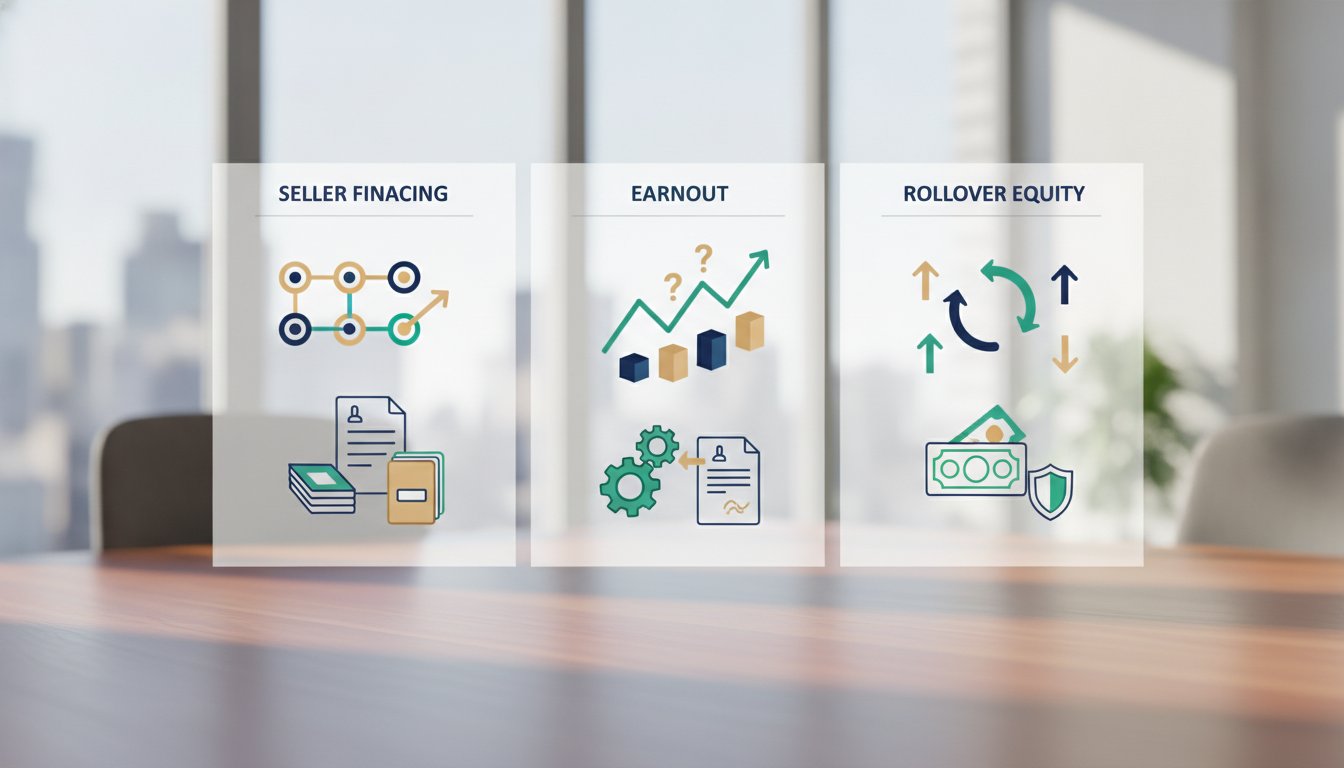
Seller financing is a deal structure where the seller of a small business agrees to accept a portion of the purchase price as a series of future payments from the buyer, rather than receiving the full amount in cash at closing. For a first-time business exit, seller financing small business exit arrangements can bridge the gap between what a buyer can borrow and what a seller wants to receive, but they also introduce ongoing credit risk that many founders underestimate.
First-time sellers often focus exclusively on the headline purchase price, treating a $5 million offer as a simple number. In practice, the deal structure determines how much of that amount actually lands in the seller's bank account and on what timeline. Seller financing is used in approximately 25% of SMB transactions under $10 million, often when bank financing is unavailable.1 The risk is not abstract — earnout disputes account for over 40% of post-acquisition litigation in private company deals.2
The core mistake is treating all deal dollars as equal. Cash at closing is worth more than a promissory note due in three years, which is worth more than an earnout tied to future revenue targets. A seller who accepts, for example, $3 million in cash and $2 million in seller financing has not sold the business for $5 million — they have sold it for $3 million plus a risky loan to the buyer.
Seller Financing: How It Works in an SMB Exit
In a seller financing arrangement, the seller acts as the bank. The buyer makes a down payment — typically 30% to 50% of the purchase price — and the seller carries a note for the remainder, often amortized over three to seven years at an interest rate negotiated between the parties. The note is usually secured by the business assets, meaning the seller can reclaim the business if the buyer defaults.
SBA 7(a) loans cannot be used for seller-financed portions exceeding 30% of the purchase price.3 This rule creates a practical ceiling: if a buyer needs SBA financing, the seller can carry no more than 30% of the deal value as a note. For a $4 million transaction, that caps seller financing at $1.2 million.
The risk for the seller is straightforward: the buyer may fail to operate the business profitably. Consider a hypothetical manufacturing company sold for $3 million with $1 million in seller financing. If the buyer loses a key customer in year two and defaults, the seller must either repossess a damaged business or negotiate a discount on the remaining balance.
When Earnout Structures Protect Both Buyer and Seller
An earnout ties a portion of the purchase price to the business achieving specific performance targets after the sale, typically revenue or EBITDA milestones over one to three years. Earnouts make up nearly 30% of M&A deals and are most common when valuation gaps exceed 15% to 20%.4
Earnouts solve a legitimate information problem. The seller knows the business better than the buyer, and the buyer worries about paying for growth that does not materialize. An earnout aligns incentives: the seller earns more if the business performs, and the buyer pays less if it does not.
The practical challenge is measurement. Earnout disputes account for over 40% of post-acquisition litigation in private company deals.2 Common flashpoints include how expenses are allocated after the sale, whether the buyer can change the product mix, and what happens if the buyer fires the seller's key employees. A well-written earnout clause defines the metric, the accounting method, and the timeline with precision — "EBITDA as calculated under GAAP, excluding one-time integration costs approved in writing by both parties" rather than "profits."
Rollover Equity: Staying Invested After the Sale
Rollover equity occurs when the seller accepts a portion of the purchase price as equity in the acquiring company or a new holding company formed for the transaction. Instead of cash, the seller receives shares that may appreciate if the combined business grows.
The primary tax advantage is significant. Rollover equity allows sellers to defer capital gains taxes under Section 1045 of the Internal Revenue Code if proceeds are reinvested in Qualified Small Business Stock (QSBS) — but only if the original stock was QSBS held for more than 5 years, and the rollover equity must be in a C corporation, not an S corporation or LLC.5 For a seller facing a 20% federal capital gains rate plus state taxes, deferring that liability can preserve hundreds of thousands of dollars.
The trade-off is concentration risk. The seller has already built one business and is now betting on a second — often in the same industry — without the control they had as the owner. For a first-time business exit, seller financing may feel safer than rolling equity into an acquirer whose management team is unknown.
Comparing Tax Implications of Each Exit Structure
The tax treatment of each structure differs materially, and the timing of tax liability often matters more than the rate.
| Structure | Tax Event | Rate | Deferral Option |
|---|---|---|---|
| Cash at closing | Immediate | Capital gains (20% federal + state) | Section 1045 QSBS rollover |
| Seller financing | Installment sale | Capital gains on each payment | Yes, under installment sale rules |
| Earnout payments | When received | Capital gains if structured as additional purchase price | No, unless structured as contingent payment installment sale |
| Rollover equity | When shares sold | Capital gains | Yes, until shares are liquidated |
For a seller receiving, for example, $2 million in cash and $2 million in seller financing, the installment sale method allows the seller to report gain only as payments are received. If the note pays, say, $400,000 per year for five years, the tax liability on that portion is spread across five tax returns rather than hitting in a single year.
Which Exit Strategy Fits Your Business Size and Goals
Business size and industry concentration drive the appropriate structure. For a business with $2 million to $5 million in revenue, seller financing is often the only option because institutional lenders avoid deals below a certain threshold. 37% of small employer firms applied for financing in 2024, with approval rates for acquisition loans dropping to 48% from 62% in 2022.6 When bank financing is scarce, the seller must carry more of the deal.
For a business with recurring revenue and low customer concentration — say a hypothetical SaaS company with 200 customers and 95% annual retention — an earnout tied to retention rates may be attractive because the seller can reasonably predict the outcome. For a business with three customers representing 80% of revenue, an earnout introduces too much uncertainty.
Rollover equity suits sellers who believe the acquirer can create value beyond what the standalone business could achieve. A niche manufacturing firm acquired by a larger competitor with distribution channels may see its products reach markets the seller could never access alone.
Negotiating Deal Terms That Preserve Seller Value
Sellers enter negotiations with less information than buyers, who typically conduct weeks of due diligence. The asymmetry creates leverage points that acquirers exploit.
The most common tactic is the "earnout as gap filler." A buyer offers $4 million in cash, the seller wants $5 million, and the buyer proposes a $1 million earnout to close the gap. The seller accepts, believing the earnout is achievable. In practice, earnout targets are often set at the high end of the seller's projections, and the buyer controls the business operations after closing. A seller should model the earnout under conservative assumptions — for example, if the business grows at 5% instead of 15%, does the earnout pay anything?
For seller financing, the key terms are interest rate, amortization period, and personal guarantee. A note at, for example, 6% interest over five years with a personal guarantee from the buyer is worth more than a note at 8% over seven years with no guarantee. The seller should also negotiate a personal guarantee from the buyer's principals, not just a corporate guarantee from a shell entity.
Your Next Step
Review your current business financials and identify the three metrics a buyer would use to structure an earnout — revenue growth rate, gross margin stability, and customer concentration. Calculate the maximum seller financing you could offer under SBA rules by taking 30% of your estimated sale price. Email those three numbers to [email protected] for a confidential review of which deal structure fits your exit timeline.