Disclaimer: This is not financial advice. Always consult a licensed professional for your specific situation.
The CFO Dilemma for Growing Businesses
You’re hitting your growth targets, but your financial picture is getting blurry. The spreadsheets are multiplying, cash flow feels unpredictable, and strategic decisions about hiring or investment are made on gut feeling. You know you need financial leadership, but the traditional path—hiring a full-time CFO—seems like a massive, expensive leap. You’re not alone. The decision between a fractional CFO vs full-time CFO is a critical inflection point for small businesses and startups. A fractional CFO is an experienced finance executive who works for your company on a part-time, contract basis, providing strategic financial guidance without the cost of a full-time salary and benefits1. This guide provides a clear framework to help you make the right choice for your business in 2026.
What Does a CFO Actually Do for a Small Business?
Before choosing a model, understand the value. A CFO moves your business from reactive bookkeeping to proactive financial strategy. Their core functions include:
- Financial Strategy & Planning: Translating business goals into financial roadmaps, including budgeting, forecasting, and long-term planning.
- Cash Flow Management: Ensuring you have the liquidity to operate, pay employees, and seize opportunities. This is the lifeblood of any SMB.
- Fundraising & Investor Relations: Preparing financial models and decks, identifying funding sources, and communicating with investors or banks.
- Financial Reporting & Analysis: Moving beyond basic profit and loss statements to provide insights on unit economics, customer acquisition cost, and profitability by product line.
- Risk Management & Compliance: Establishing internal controls, ensuring tax compliance, and mitigating financial risks.
A common misconception is that a CFO is just a glorified accountant. While they oversee accounting, their primary role is to be a strategic partner, using financial data to guide the company's direction.
Fractional CFO: The Flexible, Strategic Partner
A fractional CFO engages with your company for a set number of hours or days per month. Think of them as a seasoned guide you hire for the most treacherous parts of the trail, not the entire journey.
Typical Engagement Models:
- Retainer Model: A fixed monthly fee for a defined scope of work (e.g., 10-20 hours per month for financial oversight, reporting, and strategic meetings).
- Project-Based Model: A set fee for a specific project, such as preparing for a fundraising round, building a 3-year financial model, or conducting a pricing analysis.
- Hybrid Model: A base retainer with additional hours available as needed for special projects or during intense periods like year-end.
Who is the Ideal Candidate for a Fractional CFO?
- Startups (Pre-Series A/B): You need expert financial modeling for investors and burn rate management but lack the revenue to justify a $250k+ salary.
- Growing SMBs ($1M - $10M Revenue): Your business is scaling, and the founder's financial management is becoming a bottleneck. You need systems and strategy.
- Companies in Transition: You are preparing for a sale, a major investment round, or navigating a turnaround and need specialized, temporary expertise.
- Businesses with Seasonal or Cyclical Needs: Your financial complexity spikes during certain times of the year (e.g., budgeting season, audit time).
Full-Time CFO: The Dedicated Executive
A full-time CFO is a C-suite employee, fully integrated into your leadership team and responsible for the entire finance function on a daily basis.
Who is the Ideal Candidate for a Full-Time CFO?
- Later-Stage Companies ($15M+ Revenue): The financial operations are complex and voluminous enough to require daily, hands-on executive leadership.
- Businesses with Intricate Capital Structures: You have multiple entities, complex debt instruments, or a large number of investors requiring constant management.
- Companies in Heavily Regulated Industries: Finance and compliance are deeply intertwined and require a dedicated internal leader (e.g., healthcare, fintech).
- Organizations Preparing for an IPO: The process demands a full-time, internal CFO who will be scrutinized by regulators and the public market.
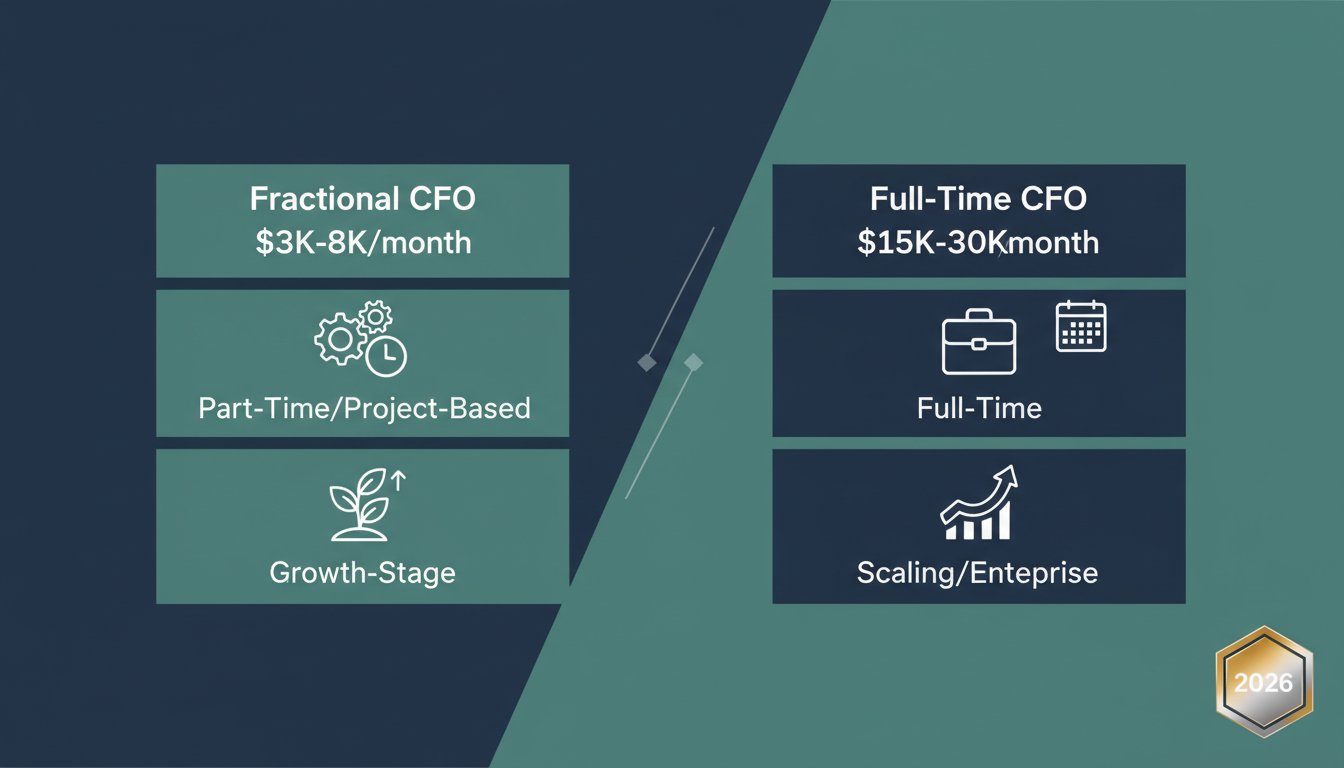
The 2026 Cost Comparison: Fractional CFO vs Full-Time CFO
Cost is often the deciding factor. The numbers have shifted, but the fundamental disparity remains significant.
| Cost Component | Fractional CFO (2026 Estimates) | Full-Time CFO (2026 Estimates) |
|---|---|---|
| Base Cash Compensation | $3,000 - $12,000 per month (retainer)2 | $200,000 - $350,000+ annual salary3 |
| Annual Cash Cost | $36,000 - $144,000 | $200,000 - $350,000+ |
| Benefits & Payroll Taxes | Typically $0 (covered by their firm) | +20-30% of salary ($40k - $105k+) |
| Equity / Bonus | Rare, or very small grant for long-term projects | Often 0.5% - 2%+ equity; 20-50% bonus potential |
| Total Annual Cost | ~$36k - $150k | ~$250k - $500k+ |
The Hidden Cost of a Bad Hire: For a full-time role, a mis-hire is catastrophic. Recruitment fees (20-30% of salary), severance, and lost productivity can easily exceed $100,000. A fractional engagement allows you to "test drive" the expertise with far less risk.
The Decision Framework: 5 Questions to Ask Yourself
Use this step-by-step framework to guide your choice.
-
What is My Primary Need?
- Strategic Guidance & Projects: You need help with specific, high-impact initiatives (fundraising, pricing strategy, M&A). → Lean Fractional.
- Daily Management & Team Leadership: You need someone to run the entire finance department, manage staff, and handle daily firefighting. → Consider Full-Time.
-
What Stage is My Business?
- Early-Stage (Pre-$5M Revenue): Cash is king, and flexibility is critical. → Almost always Fractional.
- Growth-Stage ($5M - $15M Revenue): This is the gray zone. Evaluate complexity. → Likely Fractional, moving toward Hybrid.
- Scale-Stage ($15M+ Revenue): The role is likely a full-time job. → Evaluate Full-Time.
-
Can I Afford the True Total Cost?
- Calculate the full-time CFO's total package (salary, benefits, bonus, equity). If that number causes hesitation or would strain your finances, you cannot afford a full-time CFO. A fractional CFO vs full-time CFO cost analysis makes the fractional path the prudent choice.
-
How Complex are My Financial Operations?
- Moderate Complexity: Multiple revenue streams, basic inventory, 10-30 employees. → Fractional can handle this.
- High Complexity: Multi-entity structure, international operations, complex manufacturing, >50 employees. → May require Full-Time.
-
What is My Timeline?
- Immediate, Specific Need: You have a board meeting in 60 days or an investor deck due. → Fractional (Project-Based).
- Ongoing, Evolving Need: The role is clearly defined and will only grow. → Full-Time.
Making the Transition: From Fractional to Full-Time
A common successful path is to start with a fractional CFO. As your company grows, their retained hours naturally increase. This creates a natural progression. You get to:
- Validate the need for the role.
- Build the financial infrastructure with expert help.
- "Try before you buy" the individual or the function. When the fractional CFO is consistently working near-full-time hours and the strategic need is omnipresent, the transition to hiring them (or another executive) full-time is a data-driven decision, not a leap of faith.
Your Next Step
The path to financial leadership doesn't have to start with a massive, irreversible commitment. For most small businesses and startups in 2026, a fractional CFO provides the strategic horsepower needed to scale without the financial burden of a full-time executive.
Ready to see what a fractional CFO could do for your business? At CurrentCFO, we provide clarity through strategic financial leadership. Book a free consultation to discuss your specific situation and see if a fractional CFO model is the right next step for your growth.