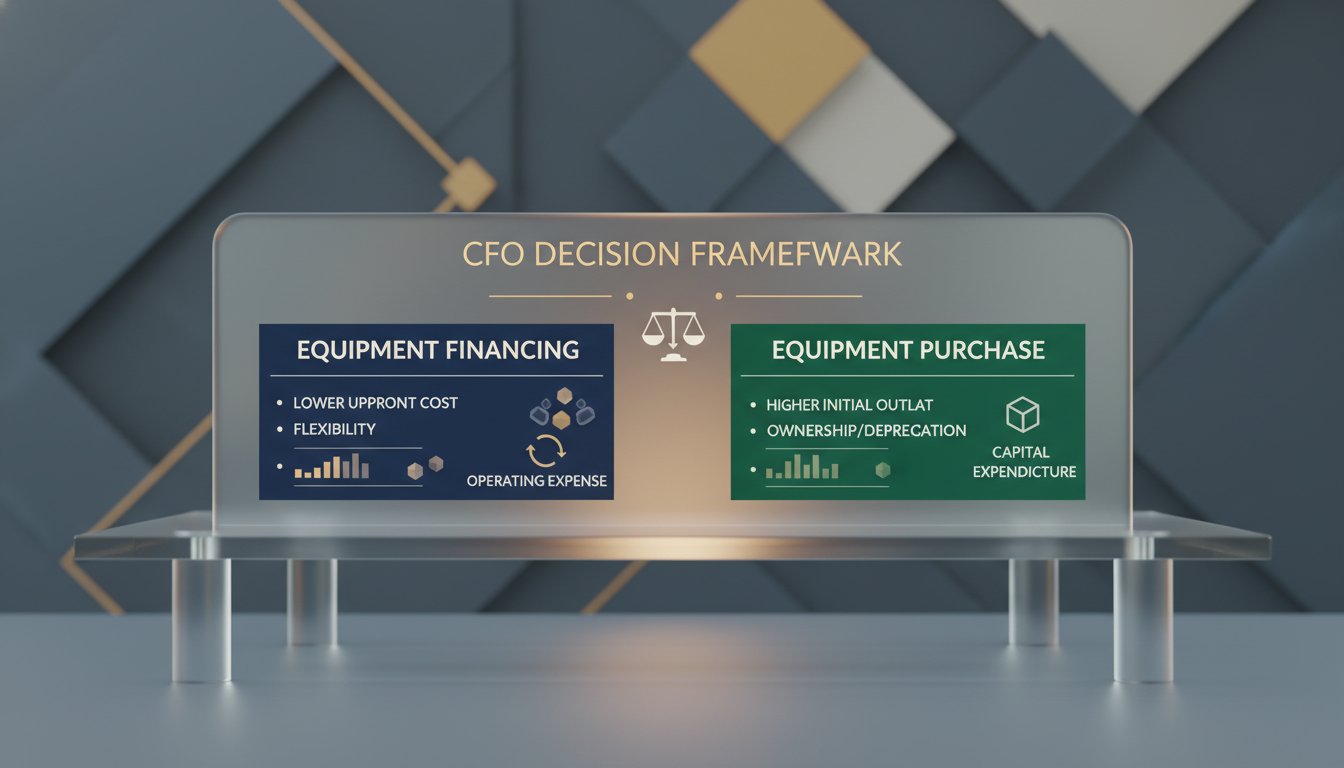
The 4-Factor Decision Matrix: Cash Flow, Tax, Balance Sheet, and Tech Lifecycle
Equipment financing vs buying small business equipment is a capital allocation choice that directly impacts cash flow, tax liability, and balance sheet health. Without a structured framework, owners default to whichever option feels safest — often the wrong one.
Equipment acquisition decisions require evaluating four distinct dimensions simultaneously. Most owners focus on only one — usually the monthly payment — and miss the bigger picture.
The four factors are:
- Cash flow impact — How does each option affect operating cash flow in the first 12 months?
- Tax efficiency — Which option produces the best after-tax cost?
- Balance sheet treatment — Does the transaction create debt or remain off-balance-sheet?
- Technology lifecycle — How long will the equipment remain productive before obsolescence?
Each factor carries different weight depending on the business's current financial position. A company with thin margins and tight working capital should prioritize cash flow impact. A profitable business with strong cash reserves might optimize for tax efficiency. A high-growth startup raising venture capital may care most about balance sheet treatment to avoid covenant violations.
The matrix works by scoring each option — lease, loan, cash purchase — across all four factors, then weighting each factor by the business's current priorities. At CurrentCFO, we use this exact framework with clients before any equipment acquisition above $25,000.
The Cash Flow Impact of Leasing vs Buying Equipment
Equipment leasing typically requires no down payment and offers fixed monthly payments, while buying often requires 10-20% down plus maintenance costs.1 This difference in upfront cash outlay is significant for most SMBs.
Consider a hypothetical manufacturing business acquiring a $100,000 CNC machine. A cash purchase drains that full amount immediately. A bank loan at a typical rate might require $20,000 down plus monthly payments of roughly $2,000 over five years. A lease might require zero down with monthly payments of $2,200.
The cash flow difference over 12 months is dramatic:
| Option | Year 1 Cash Outflow | Working Capital Remaining |
|---|---|---|
| Cash purchase | $100,000 | $0 |
| Bank loan (20% down) | $44,000 | $56,000 |
| Equipment lease (0% down) | $26,400 | $73,600 |
The 62% of businesses that finance equipment specifically to preserve cash flow are making a deliberate working capital decision.2 For a business with $200,000 in operating cash, the difference between $26,400 and $100,000 in year-one outflow could mean the difference between meeting payroll and missing it.
When Leasing Makes More Sense for Your SMB
Leasing is the better option when the equipment has a short useful life, rapid technology obsolescence, or when the business needs maximum working capital flexibility.
Three scenarios where leasing wins:
Technology-heavy equipment. Computers, servers, medical imaging machines, and manufacturing robotics typically become obsolete within three to five years. Leasing allows the business to upgrade at the end of the term rather than owning outdated equipment. For a retailer leasing point-of-sale terminals, the ability to swap hardware every three years without a capital outlay is valuable.
Seasonal or project-based businesses. A construction company that needs a crane for an 18-month project should lease, not buy. Once the project ends, the equipment becomes a liability — storage costs, maintenance, and depreciation without revenue.
Cash-constrained growth companies. A SaaS startup with $500K ARR that needs $50,000 in office equipment should lease to preserve cash for sales hiring.2 The equipment doesn't generate revenue directly; spending cash on it reduces the ability to invest in growth.
Equipment leasing typically requires no down payment and offers fixed monthly payments, making it easier to forecast.1 The trade-off is higher total cost over the equipment's life — the lessor builds profit into the lease payments.
When Buying Equipment Is the Smarter Financial Move
Buying equipment makes sense when the asset has a long useful life, the business has adequate cash reserves, and the tax benefits of ownership outweigh the financing costs.
Four scenarios where buying wins:
Long-lived assets. Real estate, heavy machinery, and vehicles that operate reliably for 10-15 years are better purchased. The total cost of leasing over that period would far exceed the purchase price.
High-utilization equipment. If the equipment will run near capacity for its entire life, buying eliminates the lessor's profit margin. A bakery using an industrial oven 16 hours a day, six days a week, should buy the oven.
Businesses with strong cash reserves. A profitable company with, for example, $500K in cash and no debt can buy equipment outright and avoid financing costs entirely. The opportunity cost of spending cash is lower than the interest cost of borrowing.
Section 179 optimization. Under 26 U.S.C. § 179, businesses can deduct up to $1,160,000 of qualifying equipment costs in 2024, phasing out dollar-for-dollar above $2,890,000.3 A business with sufficient taxable income can effectively get a government subsidy on equipment purchases by deducting the full cost in year one.
How to Calculate Total Cost of Ownership for Equipment
Total cost of ownership (TCO) captures all costs associated with equipment over its useful life, not just the purchase price or lease payments. Most owners compare monthly payments and stop there.
The TCO formula for equipment acquisition:
TCO = Acquisition cost + Financing cost + Maintenance cost + Operating cost + Disposal cost - Residual value
For a lease, acquisition cost is zero but total payments include the lessor's profit. For a purchase, acquisition cost is the purchase price plus any down payment, but the business retains residual value.
Consider a hypothetical logistics company comparing a five-year lease versus a five-year loan on a delivery truck:
| Cost Component | Lease (5 years) | Loan (5 years) |
|---|---|---|
| Monthly payment | $1,200 | $1,050 |
| Total payments | $72,000 | $63,000 |
| Down payment | $0 | $5,000 |
| Maintenance | Included | $4,000 |
| Residual value at end | $0 | $12,000 |
| Net TCO | $72,000 | $60,000 |
The loan option costs $12,000 less over five years1, but requires $5,000 upfront2 and assumes the business can manage maintenance. The lease costs more but eliminates surprise expenses.
The Role of Debt Covenants in Equipment Financing Decisions
Debt covenants are restrictions lenders place on borrowers — limits on additional debt, minimum cash balances, or maximum leverage ratios. Equipment financing decisions can trigger covenant violations if not structured properly.
A business with an existing bank loan that includes a debt-to-EBITDA covenant of 3.0x needs to consider how equipment financing affects that ratio. A capital lease (which appears as debt on the balance sheet) increases leverage. An operating lease (which stays off-balance-sheet) does not.
The SBA 7(a) loan program guarantees up to 85% of loan amounts for loans under $150,000 and is commonly used for equipment purchases.4 SBA loans typically have fewer covenant restrictions than conventional bank loans, making them attractive for businesses that already carry debt.
For a business approaching its covenant limits, leasing equipment through an operating lease preserves borrowing capacity for other needs. For a business with no existing debt, a term loan or SBA loan for equipment may be the better option.
Tax Implications: Section 179 vs Lease Payment Deductions
The tax treatment of equipment acquisition differs significantly between buying and leasing.
Buying with Section 179. Under 26 U.S.C. § 179, businesses can deduct up to $1,160,000 of qualifying equipment costs in 2024, phasing out dollar-for-dollar above $2,890,000.3 This means a business in the 24% tax bracket that buys $100,000 of equipment can reduce its tax bill by $24,000 in year one. Bonus depreciation (currently 60% for 2024)4 provides an additional deduction on top of Section 179.
Leasing. Lease payments are fully deductible as operating expenses in the year they are paid. The deduction is spread over the lease term rather than concentrated in year one. For a business with low current-year taxable income that expects higher income in future years, spreading deductions may be more valuable than accelerating them.
| Tax Strategy | Year 1 Deduction | Total Deduction Over 5 Years |
|---|---|---|
| Section 179 purchase | $100,000 | $100,000 |
| Lease (5-year term) | $26,400 | $132,000 |
The lease produces a higher total deduction because the lessor's profit is also deductible. But the Section 179 purchase delivers the deduction when it matters most — immediately.
A Simple Decision Matrix for Equipment Financing vs Buying
The following matrix applies the four-factor framework to common SMB scenarios. Score each option from 1 (worst) to 5 (best) for your specific situation.
| Scenario | Cash Purchase | Bank Loan | Equipment Lease |
|---|---|---|---|
| Strong cash reserves, long-lived asset | 5 | 3 | 1 |
| Tight cash flow, short-lived asset | 1 | 2 | 5 |
| High taxable income, need deductions | 5 | 4 | 2 |
| Existing debt covenants, need flexibility | 1 | 2 | 5 |
| Rapid technology change expected | 1 | 1 | 5 |
| Low taxable income, want to spread costs | 1 | 3 | 4 |
For a business with strong cash reserves and high taxable income buying a long-lived asset like a building, cash purchase with Section 179 on eligible components is optimal. For a cash-constrained startup buying computers, leasing preserves working capital and allows technology upgrades.
Your Next Step
Build a simple spreadsheet comparing the four-factor scores for your next equipment acquisition. List the equipment, its expected useful life, your current cash position, and your tax rate. Score each option — cash, loan, and lease — across cash flow impact, tax efficiency, balance sheet treatment, and technology lifecycle. The option with the highest weighted score is your answer.
For a free equipment acquisition model template, email [email protected].