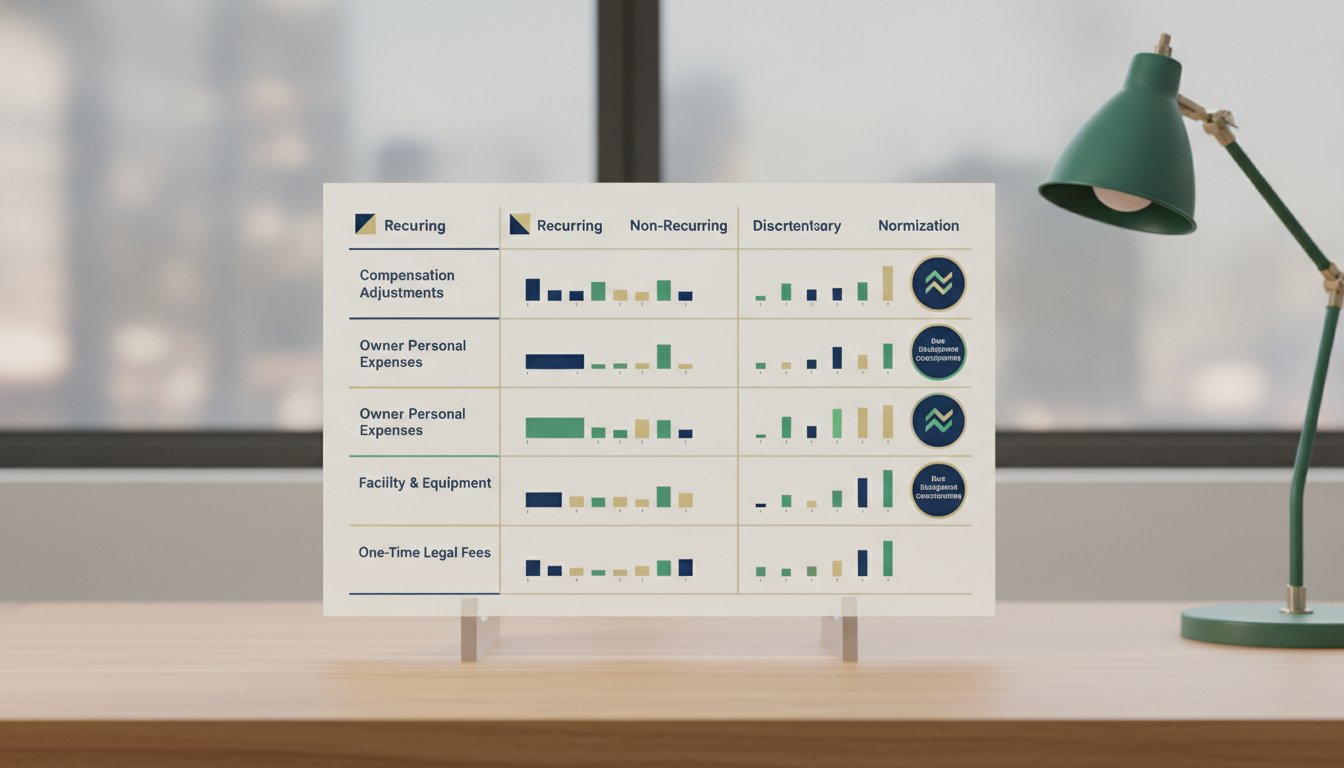
The 8 Add-Backs That Almost Always Get Cut in Diligence
EBITDA add-backs are normalization adjustments that remove non-recurring, discretionary, or personal expenses from reported earnings to reflect a company's true ongoing profitability. For small business owners preparing to sell, these adjustments help buyers see what a business would earn under new ownership — but not all ebitda add-backs survive the scrutiny of due diligence.
Treewalk identifies eight common add-backs sellers claim that do not survive diligence, including personal vehicle expenses and above-market owner compensation.1 These adjustments are routinely rejected because they lack sufficient documentation or appear to inflate earnings artificially.
The following table summarizes the eight add-backs that acquirers typically cut:
| Add-Back Type | Why It Gets Cut |
|---|---|
| Personal vehicle expenses not tied to business operations | No mileage logs or business purpose documentation |
| Above-market owner compensation without replacement salary benchmark | No comparable market data from Robert Half or industry surveys |
| One-time consulting fees paid to owner's spouse | No written contract or deliverables on file |
| Personal travel and entertainment costs | No client meeting notes or itineraries |
| Charitable donations made in company's name | Treated as owner's personal philanthropy |
| Non-recurring legal fees from lawsuit settlement | May recur or signal ongoing risk |
| Owner's personal health insurance premiums | Cannot separate from group plan if other employees exist |
| Below-market rent paid to related-party landlord | Excess rent is add-back, not market-rate portion |
For a hypothetical SMB with $4 million in revenue, an owner claiming $150,000 in personal vehicle expenses would need to show mileage logs, business purpose documentation, and IRS-compliant records.2 Without these, the add-back is rejected and adjusted EBITDA drops by the full amount.
What Counts as an EBITDA Add-Back in an SMB Deal
An EBITDA add-back is any expense added back to net income when calculating adjusted EBITDA, representing costs that a new owner would not incur. These adjustments fall into three categories: non-recurring expenses, discretionary owner perks, and non-operating items.
Non-recurring expenses include one-time legal fees, moving costs, or equipment purchases that will not repeat under new ownership. Discretionary owner perks cover personal vehicles, family travel, and above-market compensation. Non-operating items include interest income, gains on asset sales, or expenses from discontinued product lines.
PKF O'Connor Davies states that sellers must present adjusted EBITDA with evidence-based normalization adjustments to build trust with buyers.3 A typical SMB with $5 million in revenue might claim $200,000 in add-backs, but only $120,000 of those will survive if documentation is weak. The gap between reported earnings and normalized EBITDA often exceeds 20–30% of reported earnings, requiring a reclassification approach recommended by Blackland Advisors.4
The Three Tests Every Add-Back Must Pass
Every add-back must pass three tests to survive due diligence: recurrence, necessity, and documentation. The recurrence test asks whether the expense will repeat under new ownership. If a buyer would incur the same cost, it is not an add-back.
The necessity test examines whether the expense was essential to generating revenue. Personal vehicle costs that were not used for client meetings fail this test. The documentation test requires written evidence — receipts, contracts, invoices, and bank statements — that prove the expense occurred and was business-related.
Consider a hypothetical SaaS company with $500K ARR that claimed $50,000 in owner travel expenses. The buyer rejected $35,000 because the owner could not produce itineraries or client meeting notes. Only $15,000 passed all three tests. Sellers who pre-audit their add-backs against these three tests typically retain 70–80% of claimed adjustments. Understanding which ebitda add-backs for small business sales are defensible requires applying these tests systematically before a buyer asks.
Owner Perks and Personal Expenses That Survive Scrutiny
Owner perks that survive scrutiny share one characteristic: they are clearly documented as business expenses with a legitimate operational purpose. A company vehicle used primarily for client visits and only incidentally for personal use can be adjusted proportionally, provided mileage logs exist.
Personal expenses that pass due diligence include above-market health insurance premiums if the owner is the only employee covered. Retirement plan contributions that exceed typical SMB benchmarks also qualify. Business development costs like industry conferences that included family travel — but only the incremental cost of the family member's attendance is added back.
Windes outlines five ways to increase EBITDA before a sale, including eliminating discretionary owner perks and non-recurring consulting fees.5 For a hypothetical SMB with $3 million in revenue, eliminating $60,000 in owner perks and $40,000 in non-recurring consulting fees would increase adjusted EBITDA by $100,000, potentially adding $500,000 to the sale price at a 5x multiple.
One-Time Expenses vs Recurring Costs in Due Diligence
One-time expenses are the most defensible add-backs because they are inherently non-recurring. Examples include lawsuit settlements, equipment purchases, office relocation costs, and severance payments. Buyers accept these adjustments readily when the expense is clearly documented and will not repeat.
Recurring costs are harder to add back because they suggest ongoing operational expenses. A monthly software subscription, annual insurance premium, or quarterly marketing retainer are recurring by nature. However, if the owner can show that a recurring cost was above market rate due to a personal relationship, the excess portion may qualify as an add-back.
For a hypothetical retailer with $6 million in revenue, a one-time $75,000 legal settlement is a clean add-back. But a $12,000 annual software subscription that the owner's cousin provides at 50% above market requires a market-rate benchmark to justify the add-back. Buyers scrutinize recurring cost adjustments more heavily because they signal potential earnings normalization issues.
Market Salary Adjustments and the Reasonable Compensation Rule
Market salary adjustments allow sellers to add back the difference between the owner's actual compensation and what a replacement manager would earn. This is one of the largest add-backs in SMB deals, but it requires a defensible benchmark.
The reasonable compensation rule requires sellers to show that the owner's salary exceeded market rates for a comparable role in the same industry and geography. Sources for benchmarks include the Robert Half Salary Guide, industry trade association surveys, and compensation data from comparable SMBs. A hypothetical owner paying themselves $300,000 in a market where a general manager earns $150,000 could add back $150,000 — but only with written benchmark evidence.
Buyers reject market salary adjustments when the owner's compensation was below market, because that suggests the business relied on underpaid labor. For example, if the owner paid themselves $80,000 when market rate is $150,000, the buyer may argue that a replacement manager would cost more, reducing adjusted EBITDA. Sellers should adjust compensation to market rate at least 12–18 months before listing.
Documenting Add-Backs Before the Buyer Asks
Documentation is the single factor that determines whether an add-back survives due diligence. Sellers should create an add-back schedule that lists each adjustment, the dollar amount, the supporting document type, and the rationale for the add-back.
The documentation package should include: bank statements showing the expense cleared, invoices or receipts from the vendor, contracts or agreements that establish the expense's purpose, mileage logs for vehicle expenses, and market benchmarks for compensation adjustments. Each document should be organized in a digital data room with clear file names and folder structures.
Working with a fractional CFO like the team at CurrentCFO helps SMB owners build this documentation package before listing. A seller who pre-documents $250,000 in add-backs with receipts, contracts, and benchmarks will typically retain 85% of those adjustments. A seller who waits until the buyer's request will lose roughly half of claimed add-backs due to missing or incomplete records. The MetLife & U.S. Chamber Small Business Index fell to 68.4 in Q4 2025 from 72.0 the prior quarter, indicating tightening conditions that increase scrutiny on add-backs during due diligence.6
Red Flags That Trigger a Full Forensic Review
Certain patterns trigger a full forensic review by buyers and their accountants. The most common red flag is add-backs exceeding 30% of reported EBITDA, which signals potential earnings manipulation. Another red flag is add-backs that increase year over year, suggesting the business cannot sustain profitability without adjustments.
Buyers also flag add-backs that lack third-party documentation, such as cash payments to vendors or family members. Related-party transactions without arm's-length pricing are another trigger. For example, if the owner's spouse receives $100,000 in consulting fees without a written contract or deliverables, the buyer will likely reject the add-back and question the entire financial presentation.
A hypothetical SMB with $2 million in EBITDA claiming $800,000 in add-backs — 40% of EBITDA — would face a forensic review. The buyer would hire an outside accountant to audit every adjustment, delaying the deal by 4–6 weeks and potentially reducing the purchase price by 15–20%.1 Sellers who keep add-backs under a reasonable threshold of EBITDA and provide full documentation avoid this scrutiny.
Your Next Step
Review your last 12 months of financial statements and identify every expense that qualifies as non-recurring, discretionary, or personal. Create a simple spreadsheet listing each add-back, the dollar amount, the supporting document you have, and the rationale. If any add-back lacks documentation, gather it now — waiting until a buyer asks will cost you credibility and deal value. For a confidential review of your add-back schedule before you list your business, email [email protected].