When Your Loan Agreement Triggers a Covenant Breach
Debt covenant risk small business owners face is the consequence of failing to meet specific financial thresholds in a loan agreement. A loan agreement is a legal contract, and every contract contains promises. For small business owners, the most consequential promises are often the financial covenants — specific thresholds the business must maintain. When those thresholds are breached, the lender gains the right to demand immediate repayment, accelerate interest rates, or enforce personal guarantees.
A covenant breach occurs when a borrower fails to maintain a financial ratio or reporting requirement specified in the loan agreement. The trigger is rarely a single missed payment. More often, it is a gradual deterioration in a metric like debt-to-equity or fixed charge coverage that crosses a pre-agreed floor.1
Lenders typically send a formal notice of default within 30 to 60 days after a covenant violation appears in a quarterly compliance certificate. The notice will cite the specific clause breached, the required threshold, and the actual reported figure. It will also reference the lender's remedies under the loan agreement, which may include accelerating the outstanding balance, increasing the interest rate by a default margin, or demanding additional collateral.
The critical distinction for SMB owners is between a technical default and a payment default. A technical default means the borrower violated a covenant but continues to make payments on time. A payment default means the borrower has stopped paying. Lenders treat these very differently. Technical defaults are often resolvable through a waiver or amendment. Payment defaults trigger collection proceedings and personal guarantee enforcement.2
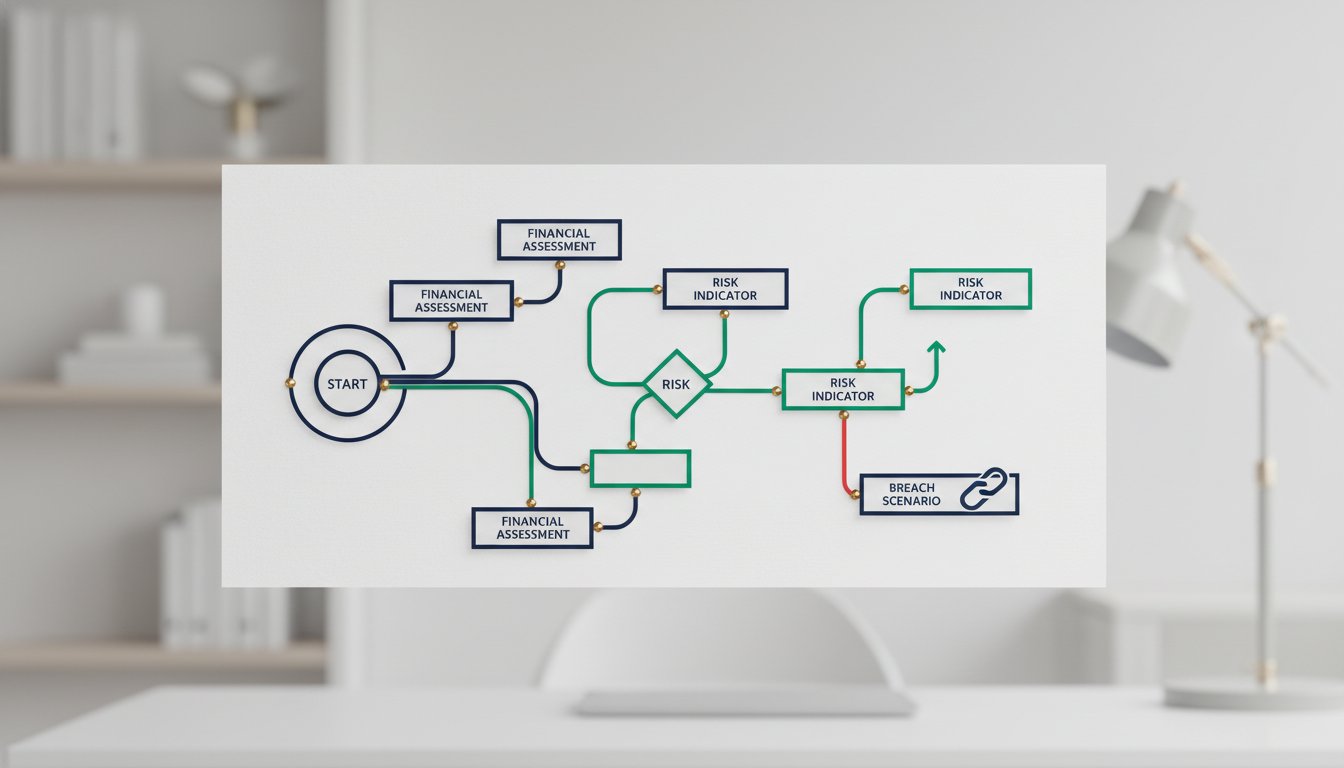
Mapping the Decision Tree from Breach Notice to Resolution
When a breach notice arrives, the owner faces a sequence of decisions. The first fork is whether the breach is curable within the grace period specified in the loan agreement. Most commercial loan documents include a 10-to-30-day cure period for financial covenants, though the terms vary by lender and loan type.
If the breach is curable — for example, the business can inject equity or reduce debt before the cure deadline — the owner should act immediately and document every step. Lenders require evidence of corrective action, not just a verbal promise.3 A wire confirmation, a signed subordination agreement from a shareholder, or a receivable collection log all serve as proof.
If the breach is not curable within the cure period, the owner moves to the second fork: negotiate a waiver or begin restructuring discussions. The decision depends on whether the breach is a one-time event or a structural problem. A one-time event — a large customer paying late, an unexpected equipment repair — supports a waiver request. A structural problem — declining revenue, shrinking margins, rising debt — requires a loan modification or restructuring.
The third fork is leverage assessment. The lender's willingness to negotiate depends on the borrower's overall relationship value, collateral coverage, and whether the business has alternative financing options. A borrower with strong collateral coverage and multiple lender options has more negotiating room than one with thin equity and no alternatives.
Three Common Debt Covenant Ratios That Trip Up Small Businesses
The three most common financial covenants in SMB loan agreements are the debt-to-equity ratio, the fixed charge coverage ratio, and the minimum liquidity requirement.
| Covenant | Typical Threshold | What It Measures | Common Breach Scenario |
|---|---|---|---|
| Debt-to-Equity | 2.0x to 3.0x | Total liabilities divided by tangible net worth | Owner takes a large distribution or incurs new debt without proportional equity growth |
| Fixed Charge Coverage | 1.15x to 1.35x | EBITDA minus capex and cash taxes, divided by total debt service plus lease payments | Revenue dips while fixed lease and loan payments remain constant |
| Minimum Liquidity | $100K to $500K or 60 days of operating expenses | Cash plus undrawn revolver availability | Seasonal cash flow cycle coincides with a large accounts payable due date |
The debt-to-equity ratio is the most frequently violated covenant among small firms because it is sensitive to owner behavior. A single large dividend or shareholder loan repayment can push the ratio above the threshold.1
The fixed charge coverage ratio captures the business's ability to service all fixed obligations from operating cash flow. It is more restrictive than the interest coverage ratio because it includes principal payments and lease obligations. A ratio below 1.0x means the business is not generating enough cash to cover its fixed charges.
Minimum liquidity requirements have become more common since 2020, especially for businesses with 10 to 50 employees. Lenders now require monthly or quarterly liquidity reporting and set thresholds based on the borrower's operating expense profile.4
How to Calculate Your Current Headroom Before the Next Reporting Date
Headroom is the difference between the actual covenant ratio and the required threshold, expressed as a percentage or dollar amount. Calculating headroom before the next reporting date allows the owner to take corrective action before a breach occurs.
For the debt-to-equity ratio, headroom equals the maximum allowable debt minus actual debt, divided by maximum allowable debt. Suppose the loan agreement requires debt-to-equity below 2.5x and the business has $1 million in tangible net worth. The maximum allowable debt is $2.5 million1. If actual debt is $2 million, headroom is 20 percent2.
For the fixed charge coverage ratio, headroom equals the actual ratio minus the required ratio, divided by the required ratio. If the required ratio is 1.2x and the actual ratio is 1.4x, headroom is approximately 17 percent.
The most practical approach is to build a rolling 13-week cash flow forecast that projects each covenant ratio weekly. This forecast should include expected receivables collections, payables timing, payroll dates, and any planned debt payments. A 13-week window is long enough to spot developing problems and short enough to be accurate.
Owners should flag any week where projected headroom falls below 10 percent. At that level, a single delayed customer payment or unexpected expense can trigger a breach. The appropriate response is to identify which lever — reducing expenses, accelerating collections, or injecting equity — can restore headroom before the next reporting date.
Negotiating a Waiver Versus Restructuring the Loan Terms
A waiver is a one-time agreement from the lender to forgive a specific covenant breach without changing the underlying loan terms. A restructuring modifies the loan agreement permanently — changing covenants, interest rates, maturity dates, or payment schedules.
| Factor | Waiver | Restructuring |
|---|---|---|
| Duration | Single reporting period | Remaining loan term |
| Lender cost | Low (legal fee only) | High (documentation, credit committee) |
| Borrower cost | Waiver fee (typically 0.25% to 1.0% of loan balance) | Amendment fee plus potential interest rate increase |
| Credit impact | None if cured within waiver period | Reported as troubled debt restructuring if principal is modified |
| Best use case | One-time, explainable breach | Structural or recurring breach |
A waiver request should include three elements: an explanation of the cause of the breach, evidence that the cause is temporary, and a specific plan to return to compliance. The plan should include a timeline and measurable milestones. Lenders are more likely to grant a waiver when the borrower demonstrates a clear path back to compliance.3
Restructuring becomes necessary when the breach reflects a permanent change in the business's financial profile. A restructuring may involve lowering the debt-to-equity covenant to 3.5x from 2.5x, extending the amortization schedule, or converting a portion of the debt to a term loan with interest-only payments.
The borrower's negotiating leverage in a restructuring depends on collateral coverage and alternative financing options. A business with unencumbered assets or a competing term sheet has significantly more leverage than one with fully pledged collateral and no alternatives.
What Fractional CFOs Look for in a Covenant Risk Assessment
A covenant risk assessment examines three dimensions: the borrower's current compliance status, the trajectory of each covenant ratio, and the borrower's capacity to respond to a breach. At a firm like CurrentCFO, this assessment is often the first deliverable when a founder suspects they are approaching a covenant threshold.
The compliance status review starts with the most recent compliance certificate. The reviewer compares each reported ratio to the required threshold and calculates the headroom. They also check whether the certificate was submitted on time — late submissions are themselves a covenant violation in many loan agreements.
The trajectory analysis examines the trend of each ratio over the past four to eight quarters. A ratio that is declining but still above the threshold is more concerning than a ratio that is stable but close to the threshold. The rate of decline matters. A debt-to-equity ratio that moved from 1.8x to 2.2x over four quarters signals a structural shift, not a seasonal fluctuation.
The response capacity assessment evaluates the borrower's ability to cure a breach without external help. This includes available cash reserves, undrawn revolver capacity, unencumbered assets that could be pledged as additional collateral, and the owner's personal liquidity for an equity injection.
A comprehensive assessment also reviews the loan agreement itself for hidden tripwires. Some agreements include cross-default provisions that tie the business loan to the owner's personal guarantees or other entity debt. A breach on one loan can trigger defaults on multiple facilities simultaneously.
Building a Covenant Monitoring Dashboard on a Small Business Budget
A covenant monitoring dashboard does not require expensive software. A well-structured spreadsheet updated weekly provides sufficient visibility for most SMBs with one or two loan facilities.
The dashboard should include four components: a data input section for the three key financial statements, a ratio calculation section that automatically computes each covenant, a headroom tracker that shows current and projected headroom for each ratio, and an alert section that flags any ratio approaching its threshold.
| Dashboard Component | Data Source | Update Frequency |
|---|---|---|
| Cash balance | Bank feed or manual entry | Weekly |
| Accounts receivable aging | Accounting software report | Weekly |
| Accounts payable aging | Accounting software report | Weekly |
| Debt balance | Loan statement | Monthly |
| Revenue and expenses | P&L statement | Monthly |
| Covenant ratio calculations | Dashboard formulas | Weekly |
The alert section should use conditional formatting to color-code each ratio. Green means headroom above 20 percent. Yellow means headroom between 10 and 20 percent. Red means headroom below 10 percent or a current breach.
For businesses with multiple loan facilities, the dashboard should also track cross-default risk. A separate tab should list each loan, its covenants, its current status, and any cross-default language in the agreement.
The total time investment to maintain this dashboard is approximately 30 minutes per week. The cost is zero beyond the bookkeeper's or owner's time. For businesses that prefer automation, tools like Fathom, LivePlan, or a custom Google Sheets setup with API connections to QuickBooks or Xero can reduce the weekly update time to 10 minutes.
Your Next Step
Open your most recent loan agreement and locate the financial covenants section. Write down each covenant, its required threshold, and the cure period. Then pull your most recent compliance certificate and calculate your current headroom for each ratio. If any ratio shows headroom below 10 percent, draft a one-page corrective action plan before your next reporting date. For a free covenant risk assessment template and a 13-week cash flow forecast spreadsheet, email [email protected].