Why Most SMB Owners Don't Know Their Most Profitable Client
Customer profitability analysis small business is a financial method that assigns revenue and direct costs to individual customers to determine which clients generate real profit and which drain resources. Without this analysis, many SMB owners see healthy top-line revenue while wondering why their bank account tells a different story.
The typical service business owner tracks total revenue and total expenses but stops there. A marketing agency might know it earned $1.2 million last year and spent $900,000, leaving a 25% overall margin. What it cannot answer is which of its 30 clients contributed that margin and which barely broke even.
The gap exists because standard accounting software — QuickBooks, Xero, FreshBooks — organizes data by category, not by customer. Rent, software subscriptions, and payroll appear as lump sums. No line item says "this client consumed 40 hours of account management time and generated, for example, $8,000 in margin."
Small businesses employing 45.9% of all US employees often operate without dedicated financial analysis tools.1 Spreadsheets remain the default, but most owners build revenue-only client lists and never attach costs. The result: pricing decisions based on gut feel rather than data.
What Customer Profitability Analysis Actually Tells You
Customer profitability analysis small business answers three specific questions. It reveals which clients generate margin above your target rate, which clients cost more to serve than the revenue they bring, and what would happen to total profit if you dropped the bottom 20% of clients.2
Consider a hypothetical design studio with 15 retainer clients. Total revenue is $900,000, total costs are $675,000, and the blended margin is 25%. CPA might reveal that three clients contribute 60% of total profit, five clients break even, and two clients actually lose money once you factor in the hours spent on revisions, meetings, and scope creep.
The insight changes strategy. The studio can raise prices for the break-even clients, restructure service delivery for the loss-making ones, or replace them entirely.
How to Build a Customer Profitability Spreadsheet From Scratch
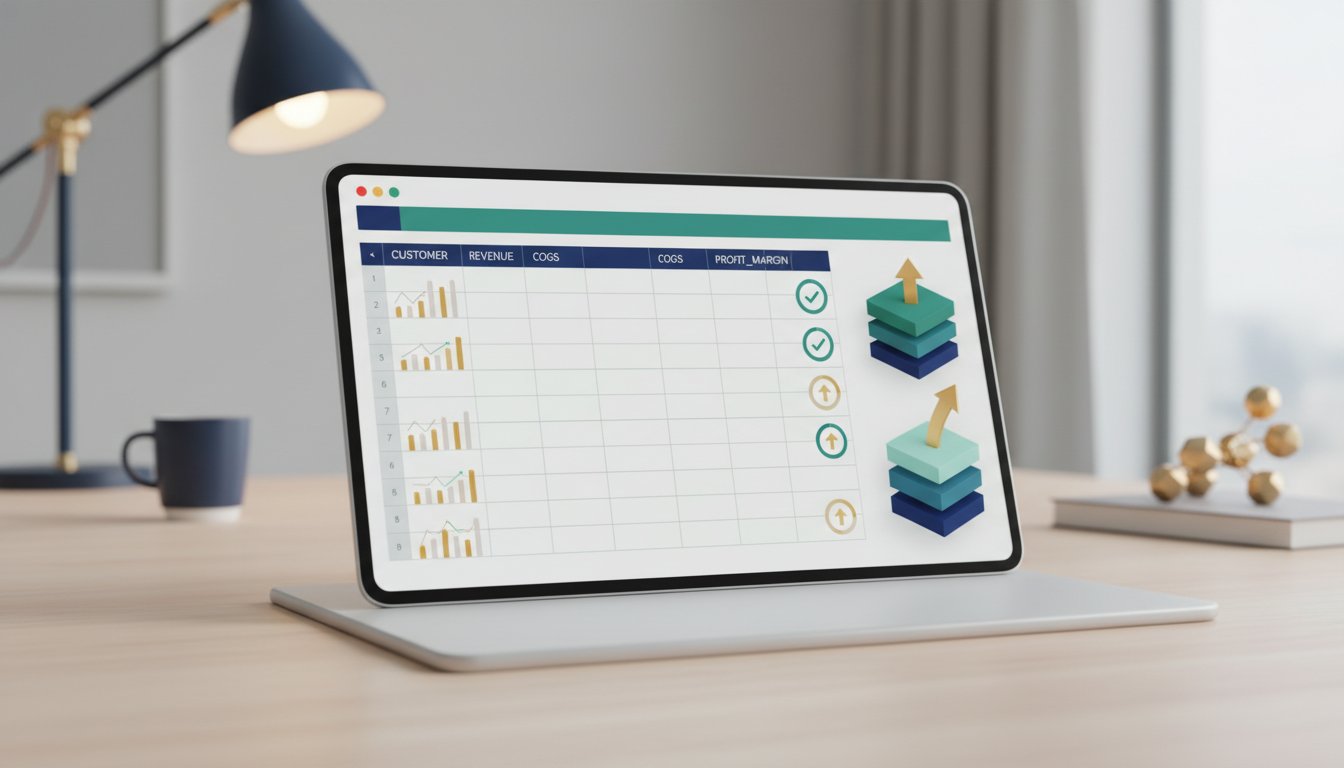
Building a customer P&L template requires four columns: client name, revenue, direct costs, and contribution margin. The calculation logic follows a standard framework used by agencies and professional service firms.3
Start with a row for each client. Enter the total revenue that client generated over a set period — monthly, quarterly, or annually. Then list every cost that exists because that client exists:
| Cost Category | Examples | Allocation Method |
|---|---|---|
| Direct labor | Hours logged to client work | Multiply hours by blended hourly cost |
| Subcontractors | Freelancers, agencies, specialists | Actual invoice amounts |
| Software | Project management tools, design licenses | Per-seat cost or usage allocation |
| Travel | Client meetings, site visits | Actual expenses |
| Materials | Print production, physical goods | Actual cost of goods sold |
For indirect costs like rent and general administration, apply a simple overhead rate. Divide total overhead by total billable hours, then assign a portion to each client based on hours worked.
The formula for each client row is: Revenue minus Direct Costs equals Contribution Margin. Contribution Margin divided by Revenue equals Contribution Margin Percentage.
A typical service business margin per client should fall between 30% and 50% after direct costs. Anything below 20% warrants a closer look at pricing or delivery efficiency.
The Three Metrics That Reveal Your Best Customers
Three metrics from your project profitability spreadsheet will tell you which clients to keep, which to grow, and which to reconsider.
Contribution Margin Percentage. This is the most direct measure. Suppose a client paying $10,000 per month costs $4,000 to serve — that yields a 60% contribution margin. Another client paying $8,000 who costs $6,000 yields only 25% — a hypothetical example that shows how quickly margins shrink when costs are high. The first client is highly profitable. The second may not be worth retaining at current pricing.
Revenue per Hour. Divide total client revenue by total hours spent. Suppose Client A generates $250 per hour and Client B generates $100 per hour — the difference reveals which engagement model works better. This metric helps set minimum pricing for new projects.
Profit Concentration. Calculate what percentage of total profit comes from your top clients. If one client represents more than 40% of total profit, the business carries significant concentration risk. Losing that client would cut profit by nearly half. Diversification becomes a strategic priority.
Common Mistakes That Skew Your Profitability Numbers
The most frequent error is excluding owner or partner time from direct costs. Many SMB owners treat their own hours as free. If a founder spends 20 hours per week on a single client account and does not charge those hours to the client's cost line, that client appears more profitable than it actually is. The correct approach is to assign a market-rate hourly cost to all time, including owner time.
Another mistake is using revenue instead of cash collections. A client who pays net-90 and consistently stretches to net-120 generates a different cash flow reality than one who pays within terms. Calculate profitability on cash received, not invoices sent.
A third error involves overhead allocation. Spreading overhead evenly across all clients ignores that some clients require more management attention, more complex reporting, or more frequent communication. A simple overhead rate works for a first pass, but refining allocation by actual usage improves accuracy.
Using Profitability Data to Set Pricing and Service Tiers
Once you know each client's contribution margin, pricing decisions become data-driven rather than reactive.
For clients with contribution margins below 20%, consider a price increase tied to specific value delivered. Present the increase alongside a summary of work completed and results achieved. Many SMB owners find that clients who receive high-touch service are willing to pay more when the value is clearly communicated.
For clients with margins above 50%, evaluate whether the engagement is properly scoped. A margin that high might indicate the client is paying for services they are not receiving, which creates retention risk when they eventually notice.
Service tiering becomes straightforward with profitability data. Create three tiers:
| Tier | Margin Target | Service Level | Typical Client Profile |
|---|---|---|---|
| Premium | 40-50% | Dedicated team, weekly strategy calls | High-revenue, low-touch clients |
| Standard | 25-35% | Pooled resources, monthly reviews | Mid-revenue clients |
| Essentials | 15-20% | Automated delivery, quarterly check-ins | Low-revenue, high-volume clients |
When to Run Customer Profitability Analysis for Maximum Impact
Run the analysis quarterly for active clients and annually for a full portfolio review. Quarterly cadence catches margin erosion early — a client who gradually adds scope without a price adjustment will show declining contribution margin over two or three cycles.
Run it immediately before any pricing change. If you plan to raise rates across the board, profitability data tells you which clients can absorb the increase and which will likely churn.
Run it when evaluating whether to take on a new client. Compare the prospective client's expected revenue and estimated service cost against your current client profitability distribution. If the new client falls below your median contribution margin, negotiate a higher rate or a narrower scope before signing.
Your Next Step
Open a spreadsheet and list your top ten clients by revenue. For each client, enter the total revenue received in the last quarter. Then list every direct cost you incurred because that client exists — hours logged, subcontractor invoices, software seats, travel expenses. Subtract costs from revenue and divide by revenue to get each client's contribution margin percentage. If any client falls below 20%, that is your first candidate for a pricing conversation or a service restructuring. For questions about building your customer profitability analysis small business framework, contact [email protected].
Footnotes
-
Kaplan Collection Agency, "54 Small Business Statistics for 2025," https://www.kaplancollectionagency.com/business-advice/54-small-business-statistics-for-2025 ↩
-
Academia.edu, "The implementation of customer profitability analysis: A case study," https://www.academia.edu/9467444/The_implementation_of_customer_profitability_analysis_A_case_study ↩
-
Parakeeto, "How to Calculate Profitability for Your Marketing Agency Clients and Projects: The Definitive Guide," https://www.parakeeto.com/blog/how-to-calculate-profitability-for-your-marketing-agency-clients-and-projects-the-definitive-guide ↩