The $31M Revenue Threshold: Why Your Service SMB Still Has a Choice
The choice between cash basis and accrual accounting is one of the most consequential financial decisions a service business owner makes, yet most contractors and agencies pick cash basis simply because it is easier. Cash vs accrual revenue recognition small business is the difference between tracking when money hits your bank account versus when you actually earn it — and that timing gap determines your tax liability, your ability to raise capital, and whether your financial statements reflect reality.
Small businesses with average annual gross receipts under $31 million can choose cash or accrual for tax purposes, per IRS Rev. Proc. 2025-9.1 That threshold covers virtually every service SMB with 1–50 employees.
The IRS does not force a method change until a business crosses that revenue line, which means most owners have genuine flexibility. The $31M figure is not static — the IRS adjusts it periodically for inflation, and businesses must calculate their average gross receipts over the prior three tax years.
For example, a contractor hitting $28M in year one and $34M in year two still qualifies if the three-year average stays under the threshold. What surprises many owners is that the choice is not permanent.
A business can switch from cash to accrual without IRS approval as long as it files Form 3115 and meets the automatic consent provisions. The reverse switch — accrual back to cash — is harder and requires demonstrating that gross receipts have fallen below the threshold.
When Your Customer Pays Matters More Than When You Invoice
Service businesses operate on a fundamental mismatch: work happens in one period, payment arrives in another. The cash vs accrual revenue recognition small business decision hinges on this timing gap.
A web agency that builds a $50,000 site over three months may invoice at project milestones, but the customer might pay net-60. Under cash basis, that agency recognizes zero revenue until the check clears. This timing gap creates a distorted picture.
The agency's P&L shows losses during the build months and a spike in the payment month. A lender reviewing those statements sees erratic revenue and may decline a credit line, even though the business is profitable. For a service business with variable contract revenue, the timing of recognition is the single largest driver of year-end tax exposure.
Consider a contractor completing four projects in November and December — each worth roughly $80,000 — but not collecting until January. That business will show a loss for the current year and a windfall the next. That deferral can be strategic, but it can also create a tax liability cliff when multiple large payments land in a single tax year.
The Core Difference Between Cash Basis and Accrual Accounting
Cash basis records revenue when cash is received and expenses when cash is paid. Accrual accounting records revenue when it is earned — when the performance obligation is satisfied — and expenses when they are incurred, regardless of cash movement.
| Aspect | Cash Basis | Accrual Accounting |
|---|---|---|
| Revenue timing | When cash arrives | When work is performed |
| Expense timing | When cash leaves | When obligation arises |
| Tax liability | Deferrable to cash receipt year | Matches economic activity |
| Lender readiness | Low — erratic P&L | High — consistent revenue |
| GAAP compliance | No (except very small entities) | Yes |
ASC 606 requires service businesses to recognize revenue over time as performance obligations are satisfied, not when cash is received.2 A marketing agency on a six-month retainer must recognize one-sixth of the revenue each month under accrual, even if the client pays quarterly.
The practical effect: accrual accounting smooths revenue recognition across contract periods. Cash basis creates spikes and valleys that make financial planning guesswork.
How Revenue Recognition Rules Affect Your Tax Liability
The IRS taxes income, not cash flow. A service business using cash basis can legally defer revenue by delaying invoices or structuring payment terms to push receipts into the next tax year. This is a common strategy, but it carries hidden risks.
Consider a hypothetical IT consulting firm that signs a $120,000 annual contract in October. Under cash basis, if the client pays the full amount in December, the entire amount is taxable in that year. If the client pays monthly starting in January, the revenue spreads across two tax years. The owner controls the timing — but only if the client agrees to the payment schedule.
The IRS trust fund recovery penalty under Section 6672 can hold business owners personally liable for unpaid payroll taxes even if using cash basis.3 Revenue recognition method does not shield owners from payroll tax obligations. A cash-basis business that collects client payments but delays remitting payroll taxes faces personal liability regardless of accounting method.
Service businesses using cash basis often defer revenue recognition on multi-month projects, creating a tax liability cliff when cash is received in a single year.4 A construction contractor finishing three projects in December but not collecting until January defers tax on that revenue by a full year — but if one client pays early, the entire amount lands in the current year, potentially pushing the owner into a higher bracket.
Building a Decision Tree for Your Service Business
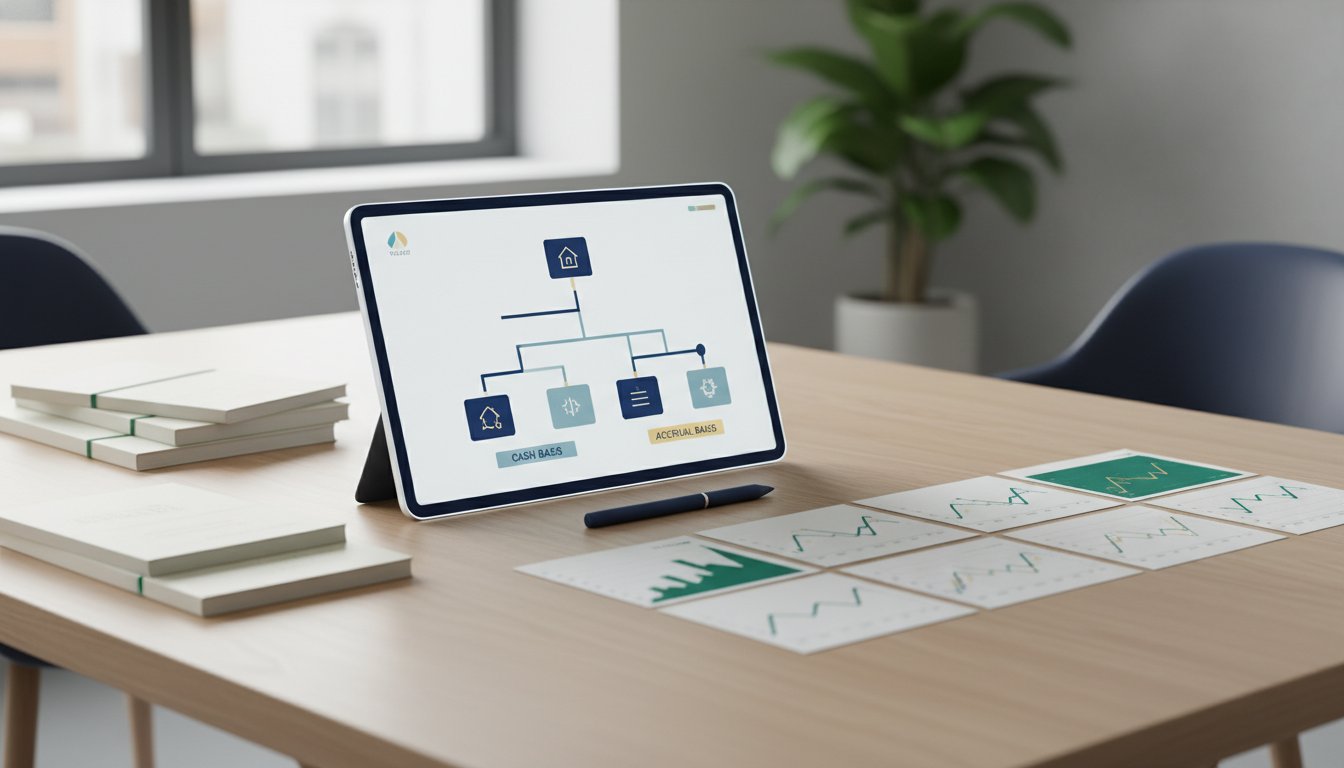
The decision between cash and accrual depends on three variables: contract duration, payment timing, and financing needs. Cash vs accrual revenue recognition small business tradeoffs become clear when you map these variables against your specific contract structure.
| Variable | Cash Basis Favored | Accrual Favored |
|---|---|---|
| Contract length | Under 3 months | Over 3 months |
| Payment terms | Net-30 or faster | Net-60 or longer |
| Financing need | None in next 12 months | Loan or line of credit |
| Revenue predictability | Low, variable | High, recurring |
| Tax bracket concern | Want to defer income | Want to smooth income |
Start with contract duration. A landscaping business with one-week projects and net-15 payment terms sees minimal difference between cash and accrual. Revenue recognition timing is tight enough that both methods produce similar results.
A software development agency with six-month projects and milestone billing faces a different reality. Under cash basis, a $200,000 project started in November may show zero revenue until the following year. Under accrual, the agency recognizes revenue each month as work progresses.
Next, assess financing needs. The SBA 7(a) loan program requires accrual-based financial statements for loans over $350,000, forcing cash-basis SMBs to convert for financing.5 A business planning to apply for an SBA loan within 12 months should switch to accrual now rather than scrambling to reconstruct financials later.
Finally, evaluate tax exposure. A cash-basis business with concentrated revenue in Q4 faces a higher effective tax rate than one that smooths income across the year. Accrual accounting distributes revenue recognition across contract periods, reducing the risk of bracket creep.
Why Accrual Accounting Wins for Growth-Stage Startups
Growth-stage service businesses — those adding headcount, opening new service lines, or seeking outside capital — benefit disproportionately from accrual accounting. The reason is not tax optimization but financial credibility.
Investors and lenders evaluate businesses on consistent revenue trends, not cash timing. A startup showing, for example, $300K in revenue one quarter and $900K the next looks volatile, even if the underlying business is stable. Accrual accounting eliminates that noise by matching revenue to the period work was performed.
82% of small businesses fail due to cash flow mismanagement, often from misaligned revenue recognition timing.6 Accrual accounting does not fix cash flow problems, but it surfaces them earlier. A business recognizing revenue on a $100,000 project over five months sees the revenue line grow each month.
If the client has not paid by month three, the gap between recognized revenue and cash on hand becomes visible — and actionable — months before a cash-basis business would notice. For startups pursuing venture debt or revenue-based financing, accrual financials are non-negotiable. Lenders require GAAP-compliant statements, and cash-basis conversions introduce audit risk and delay.
When Cash Basis Accounting Is the Smarter Choice
Cash basis remains the right choice for service businesses with short project cycles, consistent payment terms, and no near-term financing needs. A cleaning service with weekly contracts and net-7 payment terms gains nothing from accrual complexity.
The administrative burden of accrual accounting is real. A cash-basis business reconciles its bank account and books revenue when deposits post. An accrual business tracks unbilled receivables, deferred revenue, and contract progress percentages. For a solo operator or a small team without a dedicated finance function, that overhead can outweigh the benefits.
Cash basis also offers legitimate tax deferral opportunities. A business expecting a lower tax rate next year — due to planned investments, hiring, or a change in entity structure — can structure payment terms to push revenue into the lower-rate period. The IRS permits this as long as the payment terms are genuine and not a sham arrangement.
The key is intentionality. Cash basis works well when the owner understands the timing implications and actively manages payment schedules. It fails when the owner treats cash basis as "set it and forget it" and discovers the tax consequences only at filing time.
Mixing Both Methods Without Breaking GAAP
A service business can use cash basis for tax reporting and accrual basis for internal management and lender reporting. This hybrid approach is common among SMBs that want the tax simplicity of cash basis and the financial clarity of accrual.
The mechanics are straightforward. The business maintains accrual books throughout the year — recognizing revenue as work is performed, tracking receivables and payables, and producing GAAP-compliant financial statements. At year-end, the accountant makes adjusting entries to convert the accrual results to cash basis for the tax return.
This dual-method approach requires disciplined bookkeeping but avoids the tax complexity of full accrual reporting. The business gets accurate monthly financials for decision-making while retaining cash-basis tax treatment.
The IRS permits this hybrid structure under the books-and-records method, as long as the tax return ultimately reflects cash-basis income. The key is consistent application — switching between methods year to year triggers IRS scrutiny and requires Form 3115 filing.
Your Next Step
Review your three largest contracts from the past 12 months. For each contract, calculate the difference between when revenue was recognized on your tax return and when the work was actually performed.
If the gap exceeds 90 days for any contract, run a pro forma accrual calculation to see how switching methods would affect your taxable income. Email the results to [email protected] for a method review. At CurrentCFO, we help service businesses evaluate this decision with clarity — matching accounting method to contract structure, not the other way around.