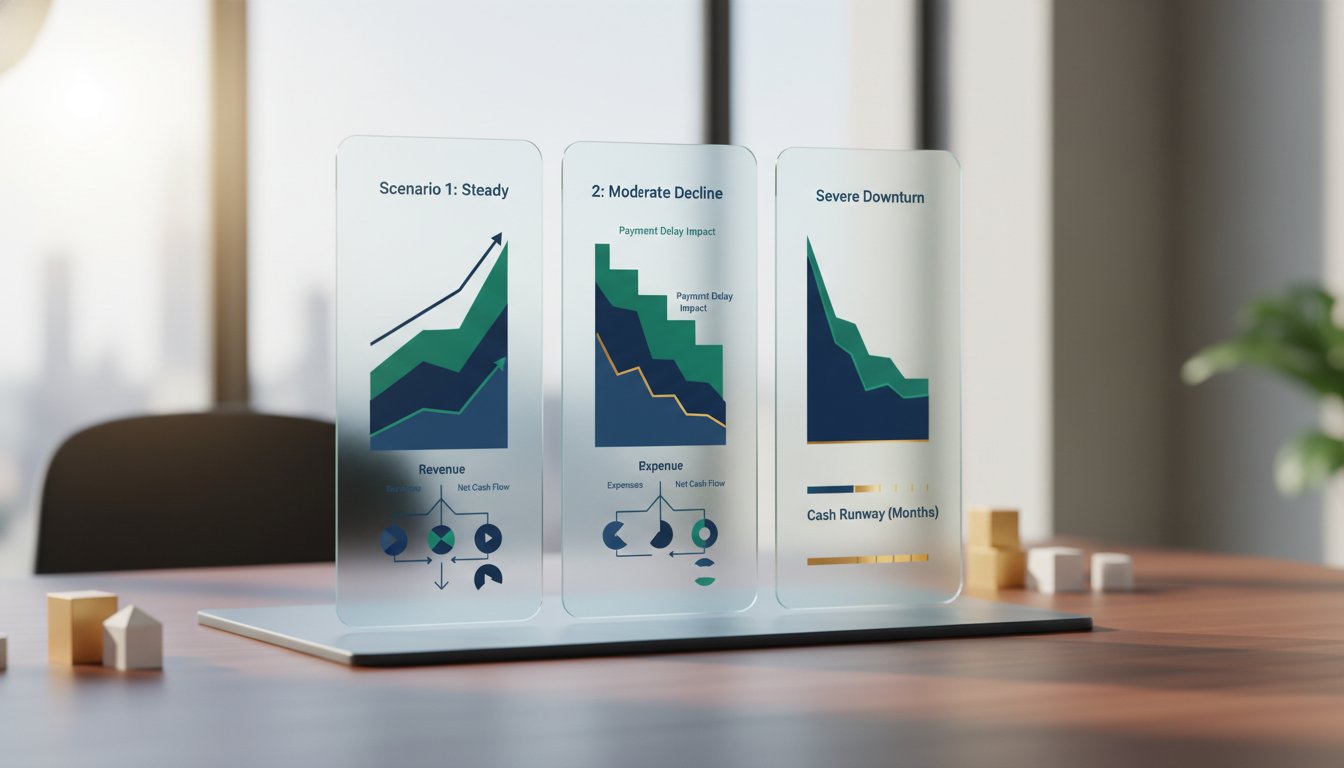
Why a Cash Flow Stress Test Matters More Than a Budget
A cash flow stress test is a forward-looking financial model that projects how much cash a business would have under specific adverse conditions, such as a revenue decline or delayed customer payments. Unlike a budget, which plans for an expected outcome, a stress test reveals whether the business can survive the unexpected.
Budgets are built on assumptions that rarely hold. A budget assumes revenue arrives on time, expenses stay flat, and no emergencies occur. A cash flow stress test assumes the opposite and asks a single question: how many months can this business operate if things go wrong?
1 That failure is rarely about poor sales. It is about timing — paying rent before a client check clears, or covering payroll while waiting on a large invoice. A budget does not capture that timing risk. A 13-week cash flow forecast does, which is why turnaround professionals and lenders use it as the standard planning horizon for assessing near-term liquidity.2
The Federal Reserve's 2025 stress test scenarios include unemployment rising to 10% and a severe recession, used to test large bank capital adequacy.3 SMBs face the same macroeconomic risks but lack the capital buffers. The SBA recommends maintaining a cash reserve covering at least six months of operating expenses.4 Yet the average SMB holds only 27 days of cash reserves, leaving minimal buffer for revenue disruptions.5 A cash flow stress test is the tool that closes that gap.
Why Most SMBs Skip Cash Flow Stress Testing
Most SMB owners do not run stress tests because they do not know how. The exercise requires building a dynamic model that links revenue timing, expense schedules, and cash balances across multiple scenarios. That is not a skill taught in business school or learned from QuickBooks reports.
The second reason is time. A proper 13-week cash flow model takes several hours to build and maintain. For an owner managing operations, sales, and payroll, that time is scarce. The third reason is discomfort. Stress testing forces an owner to confront the possibility that their business might not survive a downturn. Many prefer to focus on growth instead.
The cost of skipping the exercise is high. Without a stress test, an owner cannot answer basic questions: how many months of cash do we have if revenue drops by a typical 30%? What happens if our largest client pays 60 days late? Can we afford that new hire without downside visibility? The IRS trust fund recovery penalty under Section 6672 adds another layer of risk — responsible persons who fail to remit payroll taxes can be held personally liable for the unpaid amount.6 A stress test that shows a cash shortfall can prevent that scenario entirely.
Scenario One: A 30 Percent Revenue Drop
Consider a hypothetical SaaS company with $500K in annual recurring revenue and $50K in monthly operating expenses. In the base case, the company collects $42K in monthly revenue and holds $80K in cash1. That gives roughly two months of runway.
Now model a significant revenue drop — for example, a 30% decline. Monthly collections fall to roughly $29K2. Operating expenses remain at $50K because headcount and software subscriptions cannot be cut immediately. The monthly cash burn becomes about $21K. At that rate, the hypothetical $80K cash reserve lasts just under four months.
The stress test reveals that the company needs to cut expenses by a significant margin — for example, at least 15% — within 60 days of the revenue decline, or secure a line of credit before the drop occurs.
Scenario Two: Delayed Client Payments for 60 Days
Revenue decline is not the only risk. Payment delays from key customers can create a cash crunch even when sales are strong. For a business where one client represents 40% of revenue, a 60-day payment delay can be devastating.
Suppose a marketing agency bills $100K per month, with one client accounting for $40K. That client switches from net-30 to net-90 terms without notice. For two months, the agency collects only $60K while expenses remain at $90K — a monthly shortfall of $30K.3 If the agency holds $60K in cash, that reserve is exhausted in two months.
The stress test reveals a structural problem: the agency is overconcentrated in one client and has no payment terms policy. The fix is not a bigger cash reserve. It is diversifying the client base and enforcing standard payment terms across all contracts. The SBA recommends small businesses maintain a cash reserve covering at least six months of operating expenses,4 but that recommendation assumes the business can collect revenue on time. A stress test that models payment delays shows whether the reserve is sufficient under realistic conditions.
Scenario Three: Unexpected Capital Expense Hit
Capital expenses are the hardest to model because they are unpredictable. A piece of equipment fails. A lease requires a build-out. A vendor demands prepayment. These events can drain cash in a single month.
Consider a retailer with $30K in monthly operating expenses and $50K in cash. A refrigeration unit fails, requiring a $25K replacement. That expense alone cuts the cash reserve in half. If the failure coincides with a seasonal revenue dip, the retailer could be below the minimum operating threshold within weeks.
The stress test should model a capital expense equal to one month of operating revenue. For a business with $1M in annual revenue, that is roughly $83K. The question is whether the business can absorb that hit without borrowing. If the answer is no, the owner needs to either build a larger reserve or secure a credit line before the expense occurs.7
How to Build Your Own Cash Flow Stress Test Model
Building a cash flow stress test requires three inputs: starting cash balance, weekly cash inflows, and weekly cash outflows. The standard format is a 13-week rolling forecast.2
Start with the base case. List every expected cash inflow by week — client payments, recurring revenue, one-time sales. Then list every expected outflow — payroll, rent, software subscriptions, loan payments, taxes. Subtract outflows from inflows each week and track the cumulative cash balance.
Then create two additional scenarios. For the downside case, reduce inflows by a typical 30% and delay all client payments by 30 days. For the severe case, reduce inflows by a hypothetical 50% and delay payments by 60 days. Keep outflows constant in all three scenarios for the first four weeks, then model a 10% expense reduction starting in week five.
The model does not need to be complex. A spreadsheet with 13 columns (one per week) and 10 rows (cash categories) is sufficient. The goal is to see the cash balance trajectory under each scenario and identify the week when cash drops below the minimum operating threshold.
Interpreting Results and Setting Trigger Points
The stress test produces three cash balance trajectories. The base case should show a positive or stable balance. The downside case should show the week when cash drops below the minimum threshold. The severe case should show whether the business survives at all.
Set trigger points at three levels:
| Cash Reserve Level | Trigger Condition | Required Action |
|---|---|---|
| Level 1 (Watch) | Cash drops below 3 months of operating expenses | Freeze discretionary spending; review upcoming capital commitments |
| Level 2 (Warning) | Cash drops below 2 months of operating expenses | Draw on available credit line; begin negotiating extended payment terms with vendors |
| Level 3 (Critical) | Cash drops below 1 month of operating expenses | Implement emergency measures: reduce headcount, sell receivables, or seek bridge financing |
The trigger points should be written into the business's financial policy. When cash hits a trigger, the corresponding action is automatic. No debate, no delay. The stress test provides the data. The trigger points provide the discipline.
Turning Stress Test Insights Into Actionable Cash Reserves
The stress test reveals the required cash reserve for each scenario. If the downside scenario shows cash dropping to, for example, $10K in week eight, the business needs at least that amount more in reserve to stay above the minimum threshold. That number becomes the target.
Building that reserve requires a specific plan. The owner should set aside a fixed percentage of monthly revenue — for example, 5% — into a separate cash reserve account. If the business generates, say, $50K per month, that is $2,500 per month, or $30K per year. At that rate, a $60K reserve takes two years to build.
For businesses that cannot wait two years, the alternative is a credit line. A business line of credit provides access to cash on demand, typically at 7% to 12% interest. The stress test shows how much credit is needed and when it would be drawn. The owner can apply for the line before the crisis, when the business has strong financials and the owner has negotiating leverage.
Your Next Step
Build a 13-week cash flow model with three tabs: base case, 30% revenue decline, and 60-day payment delay. Update it weekly with actual cash data and review your trigger points monthly. If you need help building the model or running the scenarios, CurrentCFO offers a cash flow stress test workshop designed for SMBs with $1M to $10M in annual revenue. Reach out at [email protected] or visit currentcfo.com to schedule a 30-minute call.
Footnotes
-
https://www.usbank.com/financialiq/improve-your-business/operations-and-management/cash-flow-management.html ↩ ↩2
-
https://www.turnaround.org/Publications/Articles/13-Week-Cash-Flow-Forecast ↩ ↩2 ↩3
-
https://www.federalreserve.gov/publications/2025-stress-test-scenarios.htm ↩ ↩2
-
https://www.sba.gov/business-guide/manage-your-business/manage-cash-flow ↩ ↩2 ↩3
-
https://www.jpmorgan.com/insights/global-research/small-business/cash-buffer ↩
-
https://www.irs.gov/businesses/small-businesses-self-employed/employment-taxes-and-the-trust-fund-recovery-penalty-tfrp ↩