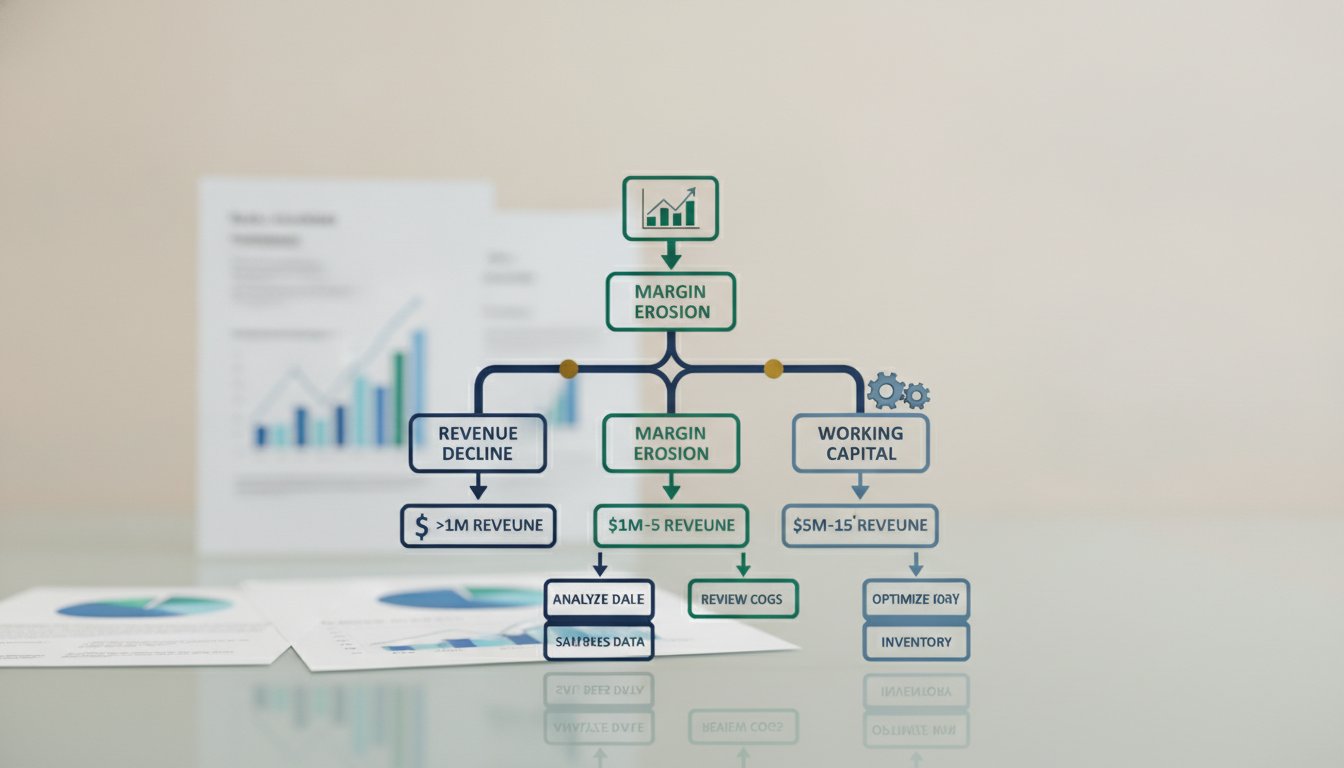
The Three Root Causes of an SMB Cash Crunch
A cash flow diagnosis tree small business is a structured decision framework that isolates whether a cash shortage stems from revenue decline, margin erosion, or working capital timing issues before any fix is applied. Most founders treat all cash problems the same way — cut costs, chase receivables, or panic — when the correct response depends entirely on which branch of the tree the problem lives in.
Every cash shortage in a business with $1M to $15M in revenue traces to one of three root causes1. Revenue decline means the top line is shrinking — fewer customers, lower average order value, or churn exceeding new sales. Margin erosion means revenue is stable or growing but the cost to deliver each dollar of sales is rising — input costs, labor inefficiency, or pricing that hasn't kept pace. Working capital timing means the business is profitable on paper but cash leaves before it arrives — net-60 receivables against net-15 payroll, inventory purchased months before seasonal sales, or a growth spurt that consumes cash faster than collections replenish it.
The distinction matters because the fix for each is different. A revenue decline requires sales and marketing intervention, not cost-cutting that accelerates the spiral. Margin erosion demands pricing strategy and procurement changes, not a receivables push. Working capital timing needs financing or payment term restructuring, not a price increase that kills demand. Applying the wrong fix makes the problem worse.
The Three Symptoms That Trigger a Cash Flow Diagnosis
Three observable symptoms tell a founder it is time to run the cash flow diagnosis tree small business framework. First, payroll feels tight — the bank balance on the Thursday before payday is lower than expected, even though the P&L shows a profit. Second, vendor relationships shift — suppliers start calling about overdue invoices, or a key material supplier switches to prepayment terms. Third, growth creates strain — a new customer win or a seasonal spike requires upfront spending that the cash account cannot cover.
Each symptom maps to a different branch of the tree. Tight payroll with a profitable P&L points to working capital timing. Vendor calls about overdue invoices when revenue is flat point to margin erosion — the business cannot afford its inputs at current pricing. Growth strain with rising receivables points to a timing problem that may require external financing. A founder who tracks which symptom appeared first can skip the guesswork and start diagnosing the correct root cause immediately.
Mapping Your Cash Conversion Cycle in Under 30 Minutes
The cash conversion cycle (CCC) measures the days between paying for inventory or labor and collecting cash from customers. For a typical SMB, the formula is straightforward: Days Inventory Outstanding plus Days Sales Outstanding minus Days Payables Outstanding. A positive CCC means the business funds operations before getting paid. A negative CCC — common in subscription or prepaid models — means customers pay before the business incurs costs.
Mapping the CCC requires three numbers from the last 90 days. Average receivables collection period: divide ending accounts receivable by average daily sales. Average payables period: divide ending accounts payable by average daily cost of goods sold. Average inventory holding period: divide ending inventory by average daily cost of goods sold. A spreadsheet with these three inputs produces the CCC in under 30 minutes.
For a business with $5M in annual revenue, a CCC of 60 days means roughly $820,000 is tied up in the cycle at any moment. Reducing that cycle by 10 days frees over $135,000 in cash without changing revenue or margins1. That is the leverage point most founders miss — they focus on cutting costs when the real cash sits in the cycle itself.
Where to Look First: Receivables, Payables, or Inventory
The diagnosis tree branches into three diagnostic paths. Start with receivables if customers are paying late or terms have drifted. A typical SMB in the $1M to $15M range carries 30 to 45 days of receivables outstanding. If the actual collection period exceeds 50 days, the cash crunch likely lives here. The fix is structural — enforce net-30 terms, charge late fees, or offer a 2% discount for payment within 10 days.
Move to payables if the business is paying vendors faster than customers pay the business. Many SMBs accept net-30 from customers but pay suppliers on net-15 or net-10 to maintain relationships. That mismatch creates a permanent cash drain. Extending payables to match receivables terms — without damaging supplier relationships — is the corrective action.
Check inventory last, because it is the hardest to fix quickly. Excess inventory ties up cash in physical goods that may take months to sell. For a retailer or manufacturer, inventory days above 90 signal a problem. The fix involves discounting slow movers, reducing order quantities, or switching to a just-in-time model. Inventory diagnosis requires the most discipline because founders often overestimate how fast stock will turn.
The Five Most Common Cash Flow Blockages for Growing SMBs
| Blockage | Typical Symptom | Root Cause Branch | Quick Diagnostic Check |
|---|---|---|---|
| Net-60 receivables on net-15 payroll | Payroll stress despite growing revenue | Working capital timing | Compare average collection days to payroll cycle |
| Pricing lag behind cost inflation | Shrinking gross margin with flat revenue | Margin erosion | Compare gross margin percentage to 12 months ago |
| Seasonal inventory buildup | Cash low in Q3, high in Q1 | Working capital timing | Calculate inventory days for each quarter |
| Rapid customer growth | ARR rising, bank balance falling | Working capital timing | Calculate cash consumed per new customer acquired |
| Owner draws exceeding free cash flow | Recurring shortfall with no clear cause | Revenue decline or margin erosion | Compare owner draws to operating cash flow |
Each blockage has a distinct signature. A founder who sees payroll stress alongside growing revenue should check receivables terms first. A founder who sees margin compression with stable revenue should check pricing against input costs. The table above maps symptom to root cause so the diagnosis takes minutes, not weeks.
Publication 535 (Business Expenses) covers what qualifies as deductible business expenses for tax purposes, and Publication 502 covers medical and dental expenses — both are IRS resources that help founders understand which costs can reduce taxable income. Publication 535 is particularly relevant when evaluating whether margin erosion stems from deductible versus non-deductible expenses.
How to Distinguish a Timing Problem from a Profitability Problem
A timing problem means the business is profitable but cash arrives after obligations are due. A profitability problem means the business loses money on each sale and cash will run out regardless of collection speed. The distinction is critical because the solutions are opposites — timing problems need financing or term restructuring, while profitability problems need pricing or cost changes.
The diagnostic test is simple. Calculate trailing 12-month net income. If net income is positive and cash is short, the problem is timing. If net income is negative or near zero, the problem is profitability. For a business with $3M in revenue and $50K in net income, a $100K cash shortfall is a timing problem — the business earns money but cannot collect fast enough. For a business with $3M in revenue and a $50K net loss, the same shortfall is a profitability problem — no amount of collection speed will fix a negative margin.
Consider a hypothetical SaaS company with $500K ARR and $450K in annual costs. Net income is $50K, but the company pays $100K in annual cloud infrastructure costs upfront while collecting $42K monthly from customers1. The cash shortfall in month one is a timing problem — the business is profitable but needs working capital to bridge the prepayment gap. The fix is a line of credit or annual prepayment from customers, not a price increase.
Building Your Weekly Cash Flow Dashboard with Three KPIs
Three KPIs give a founder full visibility into cash health without drowning in data. First, cash runway: divide current cash balance by average monthly operating expenses. A runway below 90 days triggers the diagnosis tree. Second, days sales outstanding (DSO): divide accounts receivable by average daily revenue. DSO above 45 days for a B2B SMB signals a receivables blockage. Third, gross margin trend: compare current month gross margin to the trailing 12-month average. A margin decline of more than 3 percentage points signals margin erosion.
| KPI | Formula | Healthy Range | Action Trigger |
|---|---|---|---|
| Cash Runway | Cash ÷ Monthly OpEx | 90+ days | Below 90 days: run diagnosis tree |
| Days Sales Outstanding | AR ÷ (Revenue ÷ 365) | Under 45 days | Above 45 days: audit receivables |
| Gross Margin Trend | Current GM % vs 12-month avg | Within 3 points | Decline >3 points: review pricing |
These three numbers fit on a single spreadsheet row. A founder who checks them every Monday morning catches problems before they become crises. The dashboard replaces the anxiety of checking the bank balance with a structured review of the three drivers that actually determine cash position.
When to Call a Fractional CFO vs. Fixing It Yourself
A founder can fix a timing problem alone if the business has positive net income and the cash shortfall is under 30 days of expenses. Extending payables, offering early payment discounts, or drawing on a business credit card are DIY fixes that work for mild timing mismatches. A founder should call a fractional CFO when the cash shortfall exceeds 60 days of expenses, when gross margin has declined for three consecutive months, or when the business needs a formal 13-week cash flow forecast to secure financing.
1 Building one requires projecting weekly cash inflows and outflows for the next 13 weeks — a task most founders lack the time or template to execute correctly. A fractional CFO brings the template, the experience to validate assumptions, and the credibility to present the forecast to lenders or investors.
The decision rule is simple: if the founder can identify the root cause in under 30 minutes using the diagnosis tree above, fix it alone. If the root cause remains unclear after 30 minutes, or if the fix requires external financing, bring in a fractional CFO. The cost of waiting — missed payroll, damaged vendor relationships, or a forced fire sale — far exceeds the cost of professional diagnosis.
Your Next Step
Run the three-branch diagnosis tree on your business this week. Pull your trailing 12-month P&L, calculate net income, and determine whether your cash crunch is a timing problem or a profitability problem. If net income is positive and cash is short, map your cash conversion cycle using the 30-minute exercise above. If the root cause remains unclear after 30 minutes, or if your cash runway is below 60 days, send your current balance sheet and receivables aging report to [email protected] for a same-day diagnostic review.