The Three Runway Zones: Green, Yellow, and Red
A small business cash crisis response is a structured sequence of financial actions prioritized by how many days of cash the business has remaining before obligations come due. The wrong response — cutting the wrong expense or delaying the wrong payment — can accelerate the crisis rather than resolve it.
Cash runway is measured in days of operating expenses covered by current cash on hand. Three zones define the urgency and the available options.
| Runway Zone | Days of Cash | Primary Objective | Risk Level |
|---|---|---|---|
| Green | 90+ days | Strategic restructuring | Low |
| Yellow | 30–90 days | Cash conservation | Moderate |
| Red | 0–30 days | Survival | Critical |
A business in the green zone can negotiate payment terms, restructure debt, and pursue growth capital. A business in the red zone must stop all non-essential spending immediately and may need to use emergency financing options that carry higher costs. The 82% of small businesses that fail due to cash flow mismanagement typically waited until they were in the red zone before taking action.1
Runway Depth: The First Question You Must Answer
Runway depth is calculated by dividing current cash by average monthly operating expenses. For example, a business with $120,000 in the bank and $40,000 in monthly expenses has 90 days of runway. That number determines which levers are available and which are too slow or too damaging to pull.
Many SMB owners miscalculate runway because they exclude upcoming fixed obligations. Accounts payable due within 30 days, payroll taxes, and debt service payments must be subtracted from cash before the calculation. For example, a business that shows $120,000 in the bank but has $50,000 in payables due next week actually has 52 days of runway, not 90.
The MetLife & U.S. Chamber Small Business Index fell to 68.4 in Q4 2025 from 72.0 the prior quarter, indicating that financial confidence is worsening across the SMB sector.2 Owners who calculate runway accurately — and early — have more options than those who discover the shortfall when payroll is due Friday.
The 0-30 Day Crisis: Stop the Bleeding Now
When cash covers fewer than 30 days of expenses, a small business cash crisis response is stopping cash outflows that do not directly generate revenue. The sequence matters.
First, freeze all discretionary spending. Marketing campaigns, software subscriptions, contractor engagements, and travel expenses stop immediately. A typical SMB can reduce monthly burn by 15–25% through this step alone.
Second, contact vendors with the largest payables. Explain the situation and request extended terms. Many vendors will accept net-60 or net-90 rather than risk receiving nothing if the business closes. Document every agreement in writing.
Third, accelerate accounts receivable. Send invoices immediately, call clients with outstanding balances, and offer a small discount — say 2% — for payment within 10 days. On $100,000 in receivables, that discount costs $2,000 but may bring in $50,000 within two weeks.
Fourth, evaluate accounts receivable factoring. Selling invoices to a factoring company provides immediate cash, typically 80–90% of invoice value, with the remainder paid when the customer pays.3 The cost is higher than a bank loan, but in a 0–30 day crisis, speed matters more than cost.
IRS trust fund recovery penalty under Section 6672 imposes a penalty equal to 100% of unpaid payroll taxes on responsible persons.4 Do not use payroll tax withholdings as a funding source. That money belongs to employees and the government, not the business.
The 30-60 Day Window: Buy Time Without Burning Bridges
With 30 to 60 days of runway, the business has room to negotiate rather than react. The goal is to extend the runway to 90 days without damaging vendor relationships or employee morale.
Negotiate payment terms with top vendors. Request net-60 terms on all new invoices. For a business spending $50,000 monthly with vendors, shifting from net-30 to net-60 frees $50,000 in cash within 60 days.
Reduce payroll costs without layoffs. Consider a temporary salary reduction for senior leadership, reduced hours for non-essential roles, or a deferred compensation agreement. A hypothetical SaaS company with $500K ARR and five employees might reduce monthly payroll by 20% through a 90-day salary deferral for the two founders.
Pause capital expenditures. Equipment purchases, office renovations, and technology upgrades that are not critical to operations are deferred. If the business needs new laptops, lease them rather than buy.
Apply for an SBA 7(a) loan. These loans guarantee up to 85% of loan amounts under $150,000 for working capital.5 The application process takes 30–60 days, so starting during the 30–60 day window means funds arrive before the business enters the red zone.
The 60-90 Day Zone: Restructure Before You Run Out
At 60 to 90 days of runway, a small business cash crisis response shifts to restructuring operations and financing permanently. The priority is reducing the monthly burn rate, not deferring payments.
Review all recurring expenses line by line. Software subscriptions, insurance policies, and professional services contracts often include services the business no longer uses. A typical SMB can eliminate 10–15% of recurring expenses through a thorough audit.
Renegotiate lease terms. Commercial landlords may accept reduced rent for a 6–12 month period rather than lose a tenant. Offer a shorter lease extension in exchange for lower monthly payments.
Convert short-term debt to longer terms. If the business has a line of credit at a typical double-digit interest rate, ask the lender to convert it to a 3-year term loan at a similar rate. Monthly payments drop significantly, freeing cash for operations.
Hire a fractional CFO or financial consultant. The cost — typically $2,000–$5,000 monthly — is justified if it identifies $20,000+ in monthly savings or secures financing that keeps the business alive. BILL reports that cash flow concerns increased 5 percentage points from 2024 to 2025, becoming the second biggest financial challenge for SMBs.6 Professional guidance during this window can prevent the crisis from deepening.
The 90+ Day Runway: Strategic Moves While You Have Options
Businesses with 90+ days of runway have the most options and the lowest urgency. The goal is to build a cash reserve and implement systems that prevent future crises.
Build a 13-week cash flow forecast. This rolling forecast projects cash inflows and outflows week by week, identifying potential shortfalls before they become emergencies. Update it every week.
Establish a revolving line of credit. Apply for a credit line when the business does not need it. Banks are more likely to approve credit when the business shows healthy cash reserves. A $50,000 line of credit costs nothing to maintain but provides an immediate safety net.
Diversify revenue streams. A business that relies on three clients for most of its revenue is one lost client away from a cash crisis. Develop new customer segments, introduce recurring revenue models, or expand into adjacent services.
Review pricing. Many SMBs underprice their services. A price increase on existing customers, phased in over 90 days, directly improves cash flow without increasing costs.
Which Lever to Pull First Based on Your Cash Position
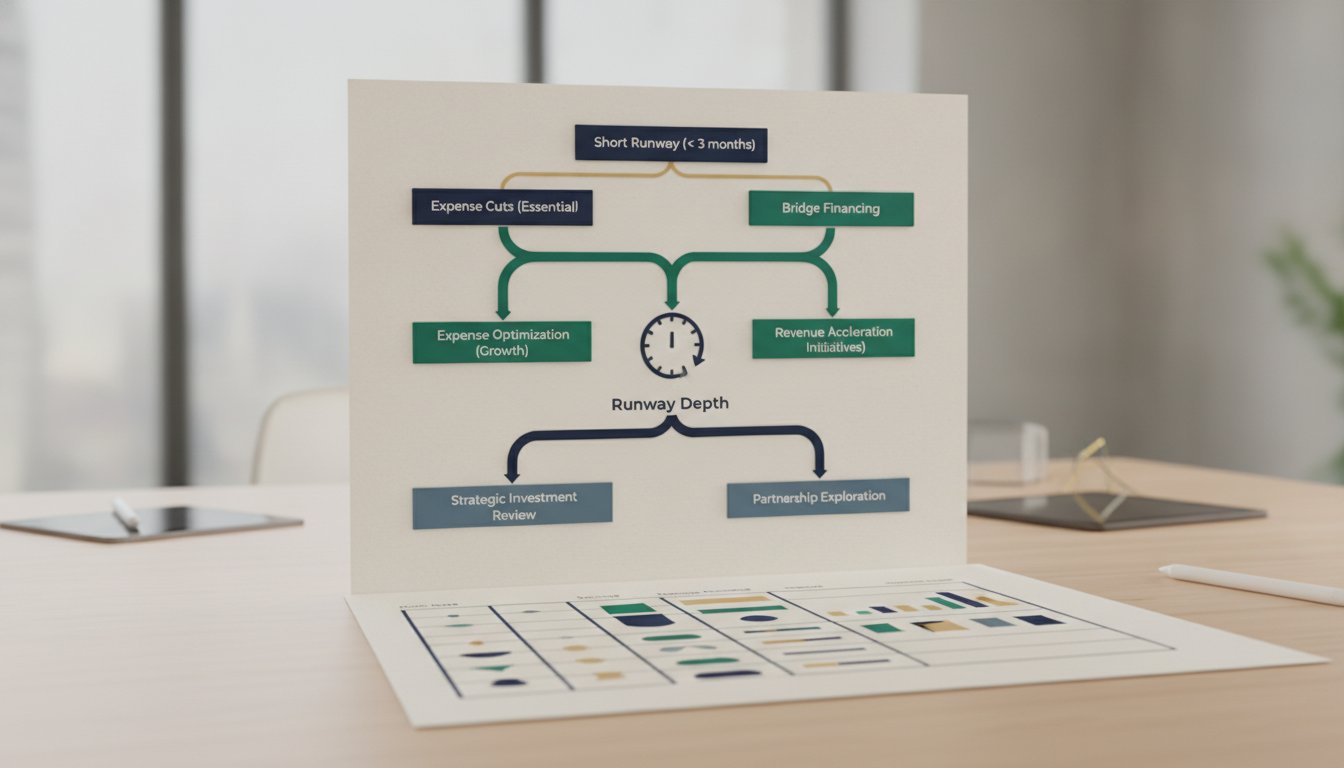
The decision tree below maps specific actions to runway depth. Pull levers in the order shown for your zone.
| Runway | First Lever | Second Lever | Third Lever |
|---|---|---|---|
| 0–30 days | Freeze discretionary spending | Accelerate AR (discounts + factoring) | Request vendor payment extensions |
| 30–60 days | Negotiate vendor terms to net-60 | Reduce payroll costs (deferrals, not layoffs) | Apply for SBA 7(a) working capital loan |
| 60–90 days | Audit recurring expenses | Renegotiate lease and debt terms | Engage fractional CFO for restructuring |
| 90+ days | Build 13-week cash forecast | Establish revolving credit line | Diversify revenue and adjust pricing |
A business in the 0–30 day zone that tries to negotiate vendor terms before freezing spending will continue burning cash while negotiations proceed. A business in the 60–90 day zone that freezes spending without restructuring debt will run out of cash when the deferrals end. The sequence is tied to the runway.
How to Build a Cash Crisis Decision Tree for Your Business
Building a decision tree requires three inputs: current cash, monthly expenses, and upcoming fixed obligations.
Step 1: Calculate exact runway. Subtract all payables due within 30 days from current cash. Divide by monthly operating expenses. The result is days of runway.
Step 2: Identify your zone. Use the table above to determine whether you are in green, yellow, or red.
Step 3: Execute the first lever. Do not skip to the second or third lever. The first lever in each zone stops the fastest bleed.
Step 4: Set a 7-day review cadence. Recalculate runway every seven days. If runway has improved, move to the next lever. If runway has worsened, escalate to the previous zone's actions.
Step 5: Document every decision. Record which vendors were contacted, what terms were agreed, and when payments are due. This documentation is critical if the business needs to apply for financing or defend against creditor claims.
Your Next Step
Calculate your exact runway today. Subtract all payables due within 30 days from your current cash balance, divide by monthly operating expenses, and identify your zone. Then pull the first lever listed for that zone. Do not wait until payroll is due Friday to discover you are short. If you need help building the forecast or negotiating with vendors, contact [email protected].
Footnotes
-
U.S. Bank. "Cash Flow Management: How to Manage, Monitor and Improve Your Business Cash Flow." https://www.usbank.com/financialiq/improve-your-business/operations-and-compliance/managing-cash-flow.html ↩
-
MetLife & U.S. Chamber of Commerce. "Small Business Index, Q4 2025." https://www.uschamber.com/sbindex/summary ↩
-
TowneBank. "How to Avoid a Cash Flow Crisis." https://www.townebank.com/business/resources/cash-flow/avoid-a-crisis ↩ ↩2
-
IRS. "Employment Taxes and the Trust Fund Recovery Penalty (TFRP)." https://www.irs.gov/businesses/small-businesses-self-employed/employment-taxes-and-the-trust-fund-recovery-penalty-tfrp ↩ ↩2
-
U.S. Small Business Administration. "7(a) Loans." https://www.sba.gov/funding-programs/loans/7a-loans ↩
-
Rieva Lesonsky. "Cash Flow SOS: What's Working in 2025." LinkedIn. https://www.linkedin.com/pulse/cash-flow-sos-whats-working-2025-rieva-lesonsky-t0jvc ↩