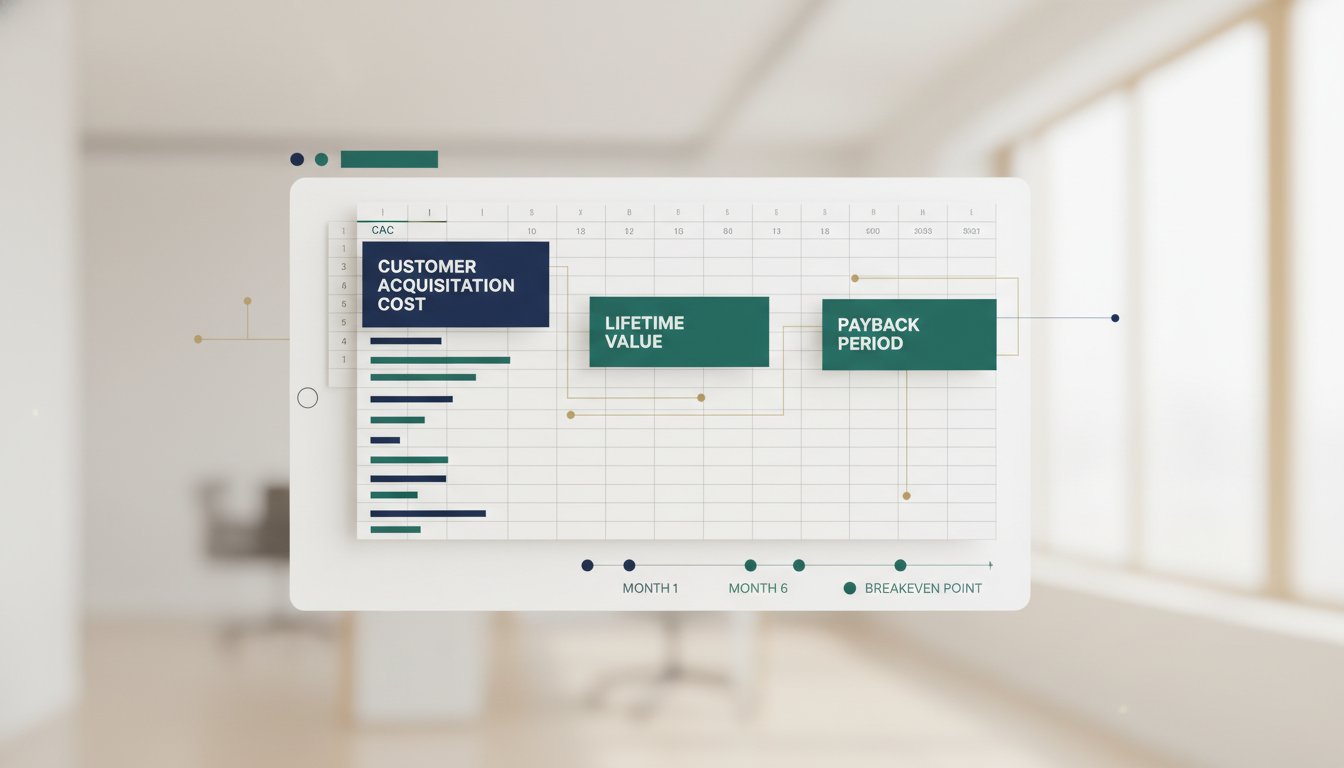
Customer acquisition cost (CAC) and lifetime value (LTV) are the two numbers that tell you whether your business model actually works. To calculate CAC LTV payback period means determining how many months it takes for a new customer's gross profit to cover the total cost of acquiring them. The payback period — the months needed for a new customer's gross profit to cover what you spent acquiring them — is the single metric that ties CAC and LTV together. To calculate CAC LTV payback period, divide the total cost of acquiring customers by the gross margin they generate each month; the result tells you how long until a customer becomes profitable.
Revenue growth can mask serious problems. The CAC payback period reveals this dynamic before cash runs out.
Why CAC Payback Period Matters More Than Revenue Growth
Customer acquisition cost (CAC) and lifetime value (LTV) are the two numbers that tell you whether your business model actually works. The payback period — the months needed for a new customer's gross profit to cover what you spent acquiring them — is the single metric that ties them together. To calculate CAC LTV payback period, divide the total cost of acquiring customers by the gross margin they generate each month; the result tells you how long until a customer becomes profitable.
Revenue growth can mask serious problems. The CAC payback period reveals this dynamic before cash runs out.
For SaaS businesses, a payback period of 6 to 12 months is considered healthy, with an LTV/CAC ratio target of 5:1 or higher for growth-stage companies.1 Outside of SaaS, benchmarks vary by industry, but the principle is universal: the faster a customer pays back their acquisition cost, the less capital you need to fund growth.
Consider a hypothetical retailer spending $50,000 on marketing in a quarter and acquiring 200 new customers. If each customer generates $50 in gross profit per month, the payback period is five months ($250 acquisition cost ÷ $50 monthly gross profit).2 That retailer can reinvest revenue from month-five customers into acquiring more customers in month six. A retailer with a 12-month payback period needs outside capital or slower growth.
The metric forces discipline. It connects marketing spend to actual customer behavior, not vanity metrics like traffic or leads.
What CAC, LTV, and Payback Period Actually Mean for Your Business
Customer Acquisition Cost (CAC) is the total cost of converting a prospect into a paying customer. This includes marketing salaries, ad spend, sales commissions, software tools, and any overhead directly tied to acquisition. The formula is simple: total acquisition costs divided by number of new customers acquired in the same period.
Lifetime Value (LTV) is the gross profit a customer generates over their entire relationship with your business. Not revenue — gross profit. If a customer pays $100 per month and your cost to serve them is $30, their monthly gross profit is $70. Multiply that by average customer lifespan in months.
Payback Period answers the question: how many months until that $70 monthly gross profit covers the $500 you spent acquiring the customer?1 The formula: CAC ÷ (monthly gross profit per customer).
| Metric | Formula | What It Tells You |
|---|---|---|
| CAC | Total acquisition costs ÷ New customers | Cost to win one customer |
| LTV | Average monthly gross profit × Average months retained | Total profit from one customer |
| Payback Period | CAC ÷ Monthly gross profit per customer | Months until customer is profitable |
The CAC payback period measures the months required for a new customer's gross margin to cover the full cost of acquiring them.2 If that number exceeds 18 months for a bootstrapped business, the model needs fixing.
Building the Spreadsheet: Step-by-Step Setup
Open Google Sheets and create five columns in a new tab: Month, New Customers, Total Acquisition Cost, Average Monthly Revenue per Customer, and Average Monthly Cost to Serve per Customer.
Step 1: Set up your time periods. Use rows for each month, going back at least 12 months. Label column A as "Month" and enter dates (e.g., January 2025, February 2025).
Step 2: Pull customer data. Column B is "New Customers." Export this from your CRM — the number of customers who made their first purchase or signed their first contract in each month.
Step 3: Calculate acquisition costs. Column C is "Total Acquisition Cost." Sum all marketing and sales expenses for each month: ad spend, salaries (prorated), software subscriptions, agency fees, and any commissions paid.
Step 4: Add revenue and cost-to-serve. Column D is "Average Monthly Revenue per Customer" for customers acquired that month. Column E is "Average Monthly Cost to Serve per Customer" — support costs, hosting, COGS, fulfillment.
Step 5: Build the formulas. In column F, calculate monthly gross profit per customer: =D2-E2. In column G, calculate CAC: =C2/B2. In column H, calculate payback period: =G2/F2.
The result is a rolling view of your unit economics by cohort. A template following this structure is available from S3 Ventures as a free unit economics workbook with templates for CAC, LTV, and cohort analysis.3
How to Calculate CAC LTV Payback Period with Real Numbers
Consider a hypothetical SaaS company with $500K ARR that spent $120,000 on sales and marketing in Q1 and acquired 40 new customers. The CAC is $3,000 ($120,000 ÷ 40).
These customers pay an average of $200 per month. The cost to serve them — hosting, support, payment processing — averages $50 per month1. Monthly gross profit per customer is $1502.
With a CAC of $3,000 and monthly gross profit of $150, the payback period is 20 months.
That is too long for a bootstrapped business. The company would need to either reduce CAC (better ad targeting, shorter sales cycle) or increase monthly gross profit (raise prices, reduce support costs).
Now suppose the same company improves targeting and drops CAC to $1,800 while keeping $150 monthly gross profit. Payback period drops to 12 months — within the healthy range for SaaS.1
| Scenario | CAC | Monthly Gross Profit | Payback Period |
|---|---|---|---|
| Current | $3,000 | $150 | 20 months |
| Improved targeting | $1,800 | $150 | 12 months |
| Improved targeting + price increase | $1,800 | $200 | 9 months |
The spreadsheet makes these scenarios testable before spending real money. Change one input and the payback period recalculates instantly.
Interpreting Your Payback Period: Good vs Warning Signs
A payback period under 6 months suggests your business has strong unit economics. You can reinvest aggressively and grow without outside capital. This is common in high-volume, low-CAC businesses like certain consumer subscriptions or service models with short sales cycles.
A payback period between 6 and 12 months is healthy for most SaaS and B2B models.1 Growth-stage investors typically look for this range alongside an LTV/CAC ratio of 5:1 or higher.
A payback period between 12 and 18 months requires scrutiny. The business can work, but it needs either higher gross margins, lower churn, or outside funding to sustain growth. Many venture-backed companies operate in this range because they prioritize market share over immediate profitability.
A payback period over 18 months is a warning sign. The business is spending more to acquire customers than those customers will ever return in profit, unless retention is exceptionally long. For a bootstrapped SMB, this model is unsustainable without fundamental changes.
| Payback Period | Assessment | Action Required |
|---|---|---|
| Under 6 months | Excellent | Invest aggressively |
| 6–12 months | Healthy | Monitor and optimize |
| 12–18 months | Caution | Review pricing and retention |
| Over 18 months | Warning | Restructure acquisition or pricing |
Using the Metric to Make Hiring and Spend Decisions
The payback period directly informs hiring timing. Suppose a business has a 10-month payback period and acquires 30 customers per month at $2,000 CAC. Each month's cohort generates $6,000 in gross profit (30 × $200 monthly gross profit). After 10 months, that cohort has paid back its acquisition cost and begins generating pure profit.
That profit can fund a new hire. If a salesperson costs $8,000 per month fully loaded — a typical figure for an SMB — the business needs roughly 40 customers per month to sustain that hire: 30 to cover existing operations plus 10 to fund the new salary. The payback period tells you whether those 40 customers will eventually become profitable.
For marketing spend decisions, the payback period sets the ceiling. If a new ad channel produces customers with a 15-month payback period but the business only has 12 months of cash runway, that channel is too expensive. The spreadsheet makes this calculation explicit before the first ad dollar is spent.
The same logic applies to pricing changes. A typical 10% price increase that drops payback period from 14 months to 11 months can eliminate the need for outside funding entirely.
When the Payback Period Breaks: Common Spreadsheet Mistakes
Mistake 1: Using revenue instead of gross profit. Revenue includes the cost of delivering your product or service. Using revenue inflates LTV and understates payback period. Always subtract cost to serve.
Mistake 2: Mixing one-time and recurring costs. If you spent $10,000 on a website redesign, that is a capital expense, not a monthly acquisition cost. Spreading it across 12 months of CAC calculations distorts the metric.
Mistake 3: Ignoring time lag. Customers acquired in January may not generate their first month of full gross profit until February or March. The payback period should start counting from the month the customer begins generating profit, not the month they were acquired.
Mistake 4: Averaging across different customer segments. Enterprise customers have a $10,000 CAC and $500 monthly gross profit — that yields a 20-month payback period. Self-serve customers with a $200 CAC and $50 monthly gross profit have a 4-month payback period. Averaging them produces a meaningless number.
Mistake 5: Forgetting to update the spreadsheet monthly. Unit economics change as your business scales. A spreadsheet built in January is unreliable by July if you have not updated acquisition costs, pricing, or churn rates.
Your Next Step
Open Google Sheets and build the five-column structure described above. Pull your last three months of CRM data — new customers, acquisition costs, and average revenue per customer. Enter the formulas for CAC, monthly gross profit, and payback period. If the result surprises you, that is the point. The spreadsheet does not lie. Once you have the numbers, email [email protected] with your payback period and industry for a second opinion on what the metric means for your growth plan.