Why Your Startup Needs a 3-Statement Model (Not Just a Spreadsheet)
A 3-statement financial model small business owners can build and maintain is an integrated spreadsheet that links the income statement, balance sheet, and cash flow statement into one dynamic system. Unlike a standalone profit and loss projection, this model shows how every revenue dollar, expense, and financing decision flows through all three financial statements automatically. For a founder without a finance background, this single tool replaces the guesswork of managing cash runway, investor reporting, and budget planning in separate spreadsheets that never reconcile.
At CurrentCFO, I see this pattern repeatedly: founders manage cash runway, investor reporting, and budget planning in separate spreadsheets that never reconcile. The 3-statement model solves this by creating one connected system.
Cash flow mismanagement causes 82% of small business failures.1 A standalone income statement tells you whether you are profitable on paper, but it cannot show you when your bank account will hit zero. The average small business holds only 27 days of cash reserves, underscoring the need for runway planning via a 3-statement model.2
The model connects your revenue forecast to your cash balance in real time. When you add a new hire in month six, the model automatically updates your operating expenses on the income statement, your accrued liabilities on the balance sheet, and your cash outflow on the cash flow statement. Without this integration, founders manually update three separate spreadsheets and inevitably miss a connection — typically the timing gap between booking revenue and collecting cash.
36.2 million small businesses operate in the US, most lacking dedicated finance staff.3 Fractional CFO services cost $3,000–$8,000 per month versus $150,000+ for a full-time hire, making DIY modeling a cost-effective alternative for founders.4 Building your own model now saves thousands while giving you direct control over your financial narrative.
What a 3-Statement Financial Model Actually Does for Your Business
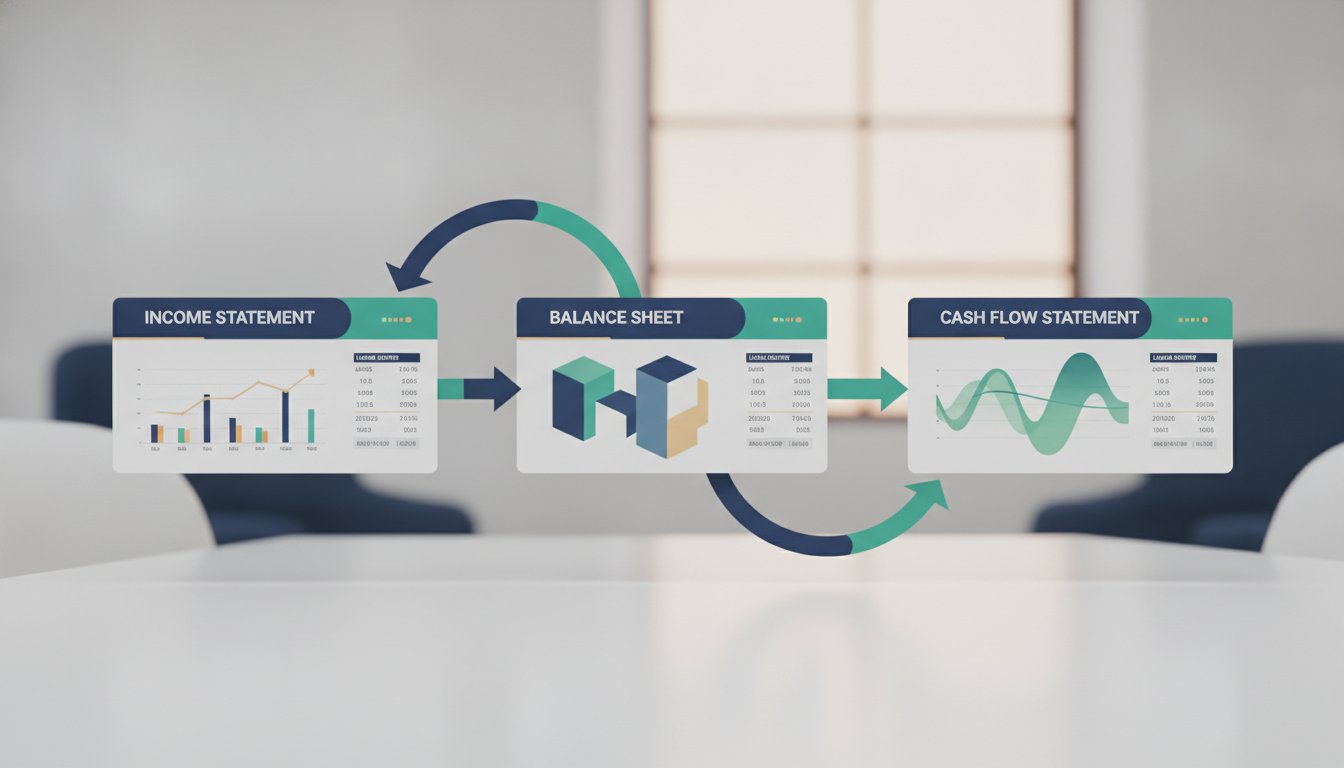
A 3-statement model dynamically links income statement, balance sheet, and cash flow statement into one connected financial system.5 When you change an assumption in any one statement, the other two update automatically. This interconnected structure reveals the hidden financial dynamics that single-statement projections miss.
Consider a hypothetical SaaS company with $500K ARR that decides to offer annual prepayment discounts. The income statement shows lower revenue per customer, but the balance sheet shows a spike in deferred revenue, and the cash flow statement shows a large upfront cash inflow. A founder looking only at the income statement would see a problem. A founder using an integrated model sees the cash runway extend by three months.
The model also enforces accounting discipline. Every line item on the income statement must have a corresponding entry on the balance sheet or cash flow statement. Accounts receivable appears as revenue on the income statement and as an asset on the balance sheet, then converts to cash on the cash flow statement when collected. This triple-entry logic catches errors that would otherwise go unnoticed until an investor asks why your cash balance does not match your reported profit.
The Income Statement: Revenue, COGS, and Operating Expenses
The income statement is the top-down driver of your entire model. Start with monthly revenue broken into at least two streams — for example, subscription revenue and professional services revenue. Each stream needs its own growth rate, seasonality factor, and churn assumption. For a typical B2B SaaS startup, monthly churn might range from 2% to 5% depending on customer segment.
Cost of goods sold (COGS) includes direct costs tied to delivering your product or service. For a software company, this means hosting infrastructure, payment processing fees, and customer support salaries. For a service business, COGS includes contractor labor and materials. The SBA recommends maintaining at least 6 months of operating expense reserves, a target that requires accurate cash flow forecasting from an integrated model.6
Operating expenses fall into fixed and variable categories. Rent, salaries, and software subscriptions are fixed in the short term. Marketing spend, travel, and contractor costs scale with revenue. Build each line item as a percentage of revenue or a fixed monthly amount — never mix the two approaches in the same line.
A common mistake is modeling marketing as a fixed cost when it should scale with customer acquisition targets. I have seen founders build models that look profitable on paper but collapse when the marketing spend does not flex with actual revenue growth.
Building the Balance Sheet Without an Accounting Degree
The balance sheet tracks what your business owns (assets), owes (liabilities), and the equity invested by founders and retained earnings. For a startup, the most important balance sheet items are cash, accounts receivable, accounts payable, deferred revenue, and accrued expenses.
Start with your opening cash balance — the actual amount in your bank account today. Accounts receivable should be calculated as a percentage of monthly revenue based on your typical collection cycle. If you invoice net-30 and collect in 45 days on average, set days sales outstanding to 45. Accounts payable follows the same logic using your vendor payment terms.
Deferred revenue captures cash collected for services not yet delivered. For a SaaS company with annual contracts, this line item can grow to several months of revenue. The balance sheet ensures that cash received upfront is not mistaken for earned revenue — a distinction that matters when investors evaluate your recurring revenue quality.
Equity starts with founder capital contributions and accumulates retained earnings from each month's net income. If you raise outside funding, the equity section expands to include investor capital and any preferred stock terms. Keep the equity section simple until you have a term sheet in hand.
Connecting the Cash Flow Statement to Your Bank Balance
The cash flow statement reconciles net income from the income statement to the change in cash on the balance sheet. It has three sections: operating activities, investing activities, and financing activities.
Operating cash flow starts with net income, then adds back non-cash expenses like depreciation and adjusts for changes in working capital. When accounts receivable increases, cash decreases — you have booked revenue but not yet collected it. When accounts payable increases, cash increases — you have received services but not yet paid for them. These working capital adjustments are where most founders make errors.
Investing activities capture capital expenditures — buying computers, servers, or office furniture. For a typical SaaS startup, this section is small until the company builds its own data infrastructure. Financing activities track equity raises, debt draws, and loan repayments.
The bottom line of the cash flow statement is the net change in cash. Add this to your opening cash balance to get your ending cash balance, which must match the cash line on your balance sheet. If these two numbers do not match, your model has an error. This reconciliation is the single most powerful validation check in the entire model.
How to Stress-Test Your Model With Realistic Scenarios
A model that only shows your base case is incomplete. Investors and board members will ask what happens if revenue grows significantly slower than planned — for example, 30% below target — or if a key customer churns. Build three scenarios: base case, downside case, and upside case.
For the downside case, reduce your revenue growth rate by half, increase churn by a significant margin (for example, 50%), and add a two-month delay in your next funding round. For a hypothetical startup projecting $2M ARR in year two, the downside case might show $1.2M ARR with cash running out in month 14 instead of month 20. This scenario tells you exactly how much runway you need to survive a bad quarter.
The upside case assumes faster growth, higher retention, and on-time fundraising. Use this scenario to plan hiring and infrastructure investments. If the upside case shows cash turning negative because you hired too fast, adjust your hiring timeline to match actual cash availability.
Run each scenario through the full 3-statement model. Do not shortcut by adjusting only the income statement — the balance sheet and cash flow statement will reveal cash constraints that the income statement alone cannot show. A typical founder discovers that their "profitable" upside case actually requires a bridge loan in month nine because receivables grow faster than the bank account.
The Minimum Viable Model: What to Include and What to Skip
First-time founders often overbuild their first model, adding dozens of line items that obscure the key drivers. A minimum viable 3-statement model needs only the following components:
| Component | What to Include | What to Skip |
|---|---|---|
| Revenue | 2-3 streams with growth rates | Customer-level unit economics |
| COGS | Hosting, payment fees, support salaries | Allocated overhead |
| Operating Expenses | Salaries, marketing, rent, G&A | Department-level breakdowns |
| Balance Sheet | Cash, AR, AP, deferred revenue, equity | Inventory, prepaids, fixed asset schedules |
| Cash Flow | Operating, investing, financing sections | Debt schedules, tax deferrals |
Build the model for 12 to 24 months on a monthly basis. Anything beyond 24 months is speculation dressed up as a forecast. Use monthly columns rather than quarterly — quarterly models hide the cash timing gaps that kill startups.
Skip depreciation schedules, complex tax calculations, and detailed debt amortization in your first version. Add these only after you have validated that the core model reconciles correctly. A model with 20 line items that reconciles is more useful than a model with 200 line items that does not.
Keeping Your Model Alive With Monthly Updates
A financial model is a living document, not a one-time deliverable for investors. Update it every month with actual results before the 15th of the following month. Compare actuals to your forecast and investigate any variance above a reasonable threshold, such as 10%.
The variance analysis is where the real value lives. If your actual COGS is 15% higher than forecast, investigate whether the increase is permanent or one-time. If your cash balance is $50K lower than projected, trace the gap to a specific working capital item or unexpected expense.
| Update Step | Action | Time Required |
|---|---|---|
| 1 | Enter actual revenue and expenses | 30 minutes |
| 2 | Reconcile bank and credit card statements | 45 minutes |
| 3 | Update balance sheet items | 20 minutes |
| 4 | Compare actuals to forecast | 15 minutes |
| 5 | Adjust forward assumptions | 20 minutes |
Set a recurring calendar reminder for the 10th of each month. After three months of updates, you will have enough actual data to refine your assumptions and improve forecast accuracy. After six months, your model becomes a reliable decision-making tool rather than a theoretical exercise.
Your Next Step
Open a blank spreadsheet and build your revenue section today. List your revenue streams, assign monthly growth rates, and project 12 months forward. That single sheet is the foundation of your entire 3-statement model. Once your revenue projection is complete, add your operating expenses in the rows below. You now have the income statement half of the model. For questions or a template review, email [email protected].
Footnotes
-
https://www.venasolutions.com/blog/small-business-revenue-statistics ↩ ↩2
-
https://www.forbes.com/advisor/business/small-business-statistics-jun-26 ↩
-
https://www.kaplancollectionagency.com/business-advice/54-small-business-statistics-for-2025 ↩
-
https://www.venasolutions.com/blog/small-business-revenue-statistics ↩
-
https://corporatefinanceinstitute.com/resources/financial-modeling/3-statement-model ↩