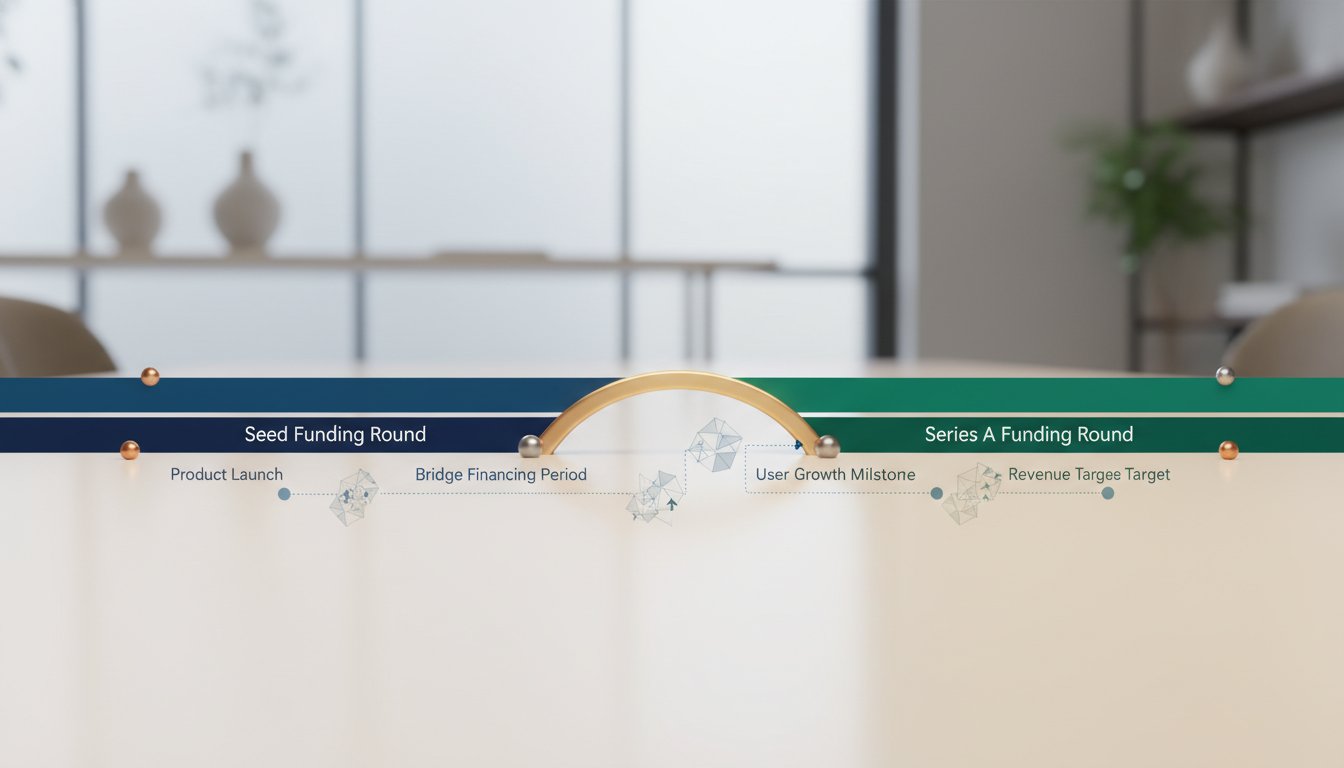
When a Bridge Round Makes Sense vs. Signals Trouble
Bridge financing is short-term capital that helps startups bridge a cash gap between funding rounds — typically lasting 3 to 12 months until the next institutional round closes.1 Whether a bridge round strengthens or undermines your fundraising position depends entirely on two things: whether existing investors are participating, and whether the capital buys time to hit a specific milestone or merely delays an inevitable shortfall.
A bridge round strengthens your position when the startup has clear traction and a defined path to the next round. It signals trouble when existing investors sit out and the bridge is used to cover operating losses without improving fundamentals.
A bridge round makes sense when you need 3-5 months of runway to close a Series A already in late-stage negotiation, or when waiting would let you raise at a materially higher valuation. For example, a SaaS startup at $1.2M ARR growing 15% month-over-month might use bridge capital to hire two sales reps and hit $2M ARR — unlocking a 3x higher Series A valuation from institutional investors. Bridge rounds are interim financings that differ structurally from traditional equity rounds in terms, speed, and dilution.2 Typical bridge rounds range from $500K to $5M at Seed stage and $2M to $15M at Series A, closing in 2-4 weeks compared to 3-6 months for a full institutional round. Venture capital funding rounds now take 22-28 months to close, creating structural need for bridge capital between rounds.3
What Bridge Financing Is and When Startups Need It
Bridge financing for startups is a short-term funding mechanism that provides capital between larger equity rounds, typically structured as convertible notes, SAFE notes, or venture debt.4 The bridge financing market was valued at approximately $76.8B in 2024 and is projected to reach $158.3B by 2033.5
Startups need bridge financing when they face a cash runway gap of 3-5 months before closing their next institutional round. Common triggers include extended fundraising timelines, delayed customer contracts, or the need to hit specific metrics before raising at a higher valuation.
How Bridge Loans Differ From Traditional Term Loans
| Feature | Bridge Loan | Traditional Term Loan |
|---|---|---|
| Duration | 3-12 months | 3-10 years |
| Collateral | Often unsecured or IP-backed | Hard assets or receivables |
| Interest rate | 6-12% typical | 4-8% for qualified borrowers |
| Conversion option | Converts to equity at next round | No conversion |
| Approval speed | 2-4 weeks | 4-12 weeks |
| Personal guarantee | Sometimes required | Usually required |
Bridge loans for startups typically convert into equity at the next funding round, often with a discount of 15-25% or a valuation cap that rewards early investors.6 Traditional term loans require monthly principal and interest payments, while bridge loans often defer payment until conversion or maturity.
Non-dilutive bridge options exist via revenue-based financing or venture debt but require recurring revenue or ARR thresholds.7 A startup with $300K in monthly recurring revenue might qualify for revenue-based financing at 1-2x monthly revenue, while a pre-revenue startup would need convertible debt from existing investors.
Key Risks Every Founder Should Evaluate Before Borrowing
The primary risk of bridge financing is signaling distress to future investors. Bridge rounds can signal distress or be a smart strategic tool depending on terms, valuation caps, and investor signaling.8 If existing investors do not participate, new investors will assume the insiders see problems.
Dilution risk increases when bridge notes have low valuation caps. For example, suppose a startup raises a $1M bridge note with a $5M valuation cap, then raises a Series A at a $15M pre-money valuation. In this scenario, the bridge investors convert at $5M, receiving 20% of the company, while Series A investors pay $15M for 20%. The founders get diluted by 40% in two rounds instead of 20% in one.
Another risk is personal liability. Many bridge lenders require personal guarantees from founders, especially for venture debt structures. If the startup fails, the founder owes the debt personally. Founders should negotiate for non-recourse terms or limited guarantees tied to specific assets.
Negotiating Terms With Lenders and Existing Investors
The most important term to negotiate is the valuation cap. A cap that is too low creates excessive dilution for founders and signals desperation to future investors. A cap that is too high makes the bridge unattractive to investors. The sweet spot is typically 20-40% below the expected Series A valuation.
Founders should also negotiate the discount rate, typically 15-25% on the next round price. A higher discount attracts investors but increases dilution. Most bridge notes include a maturity date of 12-18 months, with an automatic conversion if the next round closes before maturity.
Existing investors should be the first call when considering a bridge round. They have the most information about the company and the strongest incentive to protect their investment. A pro-rata bridge from existing investors signals confidence to new investors. Founders should present a clear plan showing how the bridge capital will generate specific metrics that unlock the next round at a higher valuation.
Using Bridge Capital to Extend Runway Without Dilution
Non-dilutive bridge financing options allow startups to extend runway without issuing equity. Venture debt from banks like Silicon Valley Bank or First Republic provides 2-4x monthly recurring revenue with warrants covering 5-15% of the loan amount.9 Revenue-based financing from providers like Clearbanc or Pipe advances 1-3x monthly revenue in exchange for a fixed percentage of future revenue.
Consider a hypothetical SaaS company with $500K ARR growing 8% month-over-month. The company needs $750K to hire three engineers and reach $1M ARR in 6 months. A venture debt facility of $750K at 9% interest with a 3-year term and 10% warrants would cost approximately $67,500 in interest plus $75,000 in warrant dilution — significantly less than the 15-20% equity dilution from a traditional bridge note.10
The key to non-dilutive bridge financing is recurring revenue. Startups with less than $100K in monthly recurring revenue typically cannot access these options and must rely on convertible notes from existing investors.
Real-World Examples of Successful Bridge Financing Rounds
A Seed-stage fintech startup raised $2M in bridge financing from existing angel investors using a SAFE note with a $10M valuation cap and 20% discount. The company used the capital to launch a second product line and grow monthly revenue from roughly $80K to approximately $250K over 8 months. The Series A round closed at a $25M pre-money valuation, and the bridge investors converted at the $10M cap, receiving 20% of the company for their $2M investment.
A Series A healthtech company raised venture debt from a specialty lender — $3.5M at 8% interest with a 3-year term and 8% warrants. The company used the capital to fund a 6-month clinical trial that would unlock FDA clearance. The trial succeeded, and the company raised a $20M Series B at a $60M valuation. The venture debt was repaid from the Series B proceeds, and the warrant dilution was minimal — well under 2% of the post-money cap table.
A B2B SaaS company raised $1.5M in revenue-based financing at 1.2x monthly revenue with a 12% fee. The company used the capital to hire a sales team and grew ARR from $1.2M to $2.8M in 9 months. The financing was fully repaid from revenue within 14 months with no equity dilution.
Your Next Step
Review your current cash runway and identify the specific metrics you need to hit before your next institutional round. Calculate the exact dollar amount and timeline gap between your current cash position and the point where you can raise at a higher valuation. If the gap is 3-5 months, prepare a one-page bridge financing memo that includes your current traction, the specific use of funds, and the valuation cap or discount you are offering.
Email that memo to your existing investors first — they are your fastest and most reliable source of bridge capital. At CurrentCFO, we help founders evaluate bridge financing options and structure terms that protect founder equity in the next round. For questions about structuring your bridge round terms, contact [email protected].
Footnotes
-
https://www.phoenixstrategy.group/blog/bridge-financing-for-startups-what-founders-need-to-know ↩
-
https://datahorizzonresearch.com/bridge-financing-services-market-49494 ↩
-
https://seedblink.com/blog/2024-12-19-bridge-rounds-a-sign-of-trouble-or-a-smart-financing-solution-in-2025 ↩
-
https://www.inkle.io/blog/what-is-bridge-round-financing-for-startups ↩
-
https://seedblink.com/blog/2024-12-19-bridge-rounds-a-sign-of-trouble-or-a-smart-financing-solution-in-2025 ↩
-
https://www.phoenixstrategy.group/blog/bridge-financing-for-startups-what-founders-need-to-know ↩
-
https://www.inkle.io/blog/what-is-bridge-round-financing-for-startups ↩