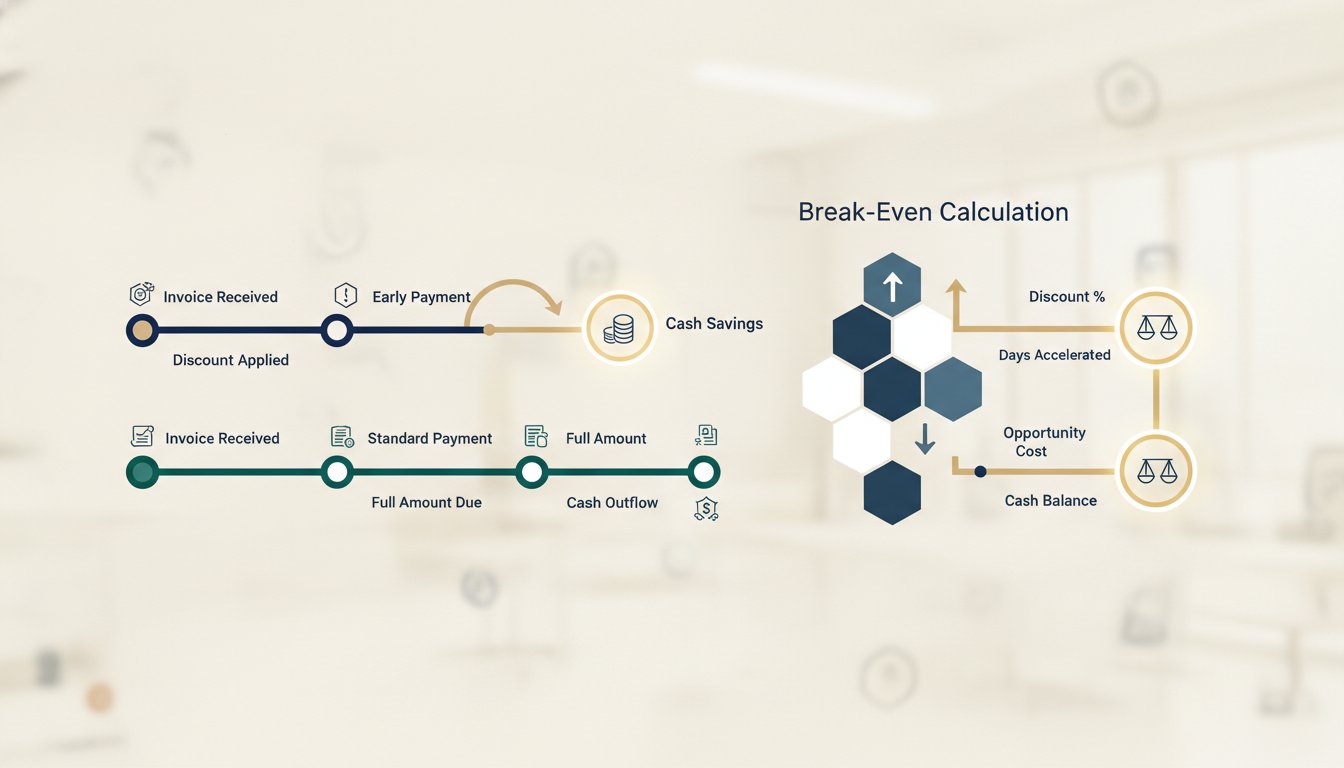
An accounts payable early payment discount is a vendor incentive that reduces an invoice total when the buyer pays before the standard due date. These terms, typically written as a percentage discount within a set number of days (for example, 2/10 net 30), can generate annualized returns exceeding 36% when captured consistently. Taking early payment discounts on vendor invoices can boost effective annual returns above 30%, but only when cash reserves are strong enough to avoid a liquidity crunch. This framework helps SMB finance leaders evaluate when an accounts payable early payment discount beats holding onto cash. Updated for 2026.
The Real Cost of Saying No to 2/10 Net 30
An accounts payable early payment discount is a vendor incentive that reduces an invoice total when the buyer pays before the standard due date. At CurrentCFO, we see SMB owners leave tens of thousands of dollars on the table every year by paying vendors on standard terms instead of capturing available discounts. The decision to take or skip these discounts can mean the difference between earning a 36.5% annualized return and losing that value entirely.
The most common early payment term in business-to-business transactions is 2/10 net 30 — a 2% discount if the invoice is paid within 10 days, with the full amount due in 30 days. Forgoing this discount is equivalent to paying a 36.5% annualized interest rate on the money you hold for those extra 20 days.1
Consider a hypothetical $10,000 invoice with 2/10 net 30 terms. Paying within 10 days costs $9,800, while waiting until day 30 costs $10,000. The $200 saved by paying early represents a 2.04% return over 20 days — annualized across 18.25 such cycles per year, that return compounds to 36.5%.1
Most SMB owners would never borrow money at 36.5% interest. Yet many routinely forgo early payment discounts, effectively doing exactly that. The math is straightforward, but the decision requires more context than a single percentage.
The True Cost of Forgoing Early Payment Discounts
Organizations that automate invoice processing capture early payment discounts three times more consistently than manual AP teams.2 For a business processing $500,000 in monthly vendor invoices, the difference is substantial.
A manual AP team that captures 60% of available discounts on $6 million in annual vendor spend might save $72,000 per year. An automated team capturing 90% would save $108,000 — a $36,000 gap driven entirely by process speed and accuracy.
The hidden cost goes beyond missed discounts. Manual AP processes prevent consistent capture of early payment incentives, leaving more than 40% of available discounts unclaimed.3 For a typical SMB, that represents thousands in forgone savings that flow directly to the bottom line.
How to Calculate Your Effective Annualized Return on Discounts
The formula for calculating the annualized return on an early payment discount is straightforward:
Annualized Return = (Discount % / (100% - Discount %)) × (365 / (Net Days - Discount Days))
For 2/10 net 30, a typical example: if the discount is 2% and payment is made 20 days early, the annualized return works out to roughly 37%1.
The slight difference from the 36.5% figure comes from compounding the discount on the discounted amount rather than the full invoice. Either way, the return is exceptional.
| Discount Term | Annualized Return |
|---|---|
| 1/10 net 30 | 18.4% |
| 2/10 net 30 | 37.2% |
| 2/10 net 60 | 14.9% |
| 3/10 net 30 | 56.4% |
| 1/10 net 20 | 36.9% |
For a business with $100,000 in monthly vendor spend, capturing all available 2/10 net 30 discounts would yield approximately $24,000 in annual savings — equivalent to adding $600,000 in revenue at a 4% net margin.
When Cash Preservation Beats the Discount Every Time
Early payment discounts offer exceptional returns, but cash preservation wins in specific scenarios. The decision framework hinges on one question: does taking the discount create a cash shortage that costs more than the discount saves?
Cash preservation beats the discount when:
- Payroll timing conflicts. If paying early leaves insufficient cash for payroll, the discount is irrelevant. Payroll penalties and morale damage far exceed 2%.
- Revenue concentration risk. A business where one customer represents 40%+ of revenue needs cash reserves to weather a potential loss. The discount return does not compensate for liquidity risk.
- Growth investment opportunities. A $10,000 discount is less valuable than using that cash to fund a marketing campaign with a 5:1 ROI.
- Debt covenant constraints. If early payment triggers a working capital ratio that violates a loan covenant, the discount cost is dwarfed by acceleration penalties and legal fees.
A typical SMB should maintain a minimum of 30 days of operating expenses in cash before considering early payment discounts. Below that threshold, cash preservation is the correct default.
Negotiating Payment Terms That Work for Both Sides
Vendor payment terms are negotiable, yet most SMBs accept standard terms without discussion. A structured negotiation approach yields better outcomes for both parties.
For buyers seeking discounts: Propose a tiered structure. For example, 2% for payment within 10 days, 1% for payment within 15 days, net 30 otherwise. Vendors often accept because any early payment improves their cash flow.
For buyers needing extended terms: Offer a small fee in exchange for net 45 or net 60 terms. For example, a 0.5% monthly fee on the extended balance is far cheaper than credit card interest or a bank line of credit.
| Negotiation Scenario | Typical Outcome |
|---|---|
| Request 2/10 net 30 on first order | 50-60% acceptance rate |
| Offer 1/10 net 30 as compromise | 70-80% acceptance rate |
| Request net 45 with 0.5% monthly fee | 60-70% acceptance rate |
| Bundle multiple vendors under single terms | 40-50% acceptance rate |
The key is timing. Negotiate terms before the first purchase order, not after invoices are due. Vendors are more flexible during onboarding than during collections.
Building a Simple Decision Framework for Every Invoice
A practical decision framework for accounts payable timing requires three inputs: cash position, discount terms, and vendor relationship.
Step 1: Check cash position. If cash on hand exceeds 30 days of operating expenses, proceed to Step 2. If not, preserve cash and pay on the net due date.
Step 2: Calculate the discount return. Use the annualized return formula above. If the return exceeds your cost of capital by 5 percentage points or more, the discount is worth pursuing.
Step 3: Evaluate vendor criticality. For essential suppliers (sole source, long lead times, mission-critical components), prioritize relationship over discount. For commodity suppliers, prioritize the discount.
Step 4: Execute or defer. If all three checks pass, pay early and capture the discount. If any check fails, pay on the net due date.
| Cash Position | Discount Return vs Cost of Capital | Vendor Criticality | Decision |
|---|---|---|---|
| Above 30 days | Exceeds by 5%+ | Non-critical | Take discount |
| Above 30 days | Exceeds by 5%+ | Critical | Take discount |
| Above 30 days | Below threshold | Any | Pay net due date |
| Below 30 days | Any | Any | Preserve cash |
Automating AP to Capture Discounts Without Manual Work
Manual accounts payable processes are the primary barrier to consistent discount capture. A typical manual AP workflow requires 7-10 days from invoice receipt to approval — often exceeding the 10-day discount window.
Organizations that automate invoice processing capture early payment discounts three times more consistently than manual AP teams.2 Automation reduces the approval cycle from days to hours, enabling consistent capture of 2/10 net 30 terms.
Key automation features for discount capture:
- Automated invoice data extraction. Eliminates manual data entry and the errors that delay approvals.
- Configurable approval workflows. Routes invoices to the correct approver based on dollar amount, vendor, or department.
- Discount optimization logic. Automatically prioritizes invoices with the highest annualized discount returns.
- Integration with accounting software. Posts approved invoices directly to the general ledger, eliminating rekeying delays.
For a business processing 200 invoices per month, AP automation typically pays for itself within 6-12 months through captured discounts alone, before considering labor savings.
Aligning AP Timing With Your Cash Flow Forecast
Early payment discounts should be integrated into the cash flow forecast, not treated as ad-hoc decisions. A rolling 13-week cash flow forecast provides the visibility needed to plan discount capture systematically.
Best practice: Review the upcoming week's invoices every Friday. Identify all invoices with early payment terms. Compare the total discount amount against the forecasted cash position for the following week. If cash is sufficient, schedule early payments for Monday.
Common pitfall: Paying early without forecasting the downstream impact. A founder who paid every supplier invoice 20-25 days early lost the float on $50,000+ monthly without negotiating any discount in return.4 The cash drain was invisible until the forecast revealed the pattern.
Integration approach: Add a "discount capture" line item to the weekly cash flow forecast. Track the percentage of available discounts actually captured each month. Target a high capture rate — for example, 90% or more — for invoices where cash position supports early payment.
Your Next Step
Run a discount capture audit on your last 90 days of vendor invoices. Calculate the total discounts available versus the total discounts captured. If your capture rate is below 80%, the gap represents immediate savings available through process improvement. Map your current invoice-to-approval cycle time and identify the bottlenecks. For most SMBs, the fix is a combination of vendor term negotiation and basic AP workflow automation. For a free review of your AP discount capture rate, email [email protected].
Footnotes
-
https://www.bdc.ca/en/articles-tools/money-finance/manage-finances/early-payment-discount-big-returns-business ↩ ↩2 ↩3 ↩4
-
https://www.linkedin.com/posts/garyjain_accounting-finance-accountspayable-activity-7429467800169000960-zuEj ↩
-
https://www.quadient.com/en/blog/20-accounts-payable-statistics-highlighting-power-ap-automation-2025 ↩