Why Your Invoicing Process Determines Collection Success
How to collect overdue invoices small business is the systematic process of recovering unpaid bills through structured communication and escalation. This process involves proactive measures taken well before payment is due—it begins with the structure and clarity of your initial invoicing process, which sets the stage for either smooth collections or difficult confrontations. A disorganized invoice—vague descriptions, missing due dates, unclear terms—signals a lack of professionalism and invites delays. Clients prioritize payments to vendors with airtight systems.
Consider a hypothetical marketing agency with $2 million in revenue. If its invoices lack a clear due date and itemization, the client’s accounts payable department may deprioritize it, defaulting to a standard 60-day cycle. This directly impacts cash flow. The agency’s effective collection process is its invoice template. A standardized, professional invoice acts as the first and most silent collector, reducing ambiguity and setting firm expectations.
The data supports this: businesses with detailed invoices including line-item descriptions, purchase order numbers, and explicit late fee policies experience fewer disputes and faster payments. The goal is to make paying your invoice the easiest step in your client’s process, removing all friction and excuses before the due date arrives.
Establish a Clear Payment Policy Before You Start Work
A formal payment policy, communicated before a contract is signed, is your primary defense against overdue invoices. This policy must be explicit, in writing, and acknowledged by the client. It transforms payment from an informal expectation into a formal business term.
Key elements to include are:
- Payment Terms: Specify net-15, net-30, or another timeframe. Avoid vague language like "upon receipt."
- Accepted Payment Methods: List ACH, credit card, wire transfer, and check.
- Late Payment Penalties: Define any fees, typically 1.5% per month on the outstanding balance, as permitted by state law.1
- Service Suspension Clause: State that work may pause if invoices are overdue by a specific period, such as 60 days.
This policy should be in your master services agreement, statement of work, or a standalone document. For a software-as-a-service (SaaS) company with $500,000 in annual recurring revenue (ARR), embedding this policy into the initial customer onboarding email sequence ensures clarity. A client cannot claim ignorance of terms they have formally accepted. This upfront agreement provides the legal and ethical foundation for all subsequent collection actions, allowing you to enforce terms without appearing adversarial.
The 30-60-90 Day Framework for Escalating Overdue Invoices
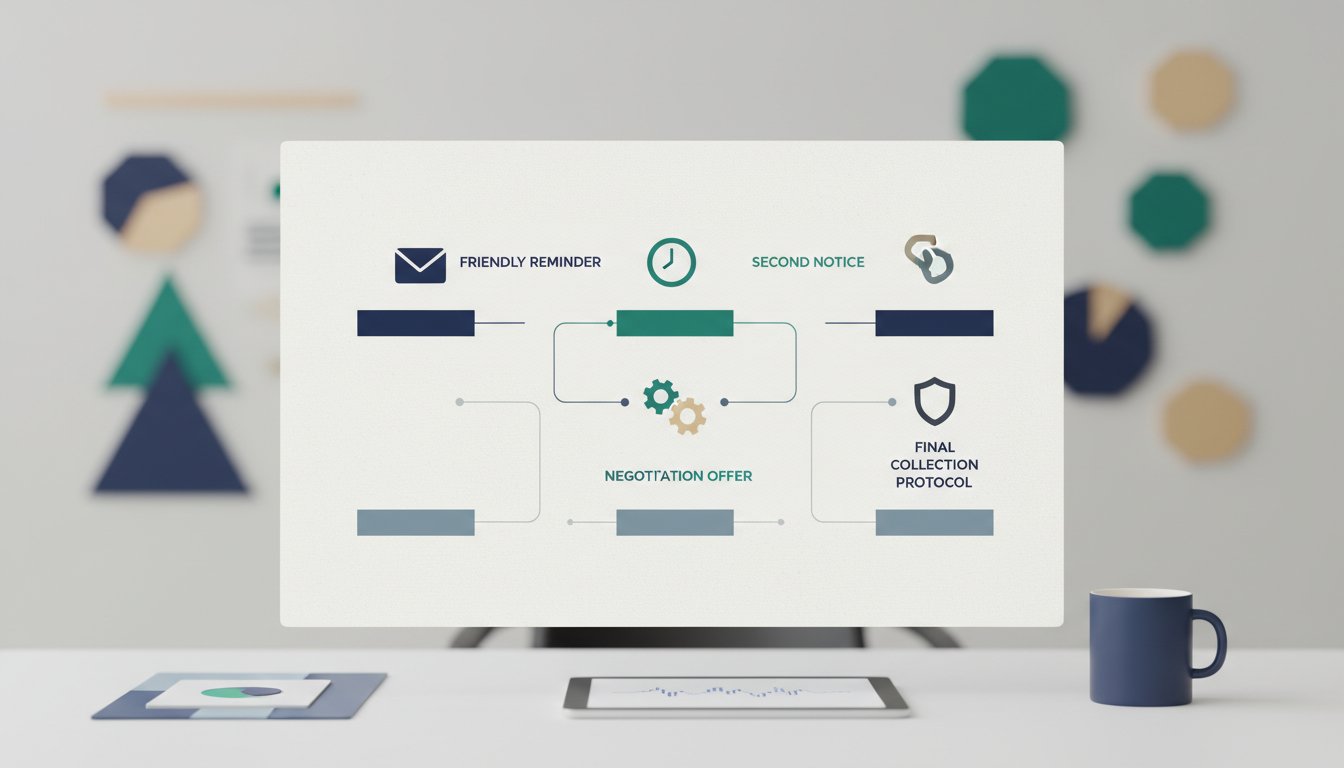
A structured, time-based escalation protocol removes emotion from the collection process. The 30-60-90 day framework provides a clear roadmap for action at each stage of delinquency, balancing firmness with professionalism.
| Days Overdue | Action Stage | Primary Actions |
|---|---|---|
| 1-30 Days | Gentle Reminder | Automated payment reminder emails; single polite follow-up email. |
| 31-60 Days | Direct Engagement | Direct phone call to the client's accounts payable or primary contact; formal email with invoice re-issued. |
| 61-90 Days | Formal Demand | Formal demand letter sent via certified mail; discussion of payment plans; notification of intent to engage collections. |
| 90+ Days | Legal/Collections | Handoff to a collections agency or filing a claim in small claims court. |
At 30 days overdue, the approach is facilitative—assuming an oversight. By 60 days, the communication shifts to investigating a genuine problem, such as a cash flow issue on the client’s end. At the 90-day mark, the conversation must turn to concrete, written resolutions, as the debt is at high risk of becoming uncollectible. This systematic progression ensures you take appropriate action at each juncture without skipping critical steps that preserve the relationship.
How to Write a Professional Payment Reminder Email
The payment reminder email is a critical tool. Its tone must remain courteous and assume good faith, while its content must be direct and action-oriented. The subject line should be clear, such as "Friendly Reminder: Invoice #INV-2025-001 Past Due."
A effective template follows this structure:
- Polite Opening: "Hope you're having a productive week."
- Direct Reference: "I'm writing to follow up on Invoice #INV-2025-001 for $12,500, which was due on Friday."
- Facilitative Language: "In case it was overlooked, I've re-attached the invoice for your convenience."
- Clear Call to Action: "Please confirm receipt and provide an expected payment date by Tuesday."
- Professional Closing: "Thank you for your prompt attention to this matter."
Avoid accusatory language like "You failed to pay." Instead, frame it as a collaborative effort to resolve an administrative matter. For a manufacturing SMB, sending this email to both the primary contact and the accounting department increases visibility. Following up with a read receipt can also confirm the message was received. The goal is to nudge, not alienate.
When and How to Make a Polite Phone Call
When an email reminder at the 30-day mark goes unanswered, a phone call is the necessary next step. This direct contact prevents the issue from being lost in an inbox and allows for immediate problem-solving. The call should be scheduled if possible, not a cold call, and framed as a check-in.
Prepare a brief script:
"Hi Michael, this is Juwon Lee from CurrentCFO. I'm calling regarding invoice #INV-2025-001 for $12,500, which is now 30 days past due. I sent a follow-up email on Monday but wanted to touch base directly. Is there an issue with the invoice, or is there a process on your end we should be aware of to facilitate payment?"
Listen actively. The client may reveal an internal approval holdup, a cash flow crunch, or a dispute with the work. Your role is to gather information. Based on their response, you can propose solutions: re-sending the invoice to a different person, clarifying a line item, or, if they indicate financial difficulty, initiating a conversation about a payment plan. Document the call's outcome and any promised next steps in a follow-up email to create a written record.
Offering Payment Plans to Recover Cash Without Losing the Client
For clients experiencing genuine short-term hardship, a structured payment plan is often the most effective way to recover cash while maintaining the relationship. A payment plan turns a potentially lost cause into a manageable stream of receivables.
The terms must be formalized in a written agreement. Key components include:
- Total Amount Owed: The original invoice total, potentially including agreed-upon late fees.
- Installment Schedule: e.g., "$5,000 upfront, followed by three monthly payments of $2,500."
- Payment Dates: Specific due dates for each installment.
- Consequences of Default: Stipulation that failure to meet a payment reverts the full remaining balance to immediate due status.
For a client who owes $15,000, a proposal might break it into three monthly payments of $5,000. This demonstrates flexibility and goodwill, but the agreement must be signed. This approach is preferable to writing off the debt or immediately engaging a collections agency, which will likely terminate the business relationship. It transforms a delinquent account into an active, performing one.
Legal Options as a Last Resort for Stubborn Non-Payers
When all diplomatic efforts fail, legal recourse is the final step. The appropriate path depends on the debt amount and jurisdictional rules.
- Small Claims Court: For debts typically under $10,000 (varies by state).2 This is a streamlined process without lawyers. You file a claim, serve the client, and present your case before a judge. It is cost-effective for smaller sums.
- Collections Agency: Agencies purchase your debt for a fraction of its value or work on contingency, taking 25-50% of what they collect.3 This option hands off the effort but yields less recovery and almost certainly ends the client relationship.
- Attorney Demand Letter & Lawsuit: For larger debts, an attorney can send a formal demand letter, which often prompts payment. If not, filing a lawsuit in civil court is the next step. This is costly and time-consuming but may be necessary for significant sums.
Before pursuing legal action, send a final demand letter via certified mail stating your intent. This last formal notice can sometimes spur payment to avoid legal proceedings. Always weigh the cost of recovery—both in fees and time—against the amount owed.
Your Next Step
Audit your accounts receivable aging report today. Identify every invoice over 30 days past due and apply the first step of the 30-60-90 framework: send a polite, professional reminder email using the template structure outlined above. Systematically addressing aging invoices is the most immediate action you can take to accelerate cash flow. For a deeper analysis of your collection processes and receivables health, detailed questions can be directed to [email protected].
Footnotes
-
State laws vary, but many align with the Uniform Commercial Code, permitting reasonable late fees. Always consult local statutes or an attorney. See https://www.law.cornell.edu/ucc/2-201 for UCC provisions on late fees. ↩ ↩2
-
Small claims court limits vary by state; for example, California's limit is $10,000, while New York's is $5,000. Check your local court's website. See https://www.ncsc.org/topics/small-claims-courts for a state-by-state directory. ↩
-
Commercial collection agency rates are typically structured on a contingency basis, ranging from 25% to 50% of the amount collected, as reported by industry surveys from the Commercial Collection Agency Association. See https://www.ccaa-com.org/industry-data for current contingency rates. ↩ ↩2