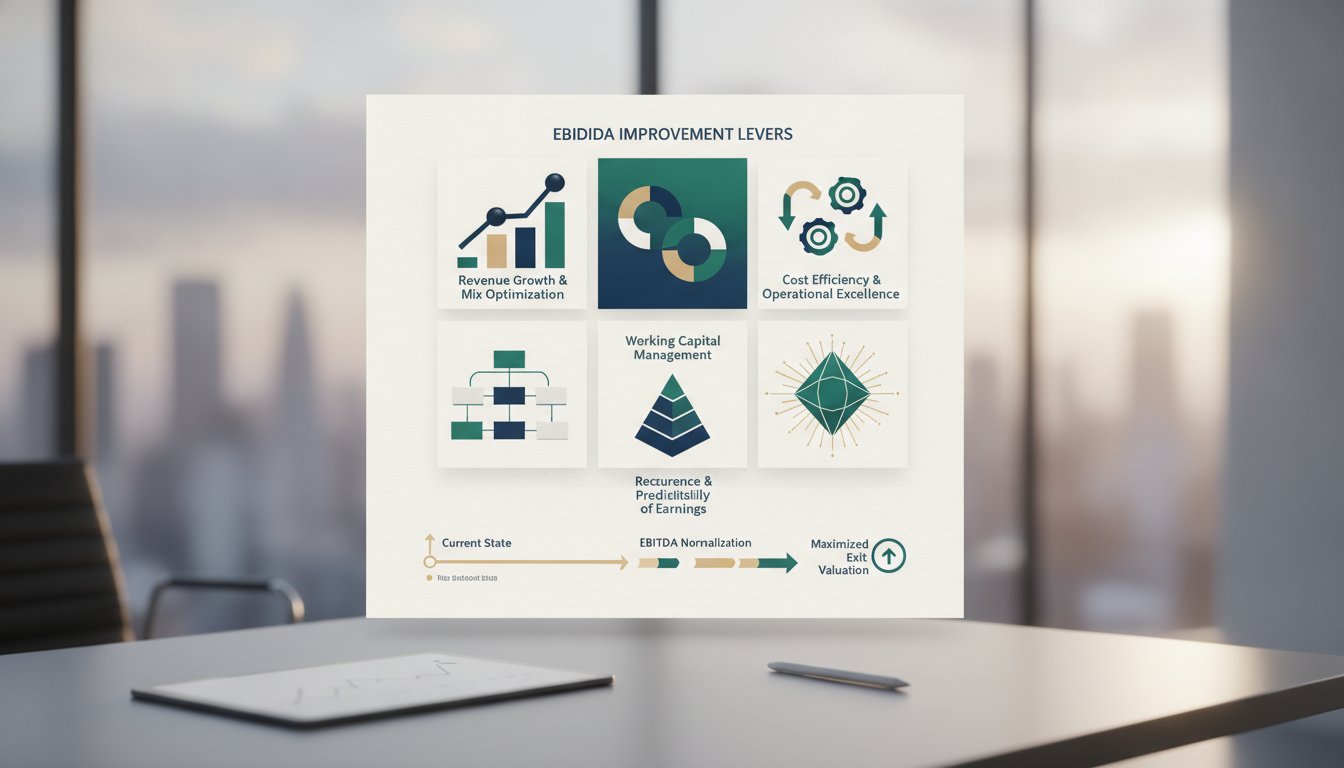
EBITDA is a measure of operating profitability that excludes financing costs, taxes, and non-cash accounting entries. For SMB owners learning how to improve EBITDA before selling business, this distinction matters because buyers use normalized EBITDA — not reported net income — to value companies. EBITDA normalization adjustments can increase SMB valuation by 3 to 5 times the adjustment amount, since most deals use a multiple of normalized EBITDA.
Why EBITDA Multiples Are the Single Biggest Lever in Your Exit
EBITDA normalization adjustments can increase SMB valuation by 3 to 5 times the adjustment amount, since most deals use a multiple of normalized EBITDA.1 For SMB owners preparing for exit, understanding how to improve EBITDA before selling business means identifying which expenses buyers will add back and which operational levers actually command higher multiples during diligence.
Buyers apply EBITDA multiples based on industry standards, growth potential, and perceived risk — improving EBITDA directly increases sale price.2 Strategic EBITDA optimization can increase business valuations by up to 45% through proven operational and financial strategies.3 The five levers below represent the specific areas buyers test during diligence, not textbook theory.
EBITDA simplifies SMB valuation comparisons by focusing on core profitability, excluding financing, taxes, and non-cash expenses.4 A business generating $1 million in EBITDA at a 5x multiple sells for $5 million. Increase that EBITDA to $1.2 million at the same multiple, and the sale price rises to $6 million — a $1 million gain from a $200,000 earnings improvement.
One of the biggest criticisms of EBITDA is that cash outlays can be recorded as expenses or assets, materially impacting the metric.5 Buyers know this. During diligence, they reconstruct your EBITDA using their own normalization framework, adding back one-time expenses, owner perks, and non-recurring costs while subtracting above-market compensation and discretionary spending.
Doreen Morgan of Sunbelt Business Brokers notes that increasing EBITDA before selling means improving normalized earnings through operational changes, not accounting tricks.6 The multiple itself depends on industry, growth trajectory, customer concentration, and risk profile. A business with recurring revenue and diversified clients commands a higher multiple than one with lumpy project revenue and three customers representing 80% of sales.
| Industry | Typical EBITDA Multiple Range |
|---|---|
| Software/SaaS | 4x - 8x |
| Manufacturing | 3x - 6x |
| Distribution | 3x - 5x |
| Professional Services | 3x - 6x |
| Retail | 2x - 4x |
Revenue Growth: Finding Profitable Revenue Before the Exit
Not all revenue is equal in a buyer's eyes. Recurring revenue with high retention rates commands a premium multiple, while one-time project revenue or low-margin wholesale accounts may actually reduce valuation. Consider a hypothetical SaaS company with $2 million in annual recurring revenue and 90% gross retention — a buyer applies a 6x multiple. If that company adds $500,000 in new ARR from annual contracts with net-90 day payment terms, the buyer values that revenue at a higher multiple than $500,000 from month-to-month customers who pay net-30.
Buyers analyze revenue quality through three lenses: concentration risk, retention rates, and gross margin stability. A business where the top three customers represent 60% of revenue faces a multiple discount, regardless of total revenue. Reducing that concentration below 25% before marketing the business signals lower risk to acquirers.
Revenue growth rate matters, but growth trajectory matters more. A business growing 15% year-over-year with clear drivers — new customer acquisition cost, lifetime value, and expansion revenue — demonstrates repeatable growth. Buyers discount growth driven by unsustainable discounting or one-time contracts.
Gross Margin Optimization: Pricing and Product Mix Adjustments
Gross margin directly influences EBITDA because every percentage point of margin improvement flows through to operating profit. A business with 40% gross margins that improves to 45% on $5 million in revenue adds $250,000 to EBITDA without adding a single new customer.
Pricing strategy is the fastest lever. A disciplined annual price increase of 3% to 5%, tied to inflation or value-added features, signals pricing power to acquirers. For a business with $3 million in COGS, a 3% price increase on $5 million in revenue adds $150,000 to gross profit — all of which drops to EBITDA if operating costs remain flat.
Product mix optimization requires analyzing which products or services generate the highest margins and shifting sales incentives toward those offerings. A distributor selling 30% margin commodity items alongside 55% margin specialty products can increase blended gross margin by reallocating marketing spend and sales commissions toward the higher-margin line.
| Margin Improvement Lever | Typical Impact on Gross Margin |
|---|---|
| Price increase (3-5%) | +2 to 4 percentage points |
| Product mix shift | +3 to 8 percentage points |
| Supplier renegotiation | +1 to 3 percentage points |
| Volume discounts from consolidation | +1 to 2 percentage points |
Operating Expense Discipline: Cutting Costs Without Cutting Growth
Buyers normalize owner-specific expenses — personal vehicles, family members on payroll, above-market salaries, travel and entertainment that serves personal rather than business purposes. These adjustments increase normalized EBITDA directly. A business showing $800,000 in reported EBITDA with $200,000 in owner perks and family salaries might show $1 million in normalized EBITDA, increasing valuation by $600,000 to $1 million depending on the multiple.
The challenge is distinguishing between discretionary costs that buyers will add back and operating expenses that signal inefficiency. Rent, insurance, and professional fees are rarely added back. Marketing spend that generates measurable ROI should remain — buyers view growth investment positively. The costs to cut are those without clear business purpose: redundant software subscriptions, excessive professional fees, above-market compensation for non-operating family members.
Buyers also scrutinize SG&A as a percentage of revenue. A business with SG&A at 25% of revenue in an industry where peers operate at 20% faces a valuation discount. Reducing SG&A by 5 percentage points on $4 million in revenue adds $200,000 to EBITDA.
Working Capital Efficiency: Freeing Cash Trapped in Operations
Working capital directly impacts the cash available at closing and the purchase price structure. A retailer with $1 million in inventory turning four times per year is more efficient than one turning twice per year. Improving inventory turns from 3x to 5x on $2 million in COGS reduces average inventory from $667,000 to $400,000, freeing $267,000 in cash.
Accounts receivable is the second working capital lever. A business with $3 million in revenue and 45-day average collection period carries $375,000 in receivables. Reducing that to 30 days frees $125,000. Buyers prefer businesses with disciplined collection practices because they indicate operational control.
Accounts payable management completes the picture. Extending payment terms from net-30 to net-45 with key suppliers, without damaging relationships, improves cash conversion cycle. The combined effect of faster receivables, slower payables, and leaner inventory can increase free cash flow by 10% to 20% without any change in revenue or margins.
Strategic Reinvestment: Timing Capital Expenditures for Maximum Impact
Capital expenditures reduce EBITDA in the year they occur, but buyers evaluate whether maintenance CapEx is sufficient to sustain operations. A business that deferred equipment maintenance for three years shows artificially inflated EBITDA — buyers discount this during diligence.
The strategic approach is to front-load necessary capital expenditures 12 to 18 months before the sale, then let the business run with normal maintenance CapEx during the marketing period. A manufacturer needing $150,000 in equipment upgrades should complete those upgrades before the buyer's quality of earnings review, not after.
Buyers also evaluate whether recent CapEx signals growth or catch-up maintenance. A business that invested $200,000 in automation that reduced labor costs by 15% demonstrates operational improvement. A business that spent $200,000 replacing broken equipment shows deferred maintenance — a red flag.
Debt Structure Optimization: Refinancing to Improve Net Income
Interest expense reduces net income but sits below EBITDA, so refinancing does not directly change EBITDA. However, lower interest payments improve cash flow available for reinvestment and signal financial discipline to buyers. Refinancing high-interest debt — say, reducing an 8% term loan to 5% — lowers annual interest expense and increases net income.
The more important consideration is debt structure at closing. Buyers prefer businesses with clean, simple capital structures. A business with multiple equipment loans, a line of credit, and seller notes creates complexity that can delay closing or reduce the purchase price. Consolidating debt into a single facility before marketing simplifies the transaction.
Debt covenants also matter. A business operating within comfortable covenant headroom demonstrates financial stability. A business approaching its debt limit signals risk. Buyers may reduce their offer to account for refinancing risk post-acquisition.
Non-Core Asset Divestiture: Selling What Doesn't Drive Your Valuation
Assets that do not contribute to core operations — real estate, excess equipment, investment accounts, or discontinued product lines — complicate valuation. Buyers value the operating business, not the real estate portfolio. Selling non-core assets before marketing simplifies the transaction and generates cash that can be distributed to the owner or reinvested in the business.
Consider a business that owns its building worth $800,000 with $200,000 in mortgage debt. The buyer wants to acquire the operating business, not the real estate. Selling the building to a third party and leasing it back at market rates removes the asset from the transaction and generates $600,000 in net proceeds for the owner. The lease payment becomes an operating expense that buyers normalize as part of ongoing operations.
Excess equipment, unused vehicles, and obsolete inventory should be liquidated before the buyer's asset appraisal. These items add no value to the transaction and create negotiation friction. A clean balance sheet with only operating assets signals a focused, well-managed business.
Your Next Step
Review your most recent 12 months of financial statements and identify every expense that is personal, one-time, or above market. Calculate what your normalized EBITDA would be with those adjustments. If the result exceeds $100,000 in additional valuation at a 4x multiple, you have a clear incentive to begin the normalization process now. For a structured review of your current EBITDA and the specific levers available in your business, contact [email protected].
Footnotes
-
https://treewalk.com/glossary/ebitda-normalization-adjustments ↩
-
https://www.sunbeltatlanta.com/blog/improve-ebitda-before-selling ↩
-
https://www.dealflowagent.com/blog/ebitda-optimization-secrets-7-strategies-increase-business-value-45-percent ↩
-
https://www.clearlyacquired.com/blog/5-ebitda-benchmarks-for-smb-valuation ↩
-
https://masource.org/education/articles/ebitda-engineering-before-selling-a-business ↩
-
https://www.sunbeltatlanta.com/blog/increase-ebitda-before-sale ↩