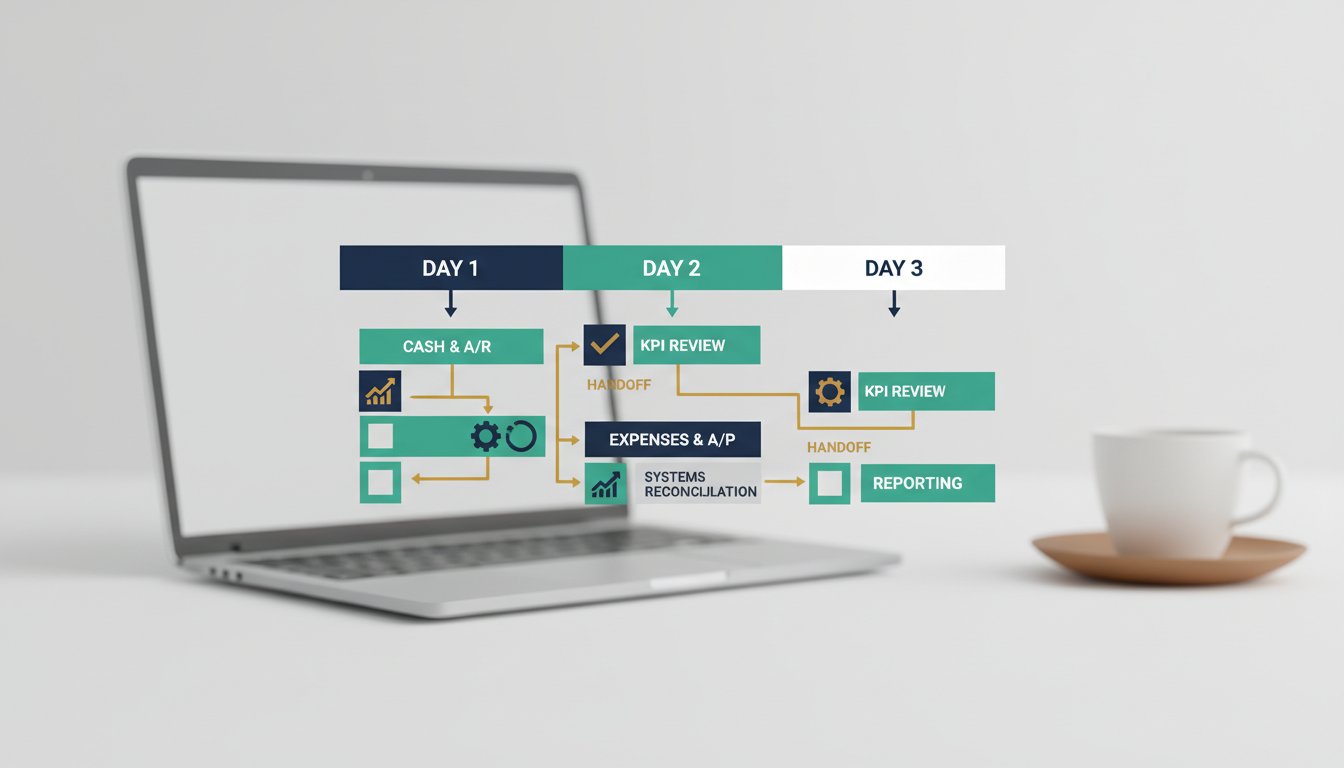
A monthly financial close process small business is a structured workflow that produces accurate, board-ready financial statements within three business days of month-end. For founders of companies in the $2M–$10M revenue range, this speed is the difference between making decisions with current data and flying blind on two-month-old numbers.
Board-ready financials require more than a clean P&L. Investors and lenders expect a complete package: income statement, balance sheet, cash flow statement, variance analysis, and rolling forecasts — all delivered within days of month-end, not weeks.
A 3-day close solves this. It compresses the workflow without cutting corners. The key difference is task sequencing: instead of one person doing everything sequentially, the 3-day model parallelizes work between the bookkeeper and the CFO or fractional finance lead. Bank reconciliations, payables review, and accrual entries happen simultaneously, not back-to-back.
The result is financials that pass investor scrutiny. Board-ready means the numbers tie to supporting schedules, variances have explanations, and cash flow reconciles to the bank statement. A 3-day close makes that achievable for a $5M company without a full-time controller.
Why a 3-Day Close Matters for Board-Ready Financials
Most SMB month-end closes drag because of three structural problems: unclear ownership, fragmented data, and manual processes.
The 2025 Ledge report found that most finance teams still rely on fragmented data and manual processes during the close1. When a founder handles receivables, the bookkeeper reconciles bank accounts, and no one owns the overall timeline, tasks fall through the cracks.
A second common bottleneck is data fragmentation. Revenue data lives in Stripe, expenses in QuickBooks, payroll in Gusto, and credit card charges across multiple portals. Pulling these together manually takes days. A Withum case study showed that process standardization alone reduced a 10-day close to 3 days2.
The third issue is the absence of a monthly close checklist. Without a written procedure, each month becomes a fire drill. Tasks get missed, adjustments are forgotten, and the balance sheet never fully reconciles.
The Three-Day Close: What Changes and What Stays
The 3-day close does not change the underlying accounting — GAAP still requires accrual accounting for audited financials3. What changes is the workflow design.
| Aspect | Traditional Close (5-10 days) | 3-Day Close |
|---|---|---|
| Task ownership | Unclear or single person | Clear delegation matrix |
| Data collection | Manual, sequential | Automated feeds + checklists |
| Reconciliation | Done after all entries | Done in parallel with entries |
| Review cycle | End of process | Daily checkpoints |
| Deliverable | Basic P&L | Full board-ready package |
The core accounting tasks remain the same: record revenue, pay bills, reconcile accounts, book accruals, review financials. What changes is the order and who does what.
For a $3M SaaS company, the bookkeeper handles bank reconciliations and payables on days one and two. The CFO or fractional finance lead reviews revenue recognition, books deferred revenue adjustments, and prepares the board deck on day three. No one waits for someone else to finish.
Day One: Clean Up Receivables and Payables
Start with receivables. Pull the accounts receivable aging report and identify every invoice past due. For a typical $5M business, this might mean reviewing 30 to 50 open invoices. Flag any that are over 60 days outstanding — these need a reserve or a collection call. Record the allowance for doubtful accounts based on historical write-off rates.
Payables follow. Confirm all bills received before month-end are recorded. For a business with net-30 or net-60 terms, this means matching purchase orders to invoices and flagging anything over 90 days past due. Deferred revenue adjustments also happen today — recognize revenue where performance obligations have been satisfied.
The goal by end of day one: all revenue and expenses for the month are recorded in the accounting system. Nothing is waiting in an inbox or a shoebox.
Day Two: Reconcile Bank Accounts and Credit Cards
Day two is reconciliation day. Every bank account, credit card, and merchant processing account must tie to the general ledger.
Start with the main operating account. Compare every cleared transaction in the bank feed to the entries in QuickBooks or Xero. Investigate any discrepancy larger than $504. For a business running 200 transactions per month, this takes two to three hours if the books are clean.
Next, credit cards. Credit card reconciliations are the most common source of errors in SMB closes. Charges post at different times, refunds appear weeks later, and personal expenses get mixed in. Pull the statement, match each charge to a receipt, and flag any that lack documentation.
Finally, merchant accounts. Stripe, Square, or PayPal balances rarely match the bank deposit exactly because of fees and settlement timing. Record the fee adjustment and confirm the net deposit ties to the bank statement.
By end of day two, cash and credit cards are fully reconciled. The balance sheet is starting to take shape.
Day Three: Review P&L, Balance Sheet, and Cash Flow
Start with the P&L. Compare actual results to the budget or prior period. For a $4M retailer, if cost of goods sold jumped from 42% to 48% of revenue, investigate why. Write a one-sentence variance explanation for any line item that deviates significantly from the budget.
Next, the balance sheet. Every account should have a supporting schedule. Prepaid expenses should tie to the amortization schedule. Accrued liabilities should match the payroll accrual. Deferred revenue should reconcile to the contract log. For example, if the cash account shows $247,000 but the bank statement says $245,000, find the $2,000 difference.
Finally, the cash flow statement. The SBA recommends maintaining six months of operating expense reserves5. The cash flow statement shows whether the business is building or burning those reserves. If operating cash flow is negative three months in a row, that is a board-level discussion.
The deliverable: a complete financial package with P&L, balance sheet, cash flow statement, and variance commentary — ready for the board meeting on Friday.
Automation Tools That Cut Close Time by 80 Percent
Automation is what makes a 3-day close realistic for a $2M business with a part-time bookkeeper.
| Tool Category | Example | Time Saved Per Month |
|---|---|---|
| Bank feed automation | QuickBooks Bank Feeds, Xero | 4-6 hours |
| Receipt capture | Expensify, Dext | 2-3 hours |
| Revenue reconciliation | Stripe dashboard, Chargebee | 2-4 hours |
| Payroll integration | Gusto, Rippling | 1-2 hours |
| Close management | FloQast, Cube | 3-5 hours |
Bank feed automation eliminates manual data entry. Receipt capture tools let employees photograph receipts on their phone, which auto-matches to credit card charges. Revenue reconciliation tools pull subscription data directly into the accounting system.
The total time savings from a fully automated stack is roughly 12 to 20 hours per month — enough to reduce a 10-day close to 3 days without adding headcount.
How a Fractional CFO Keeps Your Close on Schedule
A fractional CFO brings the process design and oversight that a bookkeeper alone cannot provide. Fractional CFO services typically cost $3,000 to $8,000 per month, compared to $150,000 or more for a full-time controller6.
The fractional CFO's role in the 3-day close is threefold. First, they design the monthly close checklist and delegation matrix — who does what, by when, and how to escalate issues. Second, they perform the day-three review, variance analysis, and board deck preparation. Third, they serve as the accountability mechanism. If the bookkeeper misses a day-one task, the CFO catches it on day two and adjusts.
For a $6M manufacturing company, the fractional CFO might spend four hours per month on the close: one hour reviewing day-one output, one hour on day-two reconciliations, and two hours on day-three analysis and board preparation. The bookkeeper handles the remaining 15 hours of data entry and reconciliation.
Your Next Step
Download the monthly close checklist template from CurrentCFO's resource library. It includes the day-by-day task list, delegation matrix, and variance analysis template used by many mid-market companies to produce board-ready financials in three days. Map your current close process against the template and identify the three tasks that take the longest. Those are your automation or delegation priorities. For a free 30-minute close process audit, email [email protected].
Footnotes
-
https://www.ledge.co/content/month-end-close-benchmarks-for-2025 ↩
-
https://www.withum.com/resources/case-study-business-processes-month-end-close-acceleration/ ↩
-
https://whipplewood.com/insights/monthly-close-checklist-for-small-business/ ↩
-
https://www.sba.gov/business-guide/manage-your-business/manage-cash-flow ↩