Disclaimer: This is not financial advice. Always consult a licensed professional for your specific situation.
Why a 13-Week Forecast is Your Business's Financial Compass
You check your bank balance and see a healthy number. Two weeks later, payroll is due, a large vendor invoice hits, and suddenly you're scrambling. This is the reality for many small business owners who manage by the rearview mirror. A 13 week cash flow forecast solves this by forcing you to look ahead. It transforms your cash position from a historical fact into a predictable, manageable resource. According to a U.S. Bank study, 82% of business failures are due to poor cash flow management1. A weekly forecast is your primary tool to avoid becoming part of that statistic.
Unlike a monthly P&L, a weekly forecast operates on your business's actual heartbeat—the timing of cash moving in and out. It answers the critical questions: Will we have enough cash to cover payroll in five weeks? Can we afford that new piece of equipment next month? When will we hit our next cash low point? This guide provides the exact framework I used as a CFO to steer companies through turnarounds and growth phases.
What You Need Before You Start Building
You can't build an accurate forecast with guesses. Start by gathering these three core data sources.
1. Your Historical Bank Statements: Pull the last 3-6 months of statements. You're looking for patterns in both income and expenses. How consistent are your client payments? Do certain utilities spike quarterly? This history is the foundation of your projection.
2. Your Accounts Receivable (A/R) Aging Report: This tells you what cash is scheduled to come in. List every outstanding invoice, the client, the amount, and, most importantly, the due date. This report is your single most reliable source for near-term cash inflow projections.
3. Your Upcoming Bills and Payroll Schedule: Gather all known upcoming expenses. This includes:
- Vendor invoices (with due dates)
- Payroll dates and amounts (including taxes)
- Loan or credit card payments
- Estimated tax payments (quarterly for many businesses)
- Rent, software subscriptions, and other fixed costs
With these in hand, you're ready to build. To skip the setup and jump straight to forecasting, you can download our pre-built Free Cash Flow Template.
Step-by-Step: Building Your 13-Week Forecast in Excel
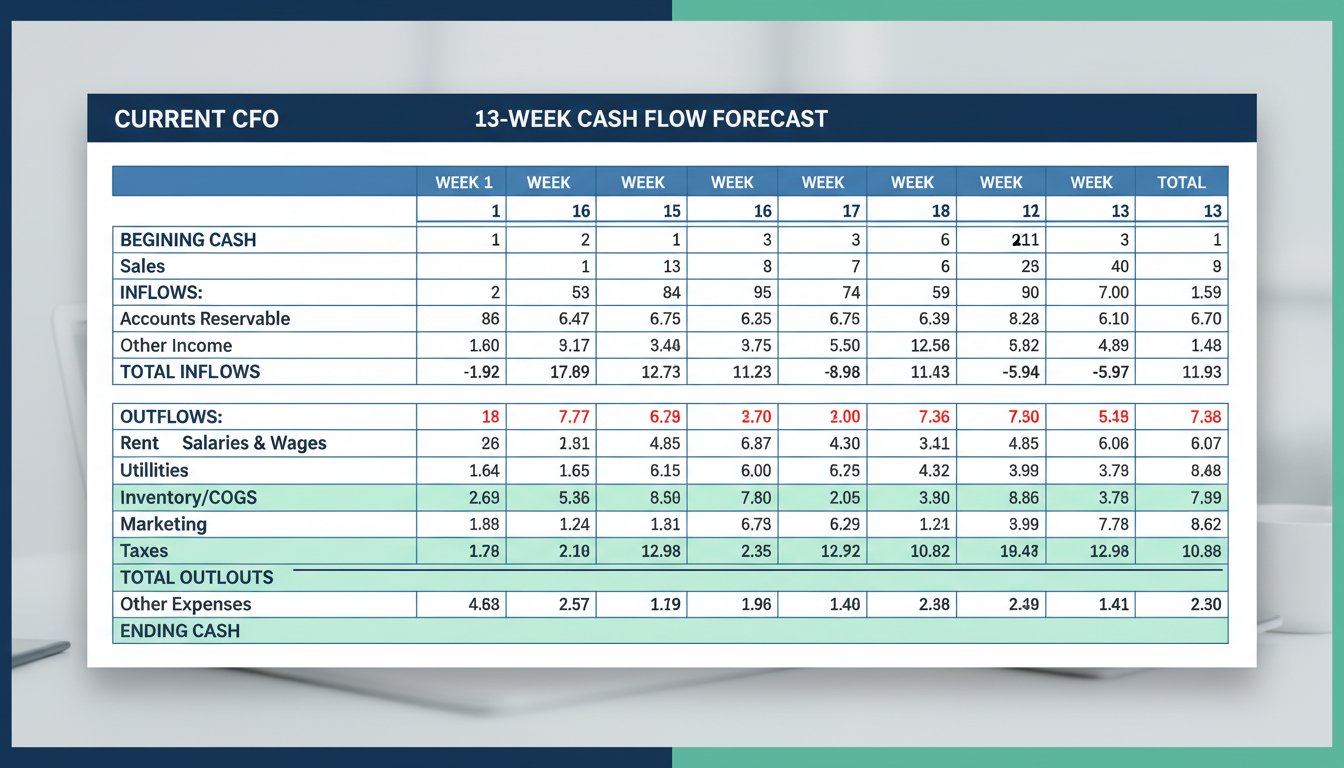
Open a new Excel workbook. You will create four main sections: Starting Cash, Cash In, Cash Out, and Ending Cash.
Step 1: Set Up Your Timeline In Row 1, starting at Column C, label each column with the next 13 week-ending dates (e.g., 4/18/2026, 4/25/2026, etc.). This creates your rolling 13-week window.
Step 2: Log Your Starting Cash (Week 0) In Row 2, label it "Beginning Cash Balance." In Column B next to it, input your actual, current bank account balance. This is your Week 0 starting point. This number will feed into your Week 1 calculation.
Step 3: Forecast Cash inflows (Rows 3-10+) Create a section for "Cash Inflows." Break down your income into logical lines for better accuracy:
- Row 3: Client A Payments (reference your A/R Aging)
- Row 4: Client B Payments
- Row 5: Retail Sales (if applicable)
- Row 6: Other Income
- Row 7: TOTAL CASH IN (a sum formula for each week's column)
Place the dollar amounts in the week you expect the cash to hit your bank account, not when you invoice. If Client A's $5,000 invoice is due April 25th, and they typically pay 3 days late, place it in the week ending May 2nd.
Step 4: Forecast Cash Outflows (Rows 11-30+) Create a section for "Cash Outflows." Detail is key here:
- Row 11: Payroll
- Row 12: Payroll Taxes
- Row 13: Rent
- Row 14: Key Vendor 1
- Row 15: Key Vendor 2
- Row 16: Loan Payment
- Row 17: Marketing Spend
- Row 18: Owner's Draw
- Row 19: TOTAL CASH OUT (a sum formula for each week)
Step 5: Calculate Your Weekly Ending Balance
This is the magic row. Create a row labeled "Ending Cash Balance."
The formula for each week is: Beginning Balance + Total Cash In - Total Cash Out.
The "Ending Cash Balance" for Week 1 becomes the "Beginning Cash Balance" for Week 2, and so on. This creates the rolling linkage through all 13 weeks.
| Forecast Component | What to Include | Pro Tip for Accuracy |
|---|---|---|
| Starting Cash | Checking account balance for all business accounts. | Use yesterday's closing balance, not today's pending transactions. |
| Cash Inflows | Customer payments, deposit refunds, grant disbursements. | Use your A/R Aging report; be conservative on timing. |
| Cash Outflows | Payroll, rent, vendor bills, loan payments, estimated taxes. | Include all owners' draws or dividends. |
| Ending Balance | Calculated (Start + In - Out). | Highlight any week where the balance falls below your safety threshold (e.g., 2x weekly payroll). |
Interpreting Your Forecast: From Data to Decisions
A forecast is useless unless you act on it. Look for these three critical patterns:
1. Identify Your Cash Runway. How many weeks until your "Ending Cash Balance" hits zero or a dangerous minimum? This is your runway. If it's less than 4 weeks, you have an urgent problem. Your immediate actions should focus on accelerating inflows (collecting A/R) or delaying outflows (negotiating terms with vendors).
2. Spot Seasonal Dips and Upcoming Crunches. You might see a tight week in Week 7 due to a large tax payment, followed by a strong week in Week 9 from a big project completion. Seeing this in advance allows you to plan. Can you arrange a short-term line of credit to bridge Week 7? Can you incentivize early payment from the Week 9 client?
3. Model "What-If" Scenarios. This is the superpower of your model. Duplicate your forecast tab and run scenarios:
- Best Case: A new big client pays 50% upfront.
- Worst Case: Your top client pays 30 days late.
- Investment Case: What if you hire that new employee in Week 8? Add their salary and payroll taxes to your "Cash Out" section and see the impact on your runway.
Seeing these scenarios on paper removes emotion from decision-making and replaces it with clarity.
Common Pitfalls to Avoid in Your Cash Flow Forecast
Even with a great template, forecasts can be misleading. Steer clear of these mistakes:
- Optimism Bias in Sales Projections: It's tempting to project that new marketing campaign will double sales. Instead, base inflows on your sales pipeline's worst-case close rates and historical payment patterns. Under-promise and over-deliver to your own forecast.
- Forgetting Irregular Expenses: Your $5,000 annual insurance premium or $15,000 estimated tax payment will sink you if it's not in the model. Create a separate row for each known, large, irregular expense and place it in the correct week.
- Ignoring the Timing Difference: The #1 error is confusing profits for cash. You may have a profitable month on your P&L, but if all your invoices are paid on Net-60 terms, your cash flow for that month could be deeply negative. Your forecast must follow the cash, not the accrual accounting principle.
- Setting and Forgetting: A forecast is a living document. Every Monday, update Week 1 with actual cash in and out, and add a new Week 14 to the end. This "rolling forecast" practice keeps your view perpetually 13 weeks ahead.
Using Your Forecast to Secure Financing
A solid 13 week cash flow forecast is more than an internal tool; it's a credibility engine with lenders and investors. When you walk into a bank for a line of credit, presenting this document shows you are a sophisticated operator who understands your business's financial rhythm.
It demonstrates you know exactly why you need the money (to bridge the gap in Week 7), how much you need (the minimum balance you must maintain), and how you will repay it (from the inflows projected in Weeks 9-12). This level of detail significantly increases your chances of approval and often leads to better terms. The U.S. Small Business Administration explicitly recommends detailed cash flow projections as part of any loan application package2.
Your Next Step: From Insight to Action
You now have the blueprint to build your 13 week cash flow forecast. This model will shift your mindset from reactive to proactive, giving you control over your business's most vital resource.
The single most important thing you can do today is to start. Use the data you've gathered and begin populating your first version. Your initial forecast will be imperfect, and that's okay. The act of building it will reveal gaps in your knowledge and force the financial clarity you need.
To save hours of Excel setup, download our free, pre-formatted template. It includes all the formulas, sections, and a guide to get your first forecast running in under 30 minutes.
Download Your Free 13-Week Cash Flow Excel Template Here
If you've built your forecast and identified a concerning cash gap or simply want an expert review, I offer a limited number of free consultations each week to discuss SMB financial strategy.
Book a Free Cash Flow Strategy Call