Revenue Stage 1: Pre-Revenue and Early-Stage — Prioritize R&D Credits and NOL Carryforwards
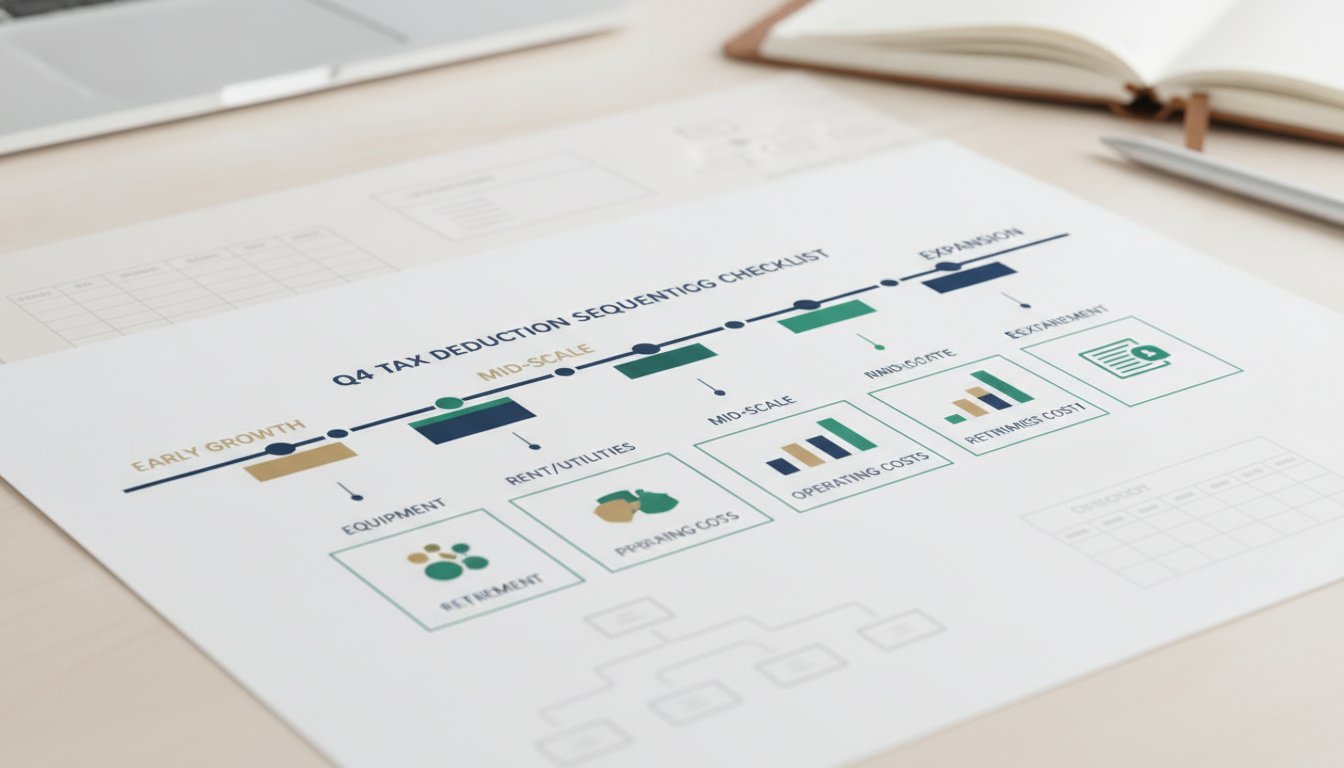
A q4 tax deduction checklist small business owners use is a revenue-stage-specific sequencing guide that tells you which deductions to accelerate and which to defer before the calendar year closes. Getting the order wrong can trigger the Alternative Minimum Tax (AMT) or leave money on the table.
For pre-revenue and early-stage companies, the primary tax objective is generating net operating losses (NOLs) that can offset future taxable income. Under current law, NOLs arising in tax years beginning after 2020 can only offset 80% of taxable income and cannot be carried back, but can be carried forward indefinitely.1 This makes the timing of your first profitable year critical.
Consider a hypothetical SaaS startup that has spent $200,000 on software development costs in 2025 with zero revenue. Those R&D expenses should be fully captured under Section 174 capitalization rules, and the resulting NOL carries forward to offset future subscription income. The key Q4 move here is ensuring all contractor invoices for development work are received and paid by December 31 — not January 2 — to lock the deduction into the current tax year.
The qualified business income (QBI) deduction under Section 199A is irrelevant at this stage since there is no positive taxable income to reduce.2 Focus instead on documenting all startup costs under Section 195, which allows deducting up to $5,000 in organizational costs in the first year, with the remainder amortized over 180 months.
Revenue Stage One: Pre-Revenue and Early-Stage Deduction Priorities
Within the pre-revenue stage, deduction sequencing follows a clear priority order. First, capture all ordinary and necessary business expenses under Section 162 — rent, software subscriptions, professional fees, and marketing costs. Second, maximize Section 179 expensing for any equipment purchased, which allows immediate expensing of up to $1,220,000 for qualified property in 2025, with phase-out starting at $3,050,000.3
Third, document home office and vehicle deductions under the simplified or actual method. For a solo operator using a home office exclusively and regularly for business, the simplified method allows $5 per square foot up to 300 square feet, yielding a maximum $1,500 deduction without complex recordkeeping.
Fourth, ensure all estimated tax payments for Q4 2025 are made by January 15, 2026. Failure to make sufficient payments can result in underpayment penalties under IRC Section 6654.4 For a pre-revenue company with no tax liability, filing a return showing zero liability avoids the penalty entirely.
The $179 vs Bonus Depreciation Decision for Equipment Purchases
The choice between Section 179 expensing and bonus depreciation depends on your taxable income and the type of asset. Section 179 is limited to your taxable income from the business — you cannot create or increase an NOL with Section 179 alone. Bonus depreciation has no such income limitation and can generate an NOL.
For 2025, bonus depreciation is set at 40% for property placed in service in 2025, down from 60% in 2024, and will continue to phase down to 20% in 2026.5 This declining rate creates a strong incentive to place qualifying property in service before December 31, 2025.
| Decision Factor | Section 179 | Bonus Depreciation |
|---|---|---|
| Income limitation | Limited to taxable income | No income limit |
| Property types | New and used qualified property | Generally new property only |
| 2025 maximum | $1,220,0003 | 40% of cost5 |
| Creates NOL | No | Yes |
| Phase-out threshold | $3,050,000 total purchases3 | No phase-out |
For a typical SMB with $500,000 in taxable income considering a $100,000 piece of used manufacturing equipment, Section 179 allows full expensing of the entire cost. For a business with $50,000 in taxable income, bonus depreciation on new equipment may be more strategic since it can generate an NOL carryforward.
Home Office and Vehicle Deductions for Solo Operators
Solo operators and single-member LLCs should evaluate both the simplified and actual methods for home office deductions before year-end. The simplified method caps at $1,500 and requires no depreciation recapture upon sale of the home. The actual method captures a percentage of mortgage interest, utilities, insurance, and repairs based on the square footage of the dedicated office space.
For vehicle deductions, the standard mileage rate for 2025 is 70 cents per business mile. A solo operator driving 10,000 business miles would deduct $7,000 under the standard method — for example, a real estate agent visiting 15 client properties per week. The actual method captures depreciation, gas, insurance, and repairs — typically yielding a higher deduction for newer, more expensive vehicles.
The critical Q4 move is reconciling your mileage log. If you have been tracking miles inconsistently, reconstruct a reasonable estimate before December 31 based on calendar appointments, client locations, and delivery records. The IRS accepts reconstructed logs if they are prepared before the return is filed.
Revenue Stage Two: Scaling Teams and Retirement Plan Deadlines
Companies with 5-50 employees face a different set of Q4 deadlines. Retirement plan contributions are the most time-sensitive deduction available. SEP IRA contributions can be made as late as the tax filing deadline, including extensions, but the plan must be established by October 1 for the current tax year — or by December 31 for a new 401(k) plan.
For a hypothetical company with $2 million in revenue and $400,000 in owner compensation, a SEP IRA allows contributions of up to 25% of compensation, capped at $70,000 for 2025. That is a $70,000 deduction that must be planned before year-end even though the cash contribution can wait until October 2026.
Payroll timing also matters. Wages paid in December 2025 are deductible in 2025. Wages paid in January 2026 for work performed in December 2025 are deductible in 2026 under the cash method.
For accrual-method taxpayers, the deduction is allowed in 2025 if the liability is fixed and determinable by year-end and payment occurs within 2.5 months after year-end.
Revenue Stage Three: Inventory, COGS, and Cost Segregation Studies
Businesses with physical inventory should evaluate the last-in-first-out (LIFO) method before year-end. LIFO can reduce taxable income in periods of rising costs by matching current higher costs against current revenue. The election must be made with the tax return for the year of adoption.
Cost segregation studies are the single largest one-time deduction opportunity for businesses that have purchased or constructed commercial real estate. A cost segregation study reclassifies building components from 39-year property to 5-, 7-, or 15-year property, accelerating depreciation dramatically.
| Asset Class | Standard Depreciation | After Cost Segregation |
|---|---|---|
| Building shell | 39 years | 39 years |
| Electrical systems | 39 years | 5-7 years |
| Plumbing | 39 years | 5-7 years |
| Flooring | 39 years | 5-7 years |
| Land improvements | 15 years | 15 years |
For a hypothetical retailer that purchased a $1.5 million building in 2025, a cost segregation study typically reclassifies 20-30% of the cost to shorter-lived assets. On $300,000 of reclassified assets with 5-year MACRS and 40% bonus depreciation, the first-year deduction jumps from approximately $7,700 to $132,000.1
Revenue Stage Four: Entity Structure Review and QBI Optimization
Companies approaching $5–10 million in revenue — for example, a growing SaaS firm or a multi-location professional practice — should evaluate whether their current entity structure optimizes the QBI deduction. The Section 199A deduction allows eligible pass-through entities to deduct up to 20% of qualified business income, subject to phase-in thresholds for specified service trades or businesses (SSTBs).2
For 2025, the QBI phase-in for SSTBs begins at $197,300 for single filers and $394,600 for married filing jointly.3 Above these thresholds, the deduction phases out entirely for SSTBs. For non-SSTBs, the deduction is limited by the greater of 50% of W-2 wages or 25% of W-2 wages plus 2.5% of the unadjusted basis of qualified property.
The corporate tax rate remains a flat 21% under the Tax Cuts and Jobs Act, with no scheduled sunset for C-corporations.6 For a business generating $2 million in pass-through income, the QBI deduction at 20% saves $400,000 in tax at the individual level. Converting to a C-corporation eliminates the QBI deduction entirely but taxes retained earnings at the flat corporate rate rather than the individual top marginal rate.
Revenue Stage Five: M&A Prep and Deferred Tax Liability Planning
Companies preparing for a sale within 12-24 months should defer deductions and accelerate income in Q4. This strategy increases reported earnings, which directly impacts valuation multiples. For example, a business valued at 5x EBITDA that defers $100,000 in deductions to the post-sale period increases the sale price by $500,000.
The Alternative Minimum Tax (AMT) for corporations was repealed by the TCJA, but individual AMT remains with exemption amounts of $85,700 for married filing jointly in 2025, phasing out at $609,600.7 For a founder selling their business as an individual, AMT planning is essential. Incentive stock option (ISO) exercises in the year of sale can trigger AMT, and the timing of the exercise relative to the sale date determines whether the spread is AMT income or capital gain.
Deferred tax liability planning also involves reviewing net operating loss carryforwards. NOLs generated in prior years can offset only 80% of taxable income in the year of sale.1 If the business has $500,000 in NOL carryforwards and $2 million in taxable income in the sale year, only $1.6 million of income can be offset, leaving $400,000 taxable.
Your Next Step
Run a preliminary Q4 deduction projection using your current year-to-date financials. Compare your projected taxable income against the AMT exemption thresholds and QBI phase-in ranges. If you are within 20% of any threshold, schedule a 30-minute review with a tax professional before December 15. For a structured Q4 deduction sequencing template tailored to your revenue stage, email [email protected].
Footnotes
-
https://www.irs.gov/newsroom/irs-provides-guidance-on-net-operating-losses ↩ ↩2 ↩3 ↩4
-
https://www.irs.gov/newsroom/tax-cuts-and-jobs-act-a-comparison-for-businesses ↩ ↩2
-
https://www.irs.gov/businesses/small-businesses-self-employed/estimated-taxes ↩
-
https://www.irs.gov/businesses/depreciation-bonus-depreciation ↩ ↩2
-
https://www.irs.gov/newsroom/tax-cuts-and-jobs-act-a-comparison-for-businesses ↩