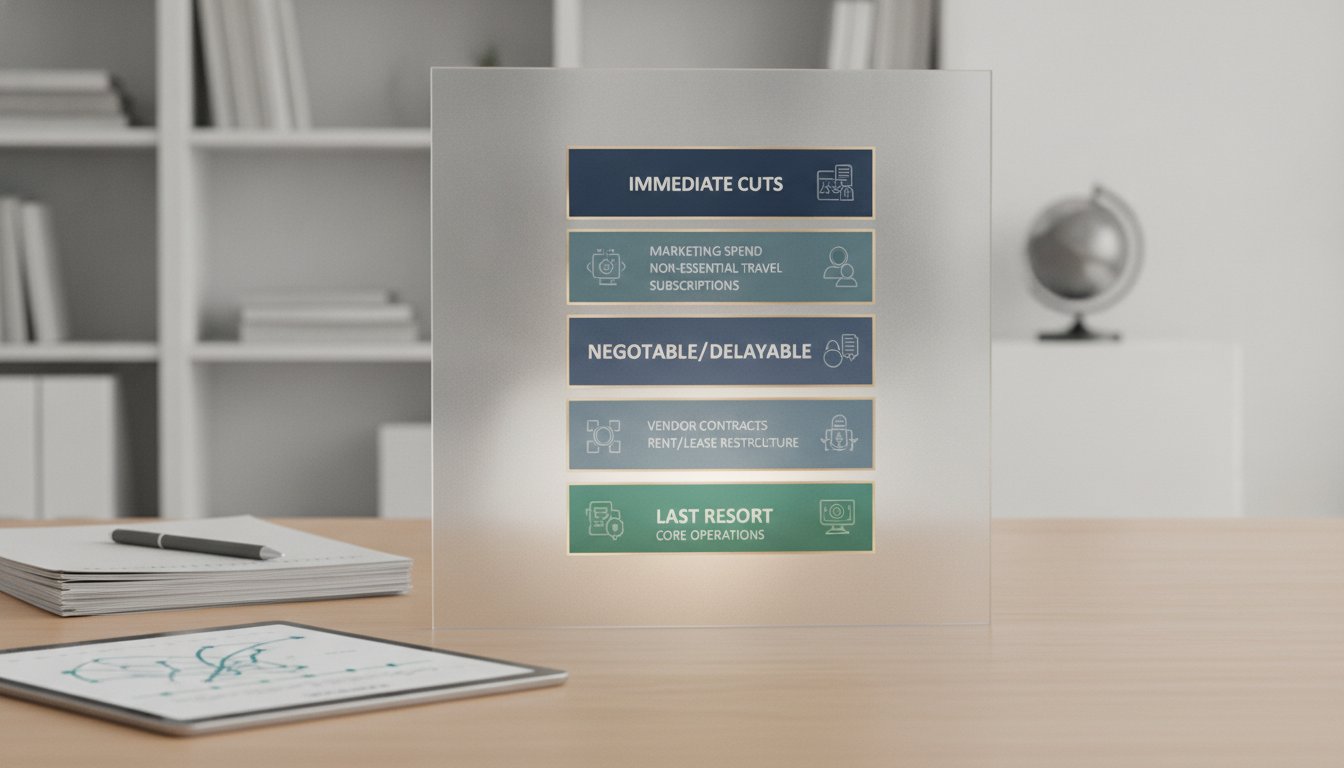
The 48-Hour Cash Flow Triage: What to Stop Paying First
A cash flow crisis playbook small business owners need is a ranked triage system that prioritizes legal risk and relationship impact over expense size. When cash runs short, the instinct is to freeze all spending, but that approach can destroy vendor relationships and trigger personal liability faster than the cash shortage itself.
The first 48 hours determine whether a cash crisis becomes a business failure. The triage framework has three tiers based on legal consequence and operational criticality.
Tier 1 — Stop immediately (zero legal risk, low operational impact):
- Software subscriptions not used in the last 30 days
- Office snacks, meals, and non-essential travel
- Professional development courses and conference registrations
- Any recurring charge that can be reinstated within 24 hours
Tier 2 — Pause and negotiate (moderate operational impact):
- Marketing spend not tied to a confirmed pipeline deal
- Contractor or agency retainers with 30-day cancellation clauses
- Equipment leases with buyout options
Tier 3 — Never stop without legal counsel (high legal risk):
- Payroll tax deposits (IRS trust fund recovery penalty applies)1
- Sales tax payments (personal liability in most states)
- Secured debt payments (triggers acceleration clauses)
The 13-week cash flow forecast is the standard CFO planning horizon for crisis management.2 Build this forecast within the first 48 hours before making any Tier 2 or Tier 3 decisions.
Fixed Costs That Look Essential But Aren't
Fixed costs feel untouchable because they are recurring, but many carry cancellation terms that make them safe to pause.
| Fixed Cost | Typical Notice Period | Risk of Pausing | Recommended Action |
|---|---|---|---|
| Cloud infrastructure (AWS, Azure) | 30 days | Data loss if not backed up | Downgrade to reserved instances, not cancel |
| Insurance (general liability, workers' comp) | 10-30 days | Legal exposure, contract violations | Switch to monthly payments, do not cancel |
| Office lease | 30-90 days | Breach of contract, eviction | Sublease or negotiate rent deferral |
| Phone and internet | 30 days | Operational shutdown | Negotiate rate reduction, do not cancel |
| Accounting software | Immediate | Loss of financial records | Downgrade to lower tier |
Consider a hypothetical retailer paying $2,400 per month for a POS system with a three-year contract. The cancellation penalty is $8,0001, but the vendor will agree to a six-month payment deferral if asked. Most SMB owners never ask.
The mistake is treating all fixed costs as equal. A $200 monthly CRM subscription with no cancellation fee should be cut before a $2,000 monthly warehouse lease that would cost $15,000 to break.
Variable Expenses: Which Line Items Kill Margins Fastest
Variable expenses are dangerous because they scale with revenue but rarely scale down as fast when revenue drops. The worst offenders are cost of goods sold (COGS) line items with thin margins.
Three variable expenses to audit immediately:
-
Expedited shipping and rush fees. A typical e-commerce business spends 8-12% of COGS on premium shipping that customers did not pay for. Switch all orders to ground shipping and set a 48-hour processing window.
-
Payment processing fees. Stripe, PayPal, and Square charge 2.5-3.5% per transaction1. For a business processing $50,000 per month, that is $1,250-$1,750 in fees. Negotiate a volume discount or switch to a flat-rate processor.
-
Third-party fulfillment labor. Many SMBs pay 20-30% above market rate for temporary warehouse staff through staffing agencies1. For example, direct-hire part-time workers at $18-$22 per hour cost significantly less than paying agencies $30-$35 per hour.
The key metric is contribution margin per unit. If a product line has a contribution margin below 30%1, it is burning cash on every sale. Pause that product line during the crisis and redirect inventory to higher-margin items.
The Payroll Decision: When to Cut Hours vs Headcount
Payroll is typically the largest expense and the most emotionally charged decision. The legal framework is clear: payroll taxes are trust fund taxes, and the IRS trust fund recovery penalty (Section 6672) holds business owners personally liable for unpaid payroll taxes.1
Cut hours first. Reduce all salaried employees to a 32-hour work week. This preserves health insurance eligibility under the ACA (30 hours is the threshold) and keeps the team intact. For a hypothetical company with 15 employees averaging $55,000 per year, a 20% hour reduction saves approximately $165,000 annually without severance costs.
Cut headcount only when hours are insufficient. The rule of thumb: if a substantial hour reduction — for example, 20% — does not close the cash gap within 90 days, reduce headcount by the minimum number needed. Use the following criteria for selection:
- Roles that do not directly generate revenue
- Roles that can be outsourced for less than the fully loaded cost
- Roles where the employee has been with the company less than 12 months (lower unemployment insurance impact)
Document every decision with a written business justification. State unemployment insurance claims are often challenged, and a clear paper trail protects against false claims.
Vendor Contracts You Can Renegotiate This Week
Most vendor contracts contain renegotiation provisions that SMB owners never use. The standard approach: call the vendor, explain the cash situation honestly, and ask for one of three concessions.
| Concession | Typical Success Rate | Impact on Cash |
|---|---|---|
| Net-30 to net-60 payment terms | 60-70% | Delays cash outflow by 30 days |
| 10% volume discount for 12-month commitment | 40-50% | Reduces ongoing cost |
| 90-day payment deferral with interest | 30-40% | Provides immediate breathing room |
The conversation script: "We value your service and want to continue the relationship. We are experiencing a temporary cash flow constraint. Can we move to net-60 terms for the next three months? If not, can you offer a discount — for example, 10% — for a 12-month prepaid commitment?"
Vendors prefer renegotiation over losing a customer. The cost of acquiring a new customer is 5-7x the cost of retaining an existing one, and most vendors know this.
Marketing Spend That Isn't Driving Immediate Revenue
Marketing is the easiest category to cut emotionally but the hardest to cut intelligently. The rule: cut anything that does not generate a lead within 30 days.
Cut immediately:
- Brand awareness campaigns (billboards, podcast sponsorships, display ads)
- Content marketing with a 6-month SEO horizon
- Trade show booth fees and travel
- Agency retainers for "strategy" without execution
Maintain or reduce:
- Google Ads with a positive ROAS (reduce budget by a meaningful percentage, do not pause)
- Email marketing to existing customers (highest ROI channel)
- Retargeting campaigns (lowest cost per conversion)
For a hypothetical SaaS company spending $15,000 per month on marketing, the breakdown might be $6,000 on brand awareness, $5,000 on Google Ads, $2,000 on email, and $2,000 on retargeting. Cutting the brand awareness spend saves $6,000 immediately with zero impact on current pipeline1.
The mistake is pausing all marketing. When cash flow recovers, rebuilding a paused campaign costs 2-3x more than maintaining a reduced one.
Debt Service Prioritization During a Cash Crunch
Not all debt is equal. Missing the wrong payment can trigger personal guarantees, accelerate the entire loan balance, or destroy a banking relationship that took years to build.
Priority 1 — Secured debt with personal guarantees. SBA 7(a) loans guarantee up to 85% of loan amounts under $150,000, but the personal guarantee means the bank can come after personal assets.3 Never miss this payment without calling the lender first.
Priority 2 — Payroll tax and sales tax. The IRS trust fund recovery penalty is a personal liability that cannot be discharged in bankruptcy.1 State sales tax authorities have similar powers.
Priority 3 — Vendor payables. Vendors are more flexible than banks. A 30-day late payment to a supplier is recoverable. A 30-day late payment on a secured loan is not.
Priority 4 — Unsecured credit cards. Interest rates are high (e.g., 20-30%), but there is no collateral at risk. Call the issuer and ask for a hardship program. Many will reduce the APR to a single-digit rate for 6-12 months.
The SBA 7(a) loan program provides a potential bridge during cash crises.3 Contact the lender before missing a payment to discuss deferment or restructuring. Banks prefer a modified payment plan over a default.
Your Next Step
Build your 13-week cash flow forecast today. List every cash inflow and outflow for the next 13 weeks, rank expenses by legal risk using the triage framework above, and make the Tier 1 cuts within 48 hours. If you need help structuring the forecast or negotiating with lenders, email [email protected].